2018/01/16

Barry Ritholtz: Here Comes the Minimum-Wage Increases

Barry Ritholtz writes that Here Comes the Minimum-Wage Increases.

2018 begins with instant raises for the lowest paid rung of the labor pool — those working for minimum wage — in 18 states and almost 22 municipalities, the lowest-paid workers are seeing an pay increase.

Emphasis Mine

The Capitalists see wages as a cost to be reduced — not as a source of funds for purchasing goods. Capitalism requires Capitalists to be myopic — profit is all that matters.

The humanity of the workers is an impediment under Capitalism. To see workers as human beings stops Capitalists making profits. The inhumanity of the system is fundamental to Capitalism.


Read more!

Ted Rall: We All Love (Our) Free Speech

Ted Rall writes that We All Love (Our) Free Speech.

Controversies over free speech on college campuses and othe place serve to remind us that free speech is in the eye of the beholder, and that people tend to disrespect expression they disagree with. The thing is, however, free speech really is a suicide pact. We're either all in it together or not at all.

Emphasis Mine

Free speech is essential for a Democracy and, more so, for a Communist society.

The question then becomes do Capitalists have free speech in a Communist society? The simple answer would be "Yes".

Ideally, Capitalists would no longer exist in a Communist society, but the practicalities would suggest that the Capitalists would maintain a marginal existence. They would serve as a reminder of why we should not return to a Capitalist society.


Read more!

Juan Cole: Top 5 Signs Trump doesn't Actually Care about Iranian Protesters

Juan Cole writes about Top 5 Signs Trump doesn't Actually Care about Iranian Protesters.

Here are the reasons for which these statements are hypocritical.

  1. If Trump cared about Iranian dissidents, he would welcome those who want to flee to the United States.…
  2. The protesters are protesting economic hardship.…
  3. Sympathizing with working people facing increased prices is not Trump’s brand, and it is rich for him to pretend to care about them.…
  4. The protesters are complaining about the arbitrary, high-handed and authoritarian way that the clerical regime has run Iran.…
  5. Trump has allied himself, and aligned himself, with the Saudi royal family, which in turn is attempting to undermine Iran.…

Protests undermine the Iranian regime. By doing so, these protests weakened Iranian influence in Iraq, Syria, and Lebanon. This weakened influence benefits Israel, and therefore, the USA.


Read more!

Chris Dillow: On anti-meritocracy

Chris Dillow writes On anti-meritocracy.

In fact, there might even be something to be said for anti-meritocracy. It’s possible that Trump’s character flaws will prevent him using his presidency to do great irreversible damage, and they might even eventually discredit his policies: imagine if somebody of ability had his agenda.

And it’s possible that the knowledge that success in politics and the media requires obnoxiousness, self-promotion and a wealthy background and the right backers will deter good people from entering them. Whilst this would degrade public life, it would improve the talent pool available to other occupations and save good people from being disappointed; the embittered old hack is a fate to be avoided. Those of us who are comfortably off can safely tend our gardens and ignore the imbecilities of elite politics.

Whether we want an anti-meritocracy or not, it’s what we’ve got. The question is how to make the best of it.

Emphasis Mine

Trotsky once wrote that the times produced people preculiar to it. He gave an example that occurred during the Russian Revolution: a businessman gathered together his savings and went in search of military officers to give the money to. He had hoped that the old order could be restored with the aid of funds. He found group, after group, of loyalist officer engaged in gambling, drinking, and womanising. There appeared to be no capable and sober loyalist officers left.

The development of social systems decay when people of talent and ability are excluded from the power structures. This may be what is happening now. If so, the decay is starting to erode the Capitalist class, just as decay eroded the fedual lords.


Read more!

2018/01/15

Steven Roth: "In the Beginning...Was the Unit of Account" - Twelve Myths About Money

Steven Roth writes that “In the Beginning…Was the Unit of Account” — Twelve Myths About Money.

So my question: what’s a good metaphorical or figurative comparison to help us understand and explain this strange conceptual thingamabob? Is money an invention like algebra? Are there other conceptual constructs that are similar to units of account, comparable mental entities that can help us think about what these things are? I can’t think of any good analogies. It’s vexing.

Emphasis Mine

In simple Marxist terms, money is a commodity. Based on this characterisation, Roth is right in saying that money is an asset. But he oversimplifies. He denies that interest is the price of money.

A commodity has both an exchange-value and a use-value. Assets are thought of in terms of exchange-value. An asset can fluctuate in its exchange-value, thereby giving an asset a capability to store exchange-value. Commodities can be further traded, or consumed. With consumption, the commodity is extinguished, and its exchange-value and use-value expire.

But not all commodities are exchangeable for all other ones. Commodities that are universably tradeable are called money.

Interest should be better described as the rental price for money. A loan is the right to use a quantity of money. The ownership of the commodity is not transferred as would be the case of an exchange.


Read more!

Telesur: Social Media Imperialism? Facebook Bans Palestinian Content at Behest of Israel, US

TeleSur writes about Social Media Imperialism? Facebook Bans Palestinian Content at Behest of Israel, US.

Facebook has been working with Israeli Government officials to suppress Palestinian voices in the social media sphere according to a report published on Saturday in The Intercept. The partnership between the social media giant and officials in Tel Aviv has resulted in the censorship, removal or blocking of content deemed critical of the Israelis with these posting being branded as “incitement.”

…

Facebook’s virtually unlimited acquiescence with Israeli requests to remove content, has been described as a “censorship rampage“ by Greenwald and have been carried out since Tel Aviv began blaming alleged, “online incitement” for unrest and resistance that overwhelmingly resulted in violence against Palestinian civilians. The hue and cry raised by Tel Aviv resulted in an arrangement between Facebook and the Israeli state, struck in Sept. 2016, that resulted in the creation of teams devoted toward the monitoring and removal of alleged “inflammatory content” criticizing the occupation.

…

Despite Facebook’s vigilance over content, the Israelis deemed “inflammatory,” posts by extremist Jewish settlers and far-right Zionist officials calling for brutal repression and violence toward Palestinians went unchecked, leaving the dispossessed people with little leverage to combat the occupation’s control of the popular social network. Palestinian complaints highlighting an increasing Israeli social media discourse of hatred remained ignored by the California-based company.

…

“One can create a fantasy world in one’s head if one wishes, in which Silicon Valley executives use their power to protect marginalized peoples around the world by censoring those who wish to harm them,” Greenwald noted.

“But in the real world, that is nothing but a sad pipe dream. Just as governments will, these companies will use their censorship power to serve, not to undermine, the world’s most powerful factions.”

Emphasis Mine

Capitalist companies exist to make a profit. They will do whatever it takes to keep making those profits.

It is delusional of the Israelis to imagine that these protests arise because of incitement. They cannot imagine that their own brutality, discrimination, harassment, dispossession, bombings, shootings, etc. towards the Palestinians has anything to do with the anger of the latter.


Read more!

John Pilger on Ken Burn's 'Vietnam War': The killing of history

John Pilger on Ken Burn's 'Vietnam War': The killing of history.

What is known in the US as "the left" has effectively allied with the darkest recesses of institutional power, notably the Pentagon and the CIA, to see off a peace deal between Trump and Vladimir Putin and to reinstate Russia as an enemy, on the basis of no evidence of its alleged interference in the 2016 presidential election.

The true scandal is the insidious assumption of power by sinister war-making vested interests for which no American voted. The rapid ascendancy of the Pentagon and the surveillance agencies under Obama represented an historic shift of power in Washington. Daniel Ellsberg rightly called it a coup. The three generals running Trump are its witness.

All of this fails to penetrate those "liberal brains pickled in the formaldehyde of identity politics", as Luciana Bohne noted memorably. Commodified and market-tested, "diversity" is the new liberal brand, not the class people serve regardless of their gender and skin colour: not the responsibility of all to stop a barbaric war to end all wars.

Emphasis Mine

In the matter of the Deep State, we would find ourselves allied with Donald Trump.

I would have to agree with the Right that the Left is now an impediment to social discourse. The Left has been co-opted by the elites.

When the Left forgot its class roots in the Proletariat, the Left became much easier to co-opt. There is seductiveness in achieving change through reform rather than revolution. The Liberal is the enemy of the Proletariat.


Read more!

Mike Kimel: Protests in Iran

Mike Kimel writes about Protests in Iran.

My limited understanding of Iran is that the religious authorities have kept a grip on power — despite being disliked by the urban intelligentsia — by maintaining support among the poor. That makes choosing guns over butter particularly stupid.

My comments on Chris Dillow's ponderings on the strange relationship between Conservatives & austerity can be found here.


Read more!

Farooq Tariq: Nepali Communists win landslide, but face big obstacles to win change

Farooq Tariq writes that Nepali Communists win landslide, but face big obstacles to win change.

The Communists landslide victory is a positive development in the South Asian region. It is like a wave fresh, cool air in a heated region on Indian subcontinent.

But the real challenge begins now. The huge victory has raised huge expectations. Reforms are on the agenda.

However, reforms under capitalism can never be of a permanent nature. The capitalist path on longer run is a road to distraction and losing mass support of the Communists ideology. They have to move ahead on the road of parliament to abolishing of capitalism and remaining elements of feudal society. They know the best how to do it if they want to do it.

Emphasis Mine

The Nepali Communists used a similar strategy to SYRIZA — building political support through community organisations.

The Nepali Communists may have an easier time because of the weakness of Capitalist development in Nepal. However, this weakness also undermines the development of a Socialist society. A Socialist society has to be industrialised.

As is being shown in Venezuela, the development of socialism during a period of dual power is difficult.


Read more!

2018/01/14

Joseph McQuade: 2017 was so Gross we even had to relitigate Evils of Colonialism

Joseph McQuade writes that 2017 was so Gross we even had to relitigate Evils of Colonialism.

Although it may seem colonialist views are far behind us, a 2014 YouGov poll revealed 59 per cent of British people view the British Empire as “something to be proud of.” Those proud of their colonial history outnumber critics of the Empire three to one. Similarly, 49 per cent believe the Empire benefited its former colonies.

Such views, often tied to nostalgia for old imperial glory, can help shape the foreign and domestic policies of Western countries.

Gilley has helped to justify these views by getting his opinions published in a peer review journal. In his article, Gilley attempts to provide evidence which proves colonialism was objectively beneficial to the colonized. He says historians are simply too politically correct to admit colonialism’s benefits.

In fact, the opposite is true. In the overwhelming majority of cases, empirical research clearly provides the facts to prove colonialism inflicted grave political, psychological and economic harms on the colonized.

It takes a highly selective misreading of the evidence to claim that colonialism was anything other than a humanitarian disaster for most of the colonized. The publication of Gilley’s article — despite the evidence of facts — calls into question the peer review process and academic standards of The Third World Quarterly.

…

The Bengal famine of 1943 was the final British-administered famine in India and claimed around three million lives. When Winston Churchill was asked to stop shipping desperately needed foodstuffs out of Bengal, he said Indians were to blame for their own deaths for ‘breeding like rabbits.’
(Shutterstock), CC BY

…

By contrast, he neglects to mention Japan, a country that legitimately was never colonized and now boasts the third largest GDP on the planet, as well as Turkey, which up until recently was widely viewed as the most successful secular country in the Muslim world.

These counter-examples disprove Gilley’s central thesis that non-Western countries are by definition incapable of reaching modernity without Western “guidance.”

In short, the facts are in, but they do not paint the picture that Gilley and other imperial apologists would like to claim. Colonialism left deep scars on the Global South and for those genuinely interested in the welfare of non-Western countries, the first step is acknowledging this.

Emphasis Mine

Cries of political correctness are used to suppress inconvenient facts.

One should remember the above picture whenever anyone meantions the famines under Stalin and Mao. Any hierarchical system is capable of such horror.

On a side note, Japan should now be considered to be an American colony because it is dominated by American military and political influence. A Japan acting indepently of American interests is inconceivable. Turkey is able to exert a more independent course for itself.


Read more!

Ted Rall: Michael Wolff's Book Shows Hillary Clinton was an Even Crappier Candidate Than We Thought

Ted Rall writes that Michael Wolff’s Book Shows Hillary Clinton was an Even Crappier Candidate Than We Thought.

Because Clinton won’t leave us alone. Because Clintonism, centrism, Third Wayism, DLCism are still running the Democratic Party. Because her corporate neoliberal BS was discredited at the polls yet the party bosses and Dem-aligned media outlets keep shoving it down voters’ throats. Because progressivism and socialism are more popular but can’t get any air until a big sharp stake is driven through the undead heart of soulless centrism once and for all (I’m looking at you, Tim Kaine and Kamala Harris.)

So think on that a while. Hillary Clinton was so sucky that she lost to the suckiest, stupidest, losingest candidate anyone ever dreamed of.

Emphasis Mine

The labourites would have us believe that we can take over the Labour Party by working inside the system. They forget that one must align to the system before one can join it. Resistance is built outside of the system.

But we cannot divorce ourselves from the system. The people we need to reach are inside the system. Where they are is where we must go. Purity is isolation.


Read more!

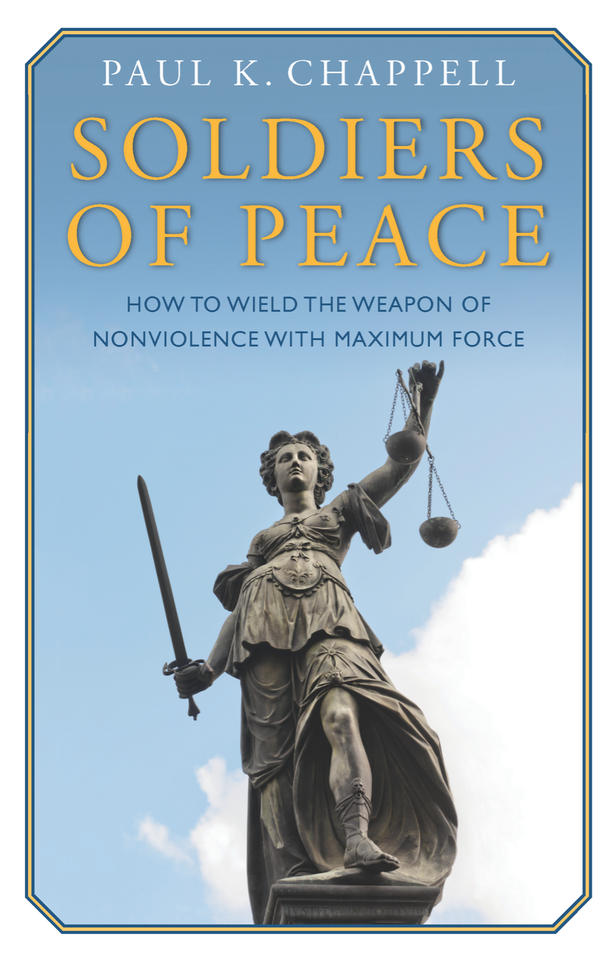
H. Patricia Hynes: Soldiers of Peace: How to Wield the Weapon of Nonviolence With Maximum Force

H. Patricia Hynes reviews Soldiers of Peace: How to Wield the Weapon of Nonviolence With Maximum Force.

Chappell lays out five questions to ask when people might want to consider using violence to overthrow an oppressive regime or system, using examples from history. Ultimately, though, he returns to the wisdom of Gandhi and King that nonviolence is a more powerful tool than violence. “Violence can kill the liar, the racist, the terrorist”; but it does not kill the “lies that sustain an unjust system, racism, or terrorism. …” He underscores his advocacy for nonviolence with recent landmark research by Erica Chenoweth and Maria Stephan that concludes, “Nonviolence is more likely than violence to defeat a militarily superior adversary.” Their study of movements from 1900-2006 to overthrow dictatorships, expel foreign occupations or achieve self-determination found that nonviolent resistance campaigns were more than twice as successful as violent insurrections with the same goals. And the trend is increasing even in extremely brutal authoritarian conditions.

Emphasis Mine

We kill the lies that sustain the system by educating ourselves. In doing so, we develop our proletarian consciousness.


Read more!

Seth Godin: "We don't do rabbits"

Seth Godin argues that we all should say "We don't do rabbits".

Good referrals are smarter than mediocre, distracting work.

Own your work. No need to do someone else's.

A revolutionary party has to concentrate on political work that advances the political line of the party congress. Yet, this political line has to reflect the realities of the political environment and the strengths of the party.

It would be nice that we could be everywhere at all political events. But the reality is that revolutionary parties are small and spread very thinly. The work we do has to:

  • Develop the cadre
  • Expand the carde
  • Educate the workers
  • Gain the confidence of the workers
  • Achieve real gains

We can only achieve real gains by understanding correctly the real political environment, and by using our real strenghts.


Read more!

Mohammed Nuruzzaman: Protests in Iran - A Different View

Dr. Mohammed Nuruzzaman writes about the Protests in Iran — A Different View.

Clearly, the protests had no chance to succeed, primarily because they were manifestations of intra-elite conflicts, not largescale mass uprisings against the government supported by powerful internal groups. If history is of any witness, political movements in Iran succeed only when they build on mass anger against foreign powers and undue foreign interference in Iranian affairs. The best examples are the 1891 anti-British tobacco movement, the anti-American and anti-British nationalist movements of the late 1940s and early 1950s concerning Iran’s oil resources, and the monumental anti-American and pro-Islamic movements leading to the 1979 revolution. The latest protests had no foreign element involved; it was directed against the government but hardly was there any blueprint to dislodge the government.

Accept it or not, the Iranian political and economic systems, despite their shortcomings, are much more representative than many countries in the Middle East. That explains why the Arab Spring did not touch down on Iran, while the neighboring undemocratic countries had to use force to contain mass protests or bribe their peoples to stay calm. In Iran, there has been an elected parliament without disruptions since 1979, the president is regularly and periodically elected by the people, and the members of the Assembly of Experts, a body responsible for selecting the Supreme Leader and overseeing his activities, are also directly elected by the Iranian voters. So, channels of vetting angers and protests are there and the government also recognizes the constitutionally guaranteed rights of the Iranians to protest peacefully.

It is the democratic practices that undercut the potential of massive popular movements to oust elected governments in Iran — conservative or reformist. Needless to say, it is useless to dream of an overthrow of the Islamic establishment in Iran someday in the future. Both the conservatives and the reformists equally believe in the fundamental ideals and objectives of the 1979 revolution — maintaining and strengthening Iran’s independent voice in a US-dominated world. And the Iranians are very unlikely to be fooled by President Trump and his cohorts.

Emphasis Mine

In Marxist-Leninist terms, there was no revolutionary party to drive and sustain the protests. And the people had not yet given up on trying to achieve their goals through democratic reforms. The democratic process in Iran has not been exhausted.


Read more!

2018/01/13

Histyar Qader: Iraqi Kurdish Leaders' No-Good very Bad Year

Histyar Qader writes about Iraqi Kurdish Leaders’ No-Good very Bad Year.

The end of the year brought strife to Iraqi Kurdistan, The northern region has to deal with a reduced area of influence, internal and external political problems, and a financial crisis.

This year brought major transformation to the semi-autonomous northern region of Iraqi Kurdistan and by the end of the year it had become clear that these changes were not necessarily going to be positive. The future is not looking so bright up north.

…

The federal government made it clear who was actually still in charge, closing Kurdish airspace and demanding that international border crossings be put back under federal control. It became very clear, very fast, that much of what many Kurdish voters had been taking for granted as their regional right, had always just been Baghdad doing them a favour — or perhaps being otherwise preoccupied, who knows.

…

Internal and inter-party conflicts continue and most recently, in late December, the major opposition parties in Iraqi Kurdistan withdrew from the regional parliament altogether.

Part of the reason for all the internal political tension, analysts say, is because of the loss of the region’s long-term political leadership, a leadership that, for all its faults, had maintained political checks and balances and some semblance of unity.

…

Iraqi Kurdish locals had been demonstrating corruption and the fact that many civil servants had not been paid for some months. The Kurdish government has major debts, has seen its revenue sources reduced significantly and owes back pay to hundreds of local workers.

The region that was once doing so well, and seemed so peaceful and prosperous, that it claimed the title “the new Dubai”, has fallen onto extremely hard times, both politically and economically.

Emphasis Mine

Kurdistan has always been an ideal, not a reality. Shared cultural identity is not enough to create a nation state. This has to be a degree of political unity.

In Kurdistan's case, the political unity was personal. As the personalities depart the scene, the political unity dissapates.

It would be difficult to build a shared political vision of Kurdistan based on four (4) separate independence struggles: against Syria, Iraq, Iran, and Turkey. The differences between those struggle are currently too great for a united front for the liberation of Kurdistan.


Read more!

Joumanah El Matrah: The feared other: Peter Dutton's and Australia's pathology around race

Joumanah El Matrah writes about The feared other: Peter Dutton's and Australia's pathology around race.

Dutton’s elevation to the home affairs ministry was always to read crime through the lens of ideology; this is the only context in which linking crime to race makes sense. Increasingly it appears that this government wants us to conceive of ourselves as a nation under siege from foreigners, and right now from foreigners that come from one of the most discriminated communities in Australia. Dutton seems compelled to persuade us that those who are most disempowered in our society are our greatest threat.

Ideology is perhaps also why Dutton chose to portray Victoria as a state of residents too frightened to leave home. This is a state that is both Australia’s progressive heartland and the nation’s best attempt at a highly diverse society. Dutton’s implication is that this is the cost of progressive politics and the cost of any sort of pride in our cultural diversity. But this is not a state of scared people, and how most Victorians would respond to Dutton’s comments was best captured by Victoria’s minister for youth affairs Jenny Mikakos’s description of them as “bullshit”.

The damage of wholesale vilification of a community, especially its young people who already face considerable challenges, is sometimes irreparable. It is not only the damage that is wrought from labelling a community as one prone to violence, it is also the damage that is wrought by communities having to defend themselves against accusations of violence as if they are personally responsible.

Emphasis Mine

Racism divides us so that the elite can rule.

Resistance starts with overcoming fear.

In seeing the dignity in others, we see the dignity in ourselves.


Read more!

Juan Cole: Trump Engineered Saudi Soft Coup, attack on Qatar, to Save Self

Juan Cole writes that Trump Engineered Saudi Soft Coup, attack on Qatar, to Save Self.

This naked power grab on the part of Saudi Arabia has likely destroyed the budding Gulf Cooperation Council (that groups Saudi Arabia, Bahrain, Oman, Kuwait and Qatar), which aimed at being sort of like the European Union plus NATO for the small Gulf Arab oil monarchies. Some of its rationale was to resist Iranian hegemony, so breaking it up helps Iran. Iran has correct relations with Qatar, and stepped in to help offset the Saudi boycott.

To any extent that Trump encouraged the rash Saudi move, he helped further fragment politics in the region. Secretary of State Rex Tillerson and SecDef Mattis clearly did not approve and have tried behind the scenes to undermine Trump policy in this regard.

So to conclude: Trump did not get hundreds of billions in new investments in the US from Saudi Arabia. He did manage to put in an erratic and aggressive crown prince in Riyadh, helping destabilize the region in ways Iran will take advantage of. The other corner of Wolff’s reporting on the May trip, that Trump thought it was a prelude to Peace in Our Time in Israel-Palestine, is too complex to take on here but that was also obviously a scam.

Emphasis Mine

In his eagerness to prove his deal-making abilities, Donald Trump is destabilizing the Middle-East by emboldening Saudi Arabia and strengthening the geopolitical clout of Iran.

In private business, Trump could walk away from a failed deal because he was using other people's money. In international affairs, a failed deal can have horrendous consequences.


Read more!

TeleSur: Israeli Ruling Party Votes to Annex West Bank and Seize Last Palestinian Lands

TeleSur reports that Israeli Ruling Party Votes to Annex West Bank and Seize Last Palestinian Lands.

Many analysts expected bolder expansionist moves by the right-wing head of state, especially in light of U.S. President Donald Trump’s announcement that Washington would move its embassy to Jerusalem — a gesture that was tantamount to a U.S. recognition of unilateral Israeli claims to the divided and unlawfully-held Arab city.

The U.S. announcement was welcomed by the Israelis, who have been working alongside Saudi Arabia in hopes to pressure the Palestinian Authority to accept Donald Trump’s so-called Arab-Israeli “deal of the century” that has not yet been announced. The “deal” would see the Palestinian question settled in exchange for the normalization of ties between Tel Aviv and the Gulf monarchies and the integration of Israel into the regional “family of nations” that the Saudis claim leadership over.

Emphasis Mine

The Palestinians are about to be screwed over “bigly”. This they have always known: the US unilaterally supports Israel; the Saudis would sell out the Palestinians in a heart-beat.

The only regimes that still garner political support for supporting the Palestinians (Syria, Iran) are figthing for survival.

It is up to the Arab Street to remind the Palestinians that they are not alone. The Palestinian struggle is an Arab one. And a human one.

We, in Australia, should remind Israel that they cannot commit genocide.


Read more!

Barry Ritholtz: Taking Stock of a Very Weird Year in Markets

Barry Ritholtz is Taking Stock of a Very Weird Year in Markets.

• Overseas Trounces U.S.: This was a notable performance metric. Although the Standard & Poor's 500 Index had a good year, up 21.7 percent, the rest of the world beat the U.S. Europe had an even better year, with a 27 percent gain, while the Pacific region advanced 28.9 percent and emerging markets surged 37.4 percent. Even Japan, mired in slow growth for ages, outperformed with a 24.3 percent gain. A global economic recovery and improving corporate profits worldwide deserve the credit, not deregulation or tax cuts in the U.S.

• Volatility: A favorite theme of ours reasserted itself last year: Political volatility doesn't equal stock-market volatility. Despite all of the political sturm und drang, be it North Korean missiles, health-care repeal drama, white nationalists is Charlottesville, Virginia, and too many other @realDonaldTrump tweets to keep up with, stock volatility was the lowest in a half-century. You have to go back to 1964 to find average daily change for the S&P 500 as low as it was in 2017. It wasn’t just the U.S.; the lack of connectivity between politics and equities in emerging markets saw those stocks ignore all manner of political crises as well.

Emphasis in Original

This would mean that investors are consistently confident. They are more so outside of the US.

This well be a delusion on the part of investors. They imagine themselves isolated from everything happening around the world. Maybe they are confident that governments will bail them out as governments did back in the Great Financial Crisis, and there would be no political ramifications for doing so.

When elites lose any connection to reality, we enter dangerous times.


Read more!

2018/01/12

GLW: Iran rocked by mass anti-regime protests fuelled by poverty

Iran rocked by mass anti-regime protests fuelled by poverty.

Iran is a country of 80 million people. Despite extensive natural resources, such as oil, gas, coal, copper … and considerable wealth, almost 70 per cent of people live in poverty. At the same time, we have growing upper classes and super rich that are mostly linked to different factions of the regime and children and relatives of the officials and various forces within the establishment. We have witnessed the most shameful theft of resources and financial embezzlement in the country’s history by these groups while workers and poor people have been continuously humiliated and their protests for their rights and accountability frequently crushed.

…

We strongly oppose and condemn any interference by Trump’s administration and its allies like the Israeli regime, and the Iranian right-wing and pro-monarchy opposition, in the protest movements in Iran. The working and poor people of Iran know well that Trump’s fascist and ultra-right politics would bring nothing but more disaster to the country. We need the workers’ and socialist organizations and progressive forces in the world to stand in solidarity with the working class and the poor oppressed people of Iran and help strengthen anti-capitalist, anti-poverty and social justice movements while increasing efforts in identifying and isolating the right wing, nationalist and pro-imperialist elements.

Emphasis Mine

The Capitalists are divided — the Iranian and American Capitalists fight each other.

Do not let this fight fool you. In the face of a proletarian revolution, the Capitalists would unite with the petite-bourgeoisie to crush the revolution.


Read more!