Showing posts with label US History. Show all posts

2023/10/30

Isaac Nellist: 'Killers of the Flower Moon': Murder, deceit and genocide

Isaac Nellist reviews 'Killers of the Flower Moon': Murder, deceit and genocide.

Oil was later discovered on Osage land, making them “the richest people per capita in the world” as they retained “headrights” (communal mineral rights).

However this also made them the target of exploitation as white Americans and the US government sought to take control of the valuable oil-rich lands through murder, manipulation and brutality.

…

Ernest and Mollie’s marriage is central to the film, beginning with a genuine chemistry and spark that is undermined by Ernest’s involvement in her family’s murders.

Ernest and his uncle want to ensure that Mollie’s family’s headrights go to her, and by extension Ernest, so they begin a horrifying plot to murder Mollie’s sisters, their partners and anyone else who threatens their claim to the wealth.

Mollie, her sisters and the other Osage women are well aware that the white men around them are pursuing their wealth. Mollie reads Ernest almost immediately: “Coyote wants money,” she tells her sisters with a smirk.

Emphasis Mine

What struck me about this movie is the line, "It is easier to convict a white man of kicking a dog than for murdering an Indian." This line illustrates the structural racism built into any criminal justice system for a settler colonial state, such as USA, Canada, Australia, and Israel.

The sobering truth is that events portrayed in this film are not confined to the past. The murder of First Nations women continue today as documented in The Highway of Tears in British Columbia, Canada, and here, in Australia, a TV report, "How Many More?", says:

Four Corners can reveal at least 315 First Nations women have either gone missing or been murdered or killed in suspicious circumstances since 2000.

But this is an incomplete picture. We will likely never know the true scale of how many First Nations women have been lost over the decades.

This is because there is no agency in Australia keeping count, and there is no standard way of collecting this important data in each state and territory.

Canada calls it a genocide. The United States considers it an epidemic. But here in Australia, we’re only just waking up to the scale of the crisis.

Emphasis Mine

The reluctance to investigate the murder of First Nations women as depicted in the film continues to this day. The Four Corners report continues:

There is an alarming pattern of what’s known as “under-policing” of Indigenous women who end up dead, says Noongar academic Hannah McGlade, a member of the United Nations permanent forum on Indigenous issues.

Research published by the British Journal of Criminology this month [2022] shows that almost 75 per cent of First Nations women who were killed “experienced police reluctance and inaction following domestic violence”.

Emphasis Mine

References

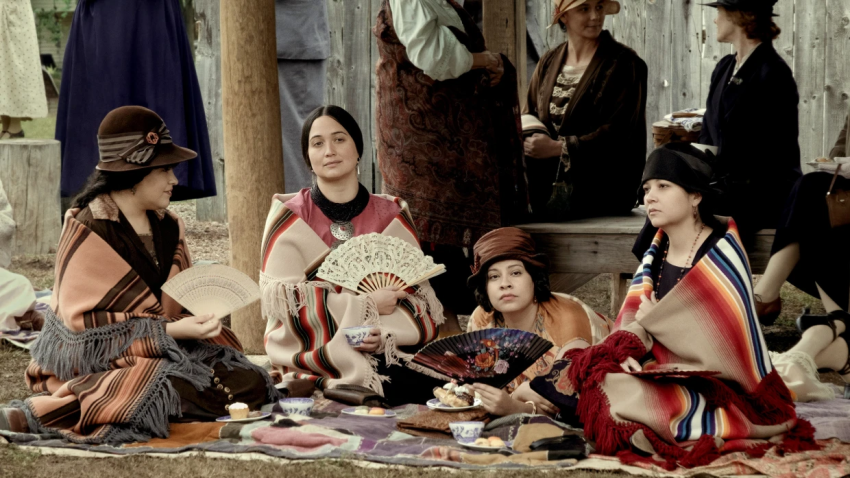
Still from the film, Killers of the Flower Moon, showing Mollie sitting with her sisters on a large blanket on the ground. All of them are holding fans.


Read more!

2020/06/03

Prospects of a Third American Revolution

Omar Ahmed asks if the current situation is Riots or Uprising? If this Turmoil were in Iran, Trump would be Cheering on Arsonists and Dreaming of Regime Change.

At the time of writing, it is unclear where the Black Lives matter protests are going in the US, but doubts are already being expressed about whether George Floyd’s family and friends can expect justice for him any time soon. Not only did it take days for the police officer involved to be arrested and charged, but his colleagues who stood by and did nothing to stop him are also still at liberty.

Floyd’s murder could be an era-defining moment, with the Trump administration’s disastrous response to Covid-19, mass unemployment and a devastated economy all thrown into the mix. Far from “making America great again”, Trump is presiding over a country whose standing in the world has never been lower. China’s GDP is on course to overtake that of the US by the end of the decade and the declining power of the petro-dollar means that Americans face tough times ahead. They need to get a grip on the racism that blights their society before it is too late; it could be the factor that tips the balance.

Emphasis Mine

This is definitely not the beginning of an American revolution. The protestors want to reform the system in order to get equal rights, not to overthrow the system.

The first American revolution was about independence from Great Britain. This was a political revolution in which the English ruling class was replaced by a local one, and by a change in political mechanisms (constitutional monarchy to a republic).

The second American revolution (1861-1865) was about the abolition of slavery during the American Civil War. This was a social revolution in which two (2) classes of people were abolished: slaves; and slave-owners.

Anthony DiMaggio argues for Revolution, Not Riots: Prospects for Radical Transformation in the Covid-19 Era.

…Within the context of these intensified protests, many self-identified radicals I have talked to believe we are witnessing the beginnings of a political and economic revolution, in light of the violent protests that have now taken over dozens of cities in the U.S. But we should be wary of romantic celebrations of revolution. Americans are nowhere near developing the radical working-class consciousness that’s needed for a socialist revolution. And efforts to frame riots as revolution are fraught with peril in a country where the large majority of Americans lack critical working-class consciousness, let alone revolutionary consciousness.

Emphasis Mine

Because of the emphasis on race in this time, it will be difficult to move the conversation to class even among Blacks.


Read more!

2018/01/18

Ted Rall: No Way Would Today's Newspapers Publish the Pentagon Papers

Ted Rall writes that No Way Would Today's Newspapers Publish the Pentagon Papers.

The key point of this story, which isn’t made in the movie and few younger moviegoers are likely to be aware, is that it was her decision to make. The Graham family held controlling interest in the Washington Post Company. Great newspaper families like the Grahams, the Chandlers and the Sulzbergers were quirky and often had bad politics. But they also had something today’s corporate, publicly-traded media outlets do not: editorial freedom.

They didn’t always do the right thing. But they could. So sometimes they did.

Sadly, those days are gone.

Emphasis Mine

Competition within the Capitalist class could sometimes serve the public interest. With the concentration of media ownership, the odiousness of monopoly power emerges. And the public interest is quashed in favour of the private Capitalist interest.


Read more!

2018/01/15

John Pilger on Ken Burn's 'Vietnam War': The killing of history

John Pilger on Ken Burn's 'Vietnam War': The killing of history.

What is known in the US as "the left" has effectively allied with the darkest recesses of institutional power, notably the Pentagon and the CIA, to see off a peace deal between Trump and Vladimir Putin and to reinstate Russia as an enemy, on the basis of no evidence of its alleged interference in the 2016 presidential election.

The true scandal is the insidious assumption of power by sinister war-making vested interests for which no American voted. The rapid ascendancy of the Pentagon and the surveillance agencies under Obama represented an historic shift of power in Washington. Daniel Ellsberg rightly called it a coup. The three generals running Trump are its witness.

All of this fails to penetrate those "liberal brains pickled in the formaldehyde of identity politics", as Luciana Bohne noted memorably. Commodified and market-tested, "diversity" is the new liberal brand, not the class people serve regardless of their gender and skin colour: not the responsibility of all to stop a barbaric war to end all wars.

Emphasis Mine

In the matter of the Deep State, we would find ourselves allied with Donald Trump.

I would have to agree with the Right that the Left is now an impediment to social discourse. The Left has been co-opted by the elites.

When the Left forgot its class roots in the Proletariat, the Left became much easier to co-opt. There is seductiveness in achieving change through reform rather than revolution. The Liberal is the enemy of the Proletariat.


Read more!

2018/01/09

Mike Kimel: The Upcoming Liberation of Mexico (and Parts of Africa)

Mike Kimel writes about The Upcoming Liberation of Mexico (and Parts of Africa).

All of this, taken together, suggests that Mexico is an awful place for Mexican and non-Mexican people alike. And yet, the land has so much promise. Plus great weather. The humane and socially aware solution is obvious: the government of Mexico must be overthrown. Ideally, it would be replaced by indigenous, peaceful, inclusive, tolerant, non-racist, intersectional, organic and home-grown Mexicanx policies and traditions. Obviously, in Mexico, that would be a social structure derived from Aztec culture. That would be the ideal outcome. However, given the conditions people in Mexico are willing to tolerate to get to and live in the US, the bar is very, very low. That means the odds of making things worse are infinitesimally small.

So for this operation, the likelihood of success is large, the probability of failure is tiny, and the benefits are huge. What’s not to like about regime change in Mexico? Furthermore, the benefits of this regime change wouldn’t accrue just to Mexicans and African refugees who are currently trapped in Mexico. Even white supremacists — who because they are in the majority in the US would bear the bulk of the cost in blood and treasure — would have a benefit: penance. The karmic load they carry would diminish slightly, and they might even develop some empathy. Some white supremacists might stop and think about how the world could have turned out but for their accident of birth. With a different history, America’s white supremacists would have all ended up in Mexico. Conversely, the Mexican population (together with America’s minority population and the few white Americans who are racially aware) might have ended up living in the US, perhaps even a US operating along pre-Columbian Mexican norms.

Now, this opportunity for racist white people to achieve some small measure of redemption doesn’t have to stop with Mexico. In fact, it shouldn’t stop with Mexico. From the LA Times article, it is clear there are people in countries in Africa who could be spared having to flee their homeland if the white supremacists in the US would develop a small measure of humanity and overthrow their governments too. Now I know what you’re thinking… we heard a similar “we will be greeted as liberators” line about a decade and a half ago. But it was different then. The motives were selfish. Our leaders thought they were acting to make Americans safer, and to make matters worse, they didn’t even bother to differentiate between the safety of the racist majority who should just die already and those who are worthy of such safety.

Emphasis Mine

Kimel is being sarcastic here. The US government currently loves the Mexican and African governments. If the US government did not, the CIA would be busy trying to overthrow these foreign governments.

The litany of US interventions to overthrow unfriendly governments can be found here.

The US government does not give a fuck about ordinary people whether they are white, black, brown, yellow, red, etc.. All Capitalist governments want to divide us by race, gender, sexual preferences, culture, history, language, nationality, etc..

It is up to we workers to develop our own consciousness about how the current world is constructed to benefit the rich and screw over the poor.


Read more!

2015/10/14

Andrew J. Bacevich: Vietnamization 2.0

Andrew J. Bacevich examines Vietnamization 2.0.

Concealed within that oft-cited “freedom” — the all-purpose justification for deploying American power — were several shades of meaning. The term, in fact, requires decoding. Yet within the upper reaches of the American national security apparatus, one definition takes precedence over all others. In Washington, freedom has become a euphemism for dominion. Spreading freedom means positioning the United States to call the shots. Seen in this context, Washington’s expected victories in both Afghanistan and Iraq were meant to affirm and broaden its preeminence by incorporating large parts of the Islamic world into the American imperium.They would benefit, of course, but to an even greater extent, so would we.

Alas, liberating Afghans and Iraqis turned out to be a tad more complicated than the architects of Bush’s freedom (or dominion) agenda anticipated. Well before Barack Obama succeeded Bush in January 2009, few observers — apart from a handful of ideologues and militarists — clung to the fairy tale of U.S. military might whipping the Greater Middle East into shape. Brutally but efficiently, war had educated the educable. As for the uneducable, they persisted in taking their cues from Fox News and the Weekly Standard.

Yet if the strategy of transformation via invasion and “nation building” had failed, there was a fallback position that seemed to be dictated by the logic of events. Together, Bush and Obama would lower expectations as to what the United States was going to achieve, even as they imposed new demands on the U.S. military, America’s go-to outfit in foreign policy, to get on with the job.

Rather than midwifing fundamental political and cultural change, the Pentagon was instead ordered to ramp up its already gargantuan efforts to create local militaries (and police forces) capable of maintaining order and national unity. President Bush provided a concise formulation of the new strategy: “As the Iraqis stand up, we will stand down.” Under Obama, after his own stab at a “surge,” the dictum applied to Afghanistan as well. Nation-building had flopped. Building armies and police forces able to keep a lid on things now became the prevailing definition of success.

The United States had, of course, attempted this approach once before, with unhappy results. This was in Vietnam. There, efforts to destroy North Vietnamese and Viet Cong forces intent on unifying their divided country had exhausted both the U.S. military and the patience of the American people. Responding to the logic of events, Presidents Lyndon Johnson and Richard Nixon had a tacitly agreed upon fallback position. As the prospects of American forces successfully eliminating threats to South Vietnamese security faded, the training and equipping of the South Vietnamese to defend themselves became priority number one.

Dubbed “Vietnamization,” this enterprise ended in abject failure with the fall of Saigon in 1975. Yet that failure raised important questions to which members of the national security elite might have attended: Given a weak state with dubious legitimacy, how feasible is it to expect outsiders to invest indigenous forces with genuine fighting power? How do differences in culture or history or religion affect the prospects for doing so? Can skill ever make up for a deficit of will? Can hardware replace cohesion? Above all, if tasked with giving some version of Vietnamization another go, what did U.S. forces need to do differently to ensure a different result?

Emphasis Mine

The double-speak of the political elites conceals the hegemonic ambitions of USA. The logic of Capitalism requires a public persona of political equality and freedom while needing restricted decision making and control over public opinion.


Read more!

2015/08/12

What It Means When You Kill People On the Other Side of the Planet and No One Notices

Tom Engelhardt asks What It Means When You Kill People On the Other Side of the Planet and No One Notices?

And this just scratches the surface of Washington's long “global war on terror.”  Yet without an antiwar movement, the spectacle of mayhem and slaughter that has been at the heart of that war has passed largely unnoticed here.  Unlike in the Vietnam years, it’s never really come home.  In an era in which successes have been in short supply for two administrations, consider this a major one.  War without an antiwar movement turns out to mean war without pause, war without end.

Admittedly, American children can no longer catch the twenty-first-century equivalents of the movies of my childhood.  Such films couldn’t be made.  After all, few are the movies that are likely to end with the Marines advancing amid a pile of nonwhite bodies, the wagon train heading for the horizon, or the cowboy galloping off on his horse with his girl.  Think of this as onscreen evidence of American imperial decline.

In the badlands and backlands of the planet, however, the spectacle of slaughter never ends, even if the only Americans watching are sometimes unnerved drone video analysts.  Could there be a sadder tale of a demobilized citizenry than that?

Emphasis Mine

The ghost of the Vietnam War haunts the anti-war movement as well. All we hear about are the sucesses. We have forgotten the long, dark years of obscurity and irrelevence.

The confidence of the working-class in a better world has also gone. We are weighed down by the unresolved GFC, the weakening of unions, the rapid advance of automation, the insecurity of life and work.

The great anti-war demonstrations of 2003 were deflated by the deafness of the governments around the world. They knew they were in no danger of being overthrown.

We have forgotten that the movements of the 1960s were about overthrowing the existing system. That was the real danger of those movements.

Today, what are people are going to do? Vote the bastards out. Our electoral system offers a choice between two groups of warmongers. This is no different in the UK or USA.


Read more!

2015/04/07

Movie Review: Home (2015)

The movie, Home, is Anti-American propaganda.

I have decoded the movie as follows:

  • The Boov are the Americans
  • The Gorg are the Muslims
  • Oh is Edward Snowden
  • Captain Smerk is the American Government

Captain Smerk steals a valuable artifact from the Gorg, This artifact is literally the future of the Gorg. Smerk does not understand why the Gorg want this artifact so badly, but uses his possession of it as his claim to power.

In a similar way, the American government steals the future of the Muslim Arabs from them by controlling their oil reserves. It is this control of oil that allows the USA to dominate the world's economy. The US government cannot understand why the Arabs want to use their oil for their own development rather than for the maintenance of US power.

In terror, the Boov flee the Gorg. The mere mention of the Gorg sends the Boov into panic. Captain Smerk proposes the invasion of Earth as the solution to their problem. He assures them that the population of Earth would be well taken care of, and would welcome the Boov as liberators. Since Boov technology is far superior to anything on Earth, the invasion is easily accomplished.

The panic after 11 September 2001 sent the US government on a series on invasions and interventions around the world: Afghanistan, the Phillipines, Iraq, Iran, Pakistan, Libya, Uzbekistan, Tajikistan, etc. The superiority of US weaponery made these easy for the US military. In Iraq, especially, the US troops were told that they would be welcomed as liberators.

What is striking about the movie is the Boov invade homes and snatch terrified people. The Boov round up all of the Earth's population and resettles them in refugee camps in the middle of the Australian desert. (This would infuriate any Australian government.) The population of Earth are understandably angry at the Boov for this rough treatment.

The Boov cannot understand why the population of Earth should be so angry with them. 'Tip' is especially angry at the descretion of cerished cultural artifacts by the Boov. Her main gripe is the turning the head of the Statue of Liberty into a likeness of Smerk.

Oh causes a crisis releases an e-mail to the entire universe. This causes Oh to become a furgitive.


Read more!

2015/02/26

The Dynamism of American Islam

Jonathan Curiel discusses The Dynamism of American Islam.

Islam’s diversity in the United States offers an inspiring vision of the religion. When Malcolm X went on the hajj to Saudi Arabia in 1964, he was shocked to witness a similar diversity, and it prompted him to abandon his beliefs in the Nation of Islam for traditional Sunni Islam. He said he’d encountered Muslims “of all colors, from blue-eyed blonds to black-skinned Africans” who were “all participating in the same ritual, displaying a spirit of unity and brotherhood.”

Emphasis Mine

Malcolm X was forced to confront his hatred of white people through the hajj. He had to throw away many of his prejudices. And in doing so, he matured considerably.

But in doing so, he incurred the fatal wrath of his former comrades in the Nation of Islam. He knew it was dangerous, but he persist because he was true to himself. Integrity can be fatal.


Read more!

2015/02/14

Senator Inhofe Sponsors Ukraine Military Weapons Bill Based on Images of Russian Soldiers in Georgia in 2008

Mike Shedlock writes that Senator Inhofe Sponsors Ukraine Military Weapons Bill Based on Images of Russian Soldiers in Georgia in 2008.

According to Ukraine and NATO, there are 5,000 Russian troops swarming Ukraine with more coming in every day.

Thus one might expect Senator Inhofe to have a basket of images to use as justification for US warmongering.

Instead, it turns out the pictures were fake. They show Russian troops in Georgia in 2008.

Emphasis Mine

Georgia, Ukraine, whatever. All these foreign countries look the same to American politicians.

The US government regularly uses lies to justify its acts of aggression:

An the ideological superstructure is instrumental in these lies by not questioning them, and by promoting them. All of this is done in the name of independent thought. You are allowed only to think thoughts that are politically correct at the time. You may have to change them at a moment's notice:

On the sixth day of Hate Week, after the processions, the speeches, the shouting, the singing, the banners, the posters, the films, the waxworks, the rolling of drums and squealing of trumpets, the tramp of marching feet, the grinding of the caterpillars of tanks, the roar of massed planes, the booming of guns — after six days of this, when the great orgasm was quivering to its climax and the general hatred of Eurasia had boiled up into such delirium that if the crowd could have got their hands on the 2,000 Eurasian war-criminals who were to be publicly hanged on the last day of the proceedings, they would unquestionably have torn them to pieces — at just this moment it had been announced that Oceania was not after all at war with Eurasia. Oceania was at war with Eastasia. Eurasia was an ally.

There was, of course, no admission that any change had taken place. Merely it became known, with extreme suddenness and everywhere at once, that Eastasia and not Eurasia was the enemy. Winston was taking part in a demonstration in one of the central London squares at the moment when it happened. It was night, and the white faces and the scarlet banners were luridly floodlit. The square was packed with several thousand people, including a block of about a thousand schoolchildren in the uniform of the Spies. On a scarlet-draped platform an orator of the Inner Party, a small lean man with disproportionately long arms and a large bald skull over which a few lank locks straggled, was haranguing the crowd. A little Rumpelstiltskin figure, contorted with hatred, he gripped the neck of the microphone with one hand while the other, enormous at the end of a bony arm, clawed the air menacingly above his head. His voice, made metallic by the amplifiers, boomed forth an endless catalogue of atrocities, massacres, deportations, lootings, rapings, torture of prisoners, bombing of civilians, lying propaganda, unjust aggressions, broken treaties. It was almost impossible to listen to him without being first convinced and then maddened. At every few moments the fury of the crowd boiled over and the voice of the speaker was drowned by a wild beast-like roaring that rose uncontrollably from thousands of throats. The most savage yells of all came from the schoolchildren. The speech had been proceeding for perhaps twenty minutes when a messenger hurried on to the platform and a scrap of paper was slipped into the speaker’s hand. He unrolled and read it without pausing in his speech. Nothing altered in his voice or manner, or in the content of what he was saying, but suddenly the names were different. Without words said, a wave of understanding rippled through the crowd. Oceania was at war with Eastasia! The next moment there was a tremendous commotion. The banners and posters with which the square was decorated were all wrong! Quite half of them had the wrong faces on them. It was sabotage! The agents of Goldstein had been at work! There was a riotous interlude while posters were ripped from the walls, banners torn to shreds and trampled underfoot. The Spies performed prodigies of activity in clambering over the rooftops and cutting the streamers that fluttered from the chimneys. But within two or three minutes it was all over. The orator, still gripping the neck of the microphone, his shoulders hunched forward, his free hand clawing at the air, had gone straight on with his speech. One minute more, and the feral roars of rage were again bursting from the crowd. The Hate continued exactly as before, except that the target had been changed.

Nineteen Eighty-four, by George Orwell, Chapter 9

Emphasis Mine


Read more!

2015/02/13

‘Lone Wolf,’ ‘Self-Radicalized': Islamophobic Buzzwords never applied to White Terrorists

Juan Coles writes that ‘Lone Wolf,’ ‘Self-Radicalized': Islamophobic Buzzwords never applied to White Terrorists.

“Terrorism” has been racialized in the American press and law enforcement community, marked as having to do with Muslims but almost never used to refer to people of northern European background. A few years ago, when a police spokesman said that “We have concluded that event was not terrorism,” likely what he meant is that no Muslims were involved or that no cell or organization was.

Racializing dissent has an old genealogy in American politics. In the early twentieth century, Jewish-American immigrants were suspected of socialism and Italian-Americans of anarchism. In the Red Scare of 1917-1920, workers who joined labor actions were falsely accused of Communism and were targeted for mob violence, especially if they had “foreign names.” African-Americans who had come north to work in factories during the war, filling a domestic labor shortage, were likewise tagged as subversive. Somehow persons of English ancestry with names like Worthington — even if they were blue collar workers– were not assumed to be Communists or foreign agents or radicals. Russian-Americans were deported. In Illinois after the war, a mob attacked Italian-Americans and razed their homes.

Today it is Muslim-Americans who have been stereotyped as radicals, although the vast majority of them are actually pillars of the establishment and they are better off educationally and financially than the average American. But how to characterize Muslim individuals who committed violence, who were unconnected to any radical network and who were clearly simply mentally ill? Initially Islamophobic diction wasn’t deployed in their regard. But over time, those promoting bigotry managed to make it respectable to sweep even these often mentally fragile individuals up into “terrorism.” The buzzwords used were “lone wolf” and “self-radicalized.”

Emphasis Mine

And so the racist constuction of the Capitalist society continues in order to keep all of us in fear of each other.


Read more!

2015/01/22

Was the Civil Rights movement a revolution?

Dan Little asks: Was the Civil Rights movement a revolution?.

So if a revolution may be described as a fundamental change in the power relations in a society, brought about by the concerted effort of a large-scale collective movement, then indeed, the civil rights movement brought about a revolution in America. Doug McAdam's fine sociology of American race relations and the civil rights movement is right to call this an insurgency in Political Process and the Development of Black Insurgency, 1930-1970. It was an insurgency that was broadly based, passionately pursued, supported by effective regional and national organizations, and largely successful in achieving its most important goals.

It barely needs saying that this revolution is not complete. Tom Sugrue found a good phrase to capture the story in the title of his recent book, Not Even Past: Barack Obama and the Burden of Race. But further progress will build upon the cultural and structural changes brought about by these courageous and committed ordinary men and women in waging revolution against an oppressive social order.

Emphasis Mine

In fact, the Civil Rights movement would have the third American Revolution. The second one was the American Civil War in which two whole classes, the slave-owners and slaves, were obliterated, and a social relationship, that of slavery, was extinguished. The destruction of one entailed that of the other, for the social relationship cannot exist without the classes, and vice verse. This was truly a social revolution.

The first American Revolution changed the composition of one class while leaving the other classes untouched, and therefore the social relationships intact. The ruling class changed from being based in England to being based in the USA. This was a political revolution.

Following Little's argument, for the Civil Rights Movement to have been a revolution, the social relationships were changed, but the classes remained untouched. This does not seem to me to be a revolution like the other ones.


Read more!

2015/01/19

As ICC launches Israel War Crimes Probe, PLO & Hamas Applaud

As ICC launches Israel War Crimes Probe, PLO & Hamas Applaud.

The Ministry of Foreign Affairs on Saturday said it welcomed the decision to open an initial probe on Israeli war crimes at the International Criminal Court.

The ministry said in a statement that the ICC decision was a positive and important step towards achieving justice and guaranteeing respect of international law.

Emphasis Mine

The violations of international law by Israel and the USA have been so egregious that they will ignore any findings by the ICC.

One should remember that the USA has been the only nation, so far, to have been found guilty of terrorism before the World Court. The US government just shrugged off the verdict and carried on.

There is no way to enforce such rulings against the USA short of all out nuclear war. And as long as Israel enjoys the patronage of the USA, Israel can continue to do the same.

The only power strong enough to take on the US government are the US citizeny. But they will not do this because they believe that they are guiltless and that the whole world has it in for them.


Read more!

2014/11/08

Understanding and Overcoming America's Plutocracy

Jeffrey Sachs opines about Understanding and Overcoming America's Plutocracy.

Despite the results of the recent mid-term elections in the USA, Sachs writes that:

The evidence is overwhelming that politicians vote the interests of their donors, not of society at large. This has now been demonstrated rigorously by many researchers, most notably Princeton Professor Martin Gilens. Whether the Republicans or Democrats are in office, the results are little different. The interests at the top of the income distribution will prevail.

Emphasis Mine

Sachs is beguiled by the illusion that the Capitalist State can be bent to the will of the people, even though he has evidence clearly before him that it serves the interests of the Capitalists. Thus, he moans about the recent trend of politics in the USA.

Sachs hopes that the people will rescue the Capitalist State from itself:

Is there a way out? Yes, but it's a very tough path. Plutocracy has a way of spreading like an epidemic until democracy itself is abandoned. History shows the wreckage of democracies killed from within. And yet America has rallied in the past to push democratic reforms, notably in the Progressive Era from 1890-1914, the New Deal from 1933-1940, and the Great Society from 1961-1969.

All of these transformative successes required grass-roots activism, public protests and demonstrations, and eventually bold leaders, indeed drawn from the rich but with their hearts with the people: Teddy Roosevelt, Franklin Roosevelt, and John F. Kennedy. Yet in all of those cases, the mass public led and the great leaders followed the cause. This is our time and responsibility to help save democracy. The Occupy Movement and the 400,000 New Yorkers who marched for climate-change control in September are pointing the way.

Emphasis Mine

The three (3) periods cited by Sachs do, indeed, correspond to times of great radical movements: rise of radical trade-unionism (IWW, CIO); communist revolutions in Russia, Italy, Germany, Hungry, Romania; Youth Revolt and the Anti-Vietnam movement. All of these periods called into question the validity of the Capitalist system. Under such an existential threat, the Capitalist State responded by granting sufficient reforms in order to drain these movements of their momentum.

Though hugely unpopular with the ruling class, those leaders saved the system from itself. Sachs is calling for popular movements to be again subverted by the ruling class in order to save the system.

Barak Obama was supposed to be such a leader. His modest reform of affordable health care is unlikely to last as long as his presidency. He will leave no legacy. Richard Nixon left a far greater reformist legacy than Obama will leave.

Sachs has forgotten the largest mass mobilisation in history occurred in February 2003 (almost twelve (12) years ago)—ten (10) million people marched against the war in Iraq. And yet the war went ahead again.

The ruling class know that the workers are defenceless and leaderless. That is why they are so blatant in their attacks.

Until the workers expand their consciousness to see that the Capitalist system will always have it for them, these crises will continue.


Read more!

2013/05/26

Paul Le Blanc: The Third American Revolution — How do we get from the capitalist present to a socialist future?

Paul Le Blanc: The Third American Revolution — How do we get from the capitalist present to a socialist future?

Le Blanc defines Socialism as follows:

Socialism means rule by the people over the economic structures and resources that we need to keep ourselves alive and healthy, to engage in creative activity, to maintain good relationships with each other, to be able to have good and meaningful lives. The economy would be socially owned, democratically controlled and planfully utilised to meet the needs of all. It could be described as economic democracy.

This is to differentiate from the current system of dictatorship of the Capitalists, Formal democracy stops at the factory or office. Economic decisions are made in the interests of the owners, not society.

Change can only be brought about by struggle:

The actual history of the United States has been shaped and punctuated by struggles for freedom and social justice. To the extent that we have any freedoms at all and to the extent that there has been dignity and wellbeing for our people, it has only come about through the dynamics so perceptively described in 1857 by Frederick Douglass, the ex-slave who became a great spokesperson and organiser in the anti-slavery struggle:

The whole history of the progress of human liberty shows that all concessions yet made to her august claims have been born of earnest struggle. … If there is no struggle, there is no progress. Those who profess to favor freedom and yet deprecate agitation, are men who want crops without plowing up the ground. They want rain without thunder and lightning. They want the ocean without the awful roar of its many waters. This struggle may be a moral one; or it may be a physical one; or it may be both moral and physical; but it must be a struggle. Power concedes nothing without a demand. It never did and it never will. Find out just what a people will submit to and you have found out the exact amount of injustice and wrong which will be imposed upon them; and these will continue till they are resisted with either words or blows, or with both. The limits of tyrants are prescribed by the endurance of those whom they oppress.

The key to the struggle is the development of consciousness:

The revolutionary socialist relies on the developing consciousness and power of a mass working-class base, putting pressure on all politicians, being in the hip pocket of none. To struggle successfully for reforms can help pave the way for mass socialist consciousness and a socialist future. The key is to build social movements and struggles that are politically independent of any pro-capitalist politicians. While some members of such movements will, in fact, support such politicians, the movement as a whole will need to remain independent in order to remain effective in being able to pressure all politicians.

A revolutionary party is part of the electoral process but is beholden to none. The electoral is part of the struggle:

Activists seeking to prepare the way for a socialist future face the challenge of developing tactics, educational and organising efforts and overarching strategies designed to build a durable mass socialist movement capable of winning meaningful victories in the here-and-now while preparing the way for the working-class majority coming to power, with a transition from capitalism to socialism. There will be a need to discuss, debate and define where electoral activities, street actions and other means toward that end fit into the overall scheme of things.


Read more!

2013/03/10

What became of Detroit?

Dan Little asks What became of Detroit?

Little thinks that White racism is the root cause:

If I had to single out a single fact out of this complicated story as the most important factor that led to these toxic changes, I would identify the mechanisms of racial residential segregation that Detroit has embodied for almost a century. For decades Eight Mile represented a key racial division in the city, and a plethora of mechanisms of exclusion conspired to maintain this division. If the city could have settled into a racially and economically mixed pattern of residence in the 1940s, much of this story would have been different. Population exit would not have reached crisis proportions; businesses would have been less likely to relocate out of the city; and a schooling system that was very successful in the 1950s could have maintained its effectiveness. This implies that Detroit is victim to the continuing tragedy of America's inability to heal its racial divisions and antagonisms.

Emphasis Mine

And yet, Little ignores the vital role racism plays in Capitalism. This role is that of control. Racism is control both blacks and whites in order to make them fearful of each other.


Read more!

2013/01/01

The Unhappy Marriage of Capitalism and Conservatism

Barry Ritholtz's 10 New Year’s Eve Reads points to The Unhappy Marriage of Capitalism and Conservatism by Nancy Folbre who writes that:

The economic interests of capitalists (defined as those who earn most of their income from capital) are beginning to diverge significantly from the interests of social conservatives (defined as those who prefer traditional gender relations and oppose government efforts to promote racial and ethnic equality).

As recounted by Folbre, this has always been the case during the history of Capitalism. The social conservatives have always sought to defend their existing privileges gained through an earlier stage of Capitalism against those who have gained from economic changes. The political struggle has always been about the alignment of political power with economic reality.

Folbre lists three (3) areas where the conflict between conservatism and Capitalism has occurred:

  1. One of the most beneficial consequences of a pattern of capitalist development shaped by political democracy was a growing demand for human capital that helped members of previously disempowered groups compete effectively for economic success and political leadership.
  2. …the polarization of income itself reflects the evolution of a partly denationalized form of capitalism in which our largest companies create more jobs in other countries than at home and minimize their tax payments in overseas tax shelters.
  3. …the role that the powerful banking sector played in the recession highlighted growing divisions within the business community.

I think Folbre misses the point that Capitalism is a dynamic system as opposed to slavery or Feudalism. By its very nature, Capitalism is always seeking new ways to make profits. Any Capitalist who becomes a conservative dooms themself.

It is this dynamic of Capitalism that has confounded Communists who followed the dictum that revolutions tend to occur when the political superstructure does not match the economic reality. The Communists had expected the revolutions to overthrow Capitalism, not sustain it as in the following crises:

  • The growth in political power of the union movement through the rise of the Labour Parties in the late 19th and early 20th centuries;
  • The extension of suffrage, in stages, to:
    • All white men
    • All white women
    • All adults
  • The creation of the welfare state as seen in 'A Conservative Case for the Welfare State'
  • The Civil Right's Movement
  • The Land Right's Movement
  • The Women's Movement

All of these covulsions have been absorbed into the Capitalist system. The danger for the Capitalist system is when it is no longer willing to absorb these changes. Such changes that need to be absorbed are:

  • Gay Marriage
  • Refugee Rights
  • Climate Change
  • Third World Debt


Read more!

2012/12/31

Why Next to No Political Reaction to the Second Gilded Age?

Mark Thoma comments on Why Next to No Political Reaction to the Second Gilded Age?, by Brad DeLong.

DeLong asks:

But the political economy of Gilded Ages? Why the first Gilded age produces a Populist and a Progressive reaction and the second, so far, does not? There I throw up my hands and say that my economic historian training betrays me. I have no clue as to what is going on here.

Thoma's response is:

I think it matters a lot whether we think of inequality as arising from a problem in the system as a whole, or as the result of individual failures. When people think it's the system as a whole — the rich and powerful are scheming to hold everyone else down (e.g. robber barons) — mass movements are more likely than when it is viewed as simply the failings of individuals.

I think both DeLong and Thoma miss several important points:

  • The populist movements of the early 20th Century arose as a reaction to several trends:
    • The great depression of the 1890's
    • The rapid industrialisation of the USA from 1890 to 1930 as agriculture gave way to industry as the main employer
    • Rise of Socialist thought (among which was Marxism and the various strands of Anarchism)
    • The rapid growth and radicalisation of the union movement in response to these trends
  • In the past 30 years, the union movement has been defeated again and again. The main defensive weapon of the workers is now in a much weaker state now than a century ago.
  • In the 1930's, there was a serious alternative to the Capitalist system in the form of the USSR. Ideologically and economically, Communism was seen as superior to Capitalism especially during the Great Depression.
  • The fall of the USSR has removed that alternative from the public consciousness.
  • There have been several significant mass movements over the past 15 years:
    • The Anti-Globalisation movements starting in Seattle in 1999.
    • The Anti-War movements of 2003. (See 15 February 2003)
    • The various Occupy movements starting in 2011.
    • The Arab Spring starting in 2012

I think the populist movements alluded to be DeLong and Thoma were the last real chance of the Capitalist system to bribe the workers away from Communism. The advent of neo-liberalism has destroyed that project once and for all.

There is a political reaction to the second Gilded Age, but it is muted as the traditional expressions of popular will have been emasculated.


Read more!

2012/11/07

Deacons for Defense

Dan Little reflects on the tension between self-defense and non-violence in Deacons for Defense.

Most of the story we remember of the Civil Rights movement of the 1950s and 1960s centers around the philosophy of non-violence espoused by Martin Luther King, Jr. and the major civil rights organizations like the NAACP and the SCLC. A few historians give emphasis to a very different part of the movement in the South, however — a movement that was based on armed self-defense by local people.

Little notes that the history of the Civil Rights movement in the USA is silent about self-defense of communities against the violence of white people. He speculates that:

But there is no discussion of the self-defense movement in Mississippi and the ideas that underlay the philosophy of self-defense that were the core of the Deacons for Defense. One possible reason for this has to do with how the narrative was framed at the time. The mainstream civil rights movement itself did not approve of the self-defense movement, and its leaders shaped the narrative towards moral protest and the philosophy of non-violence.

Another possible reason for neglect of the self-defense organizations that emerged in the South early 1960s is the idea that these organizations were harmful to the progress of the struggle for political and civil rights, and that violent conflicts between police, national guard, klansmen, and deacons were likely to lead to a bloodbath throughout the black population. … The idea here is that the balance of power so greatly favored the forces of white supremacy that armed self-defense was likely to produce horrible retaliation.

Emphasis Mine

Little concludes that:

There is a clear logic to the idea that the non-violent movement needed support from men and women who were willing to face armed attackers with their own guns, and Hill offers a number of strong examples of incidents where klan and police thugs were forced to back off.

The question of non-violence centres about the moral superiority of non-violence overcomes the actual violence of the oppression.


Read more!

2012/09/09

Tyranny of Merit

Samuel Goldman, at the The American Conservative, reviews the book Twilight of the Elites: America After Meritocracy, by Christopher Hayes, in Tyranny of Merit.

His conclusion is that:

Hayes mounts a powerful critique of the meritocratic elite that has overseen one of the most disastrous periods of recent history. He lapses into utopianism, however, when he suggests that we can do without elites altogether. Like the poor, elites will always be with us. As the word’s original meaning suggests, the question is how they ought to be chosen.

Goldman's perspective is that the unruly masses have always needed a master to keep them in line. He cannot conceive of fully formed human beings being able to select their own rulers and sit in judgement of them regularly. For Goldman, true participatory democracy is an utopian ideal.

What Goldman is worried about is the radicalisation of the so-called upper middle class where this utopian ideal may take root:

Yet Hayes is optimistic about the prospects for egalitarian reform. He places his hopes on a radicalized upper-middle class. As recently as a decade ago, people with graduate degrees and six-figure incomes could think of themselves as prospective members of the elite. While the income and influence of the very rich has zoomed ahead, however, the stagnation of the economy has left the moderately well-off at risk of proletarianization.

Emphasis Mine

This radicalisation is reflected in both the Tea Party and the Occupy Movement.

But, this proletarisation was predicted by Marx as a natural consequence of the development of Capitalism. The accumulation of riches by the Capitalists, for whom the elites work, was also predicted by Marx. And yet, people are surprised that it is happening.

The Tea Party and the Occupy Movement are not the same thing. The Tea Party is a proto-fascist movement in which the petite bourgeoise seeks to defend itself against proletarisation. And the Occupy Movement is a nascent movement that could lead to participatory democracy and the overthrow of Capitalism.


Read more!