Showing posts with label Steve Roth. Show all posts

2018/01/15

Steven Roth: "In the Beginning...Was the Unit of Account" - Twelve Myths About Money

Steven Roth writes that “In the Beginning…Was the Unit of Account” — Twelve Myths About Money.

So my question: what’s a good metaphorical or figurative comparison to help us understand and explain this strange conceptual thingamabob? Is money an invention like algebra? Are there other conceptual constructs that are similar to units of account, comparable mental entities that can help us think about what these things are? I can’t think of any good analogies. It’s vexing.

Emphasis Mine

In simple Marxist terms, money is a commodity. Based on this characterisation, Roth is right in saying that money is an asset. But he oversimplifies. He denies that interest is the price of money.

A commodity has both an exchange-value and a use-value. Assets are thought of in terms of exchange-value. An asset can fluctuate in its exchange-value, thereby giving an asset a capability to store exchange-value. Commodities can be further traded, or consumed. With consumption, the commodity is extinguished, and its exchange-value and use-value expire.

But not all commodities are exchangeable for all other ones. Commodities that are universably tradeable are called money.

Interest should be better described as the rental price for money. A loan is the right to use a quantity of money. The ownership of the commodity is not transferred as would be the case of an exchange.


Read more!

2018/01/11

Steve Roth: The Evolution of Ownership...get off my lawn

Steve Roth writes about The Evolution of Ownership…get off my lawn.

It’s not hard to see the crucial fact in this little fable: property rights are ultimately based, purely, on coercion and violence. If the controlling tribe can’t enforce its claim through violence, their “ownership” is meaningless. And those claimed rights are not just inclusionary (the one tribe can use the water). Property rights are primarily or even purely exclusionary. Owners can prevent others from doing anything with the owners’ property. Get off my lawn!

…

In the modern world we’ve largely outsourced the execution of that violence, the monopoly on violence, to government. If a family sets up a picnic on “your” lawn, you can call the police and they’ll remove that family — by force if necessary. And we’ve multiplied the institutional and legal mechanics and machinery of ownership a zillionfold. The whole world’s financial machinery — the immensely complex web of claims, claims on claims, and claims on claims on claims, endlessly and densely iterated and interwoven — all comes down to (the threat of) physical force.

…

Balance sheets, accounting, and their associated concepts (assets, liabilities, net worth, equity and equity shares) are the technology humans have developed to manage, control, and allocate our (violence-enforced) ownership claims, a crucial portion of our social relationships. At first the balance sheets were only implicit — when the tribe first laid claim to the spring. But humans started writing them down and formalizing them, tallying those ownership and obligation relationships, thousands or tens of thousands of years ago. (Coins weren’t invented till about 800 BC.)

Emphasis Mine

Roth gives a succinct history of property. The importance of the state in enforcing those rights are critical.

Different property rights are the basis of social classes. Slavery treats slaves as property. Feudalism treats a tract of land along with its people as property. Capitalism treats the products of labour as property.

In a Capitalist society, the government is not neutral, nor are the police, the justice system, or the army. They all exist to enforce and protect Capitalist property rights.

Socialist control of a Capitalist government is untenable because of the inherent contradiction between what the government protects and promotes, and what the mass of the people want.

A Socialist revolution means the sweeping away of the Capitalist instruments of power, and replacing them with Socialist ones.


Read more!

2018/01/10

Steve Roth: The winners have us all playing a loser's game

Steve Roth writes that The winners have us all playing a loser’s game.

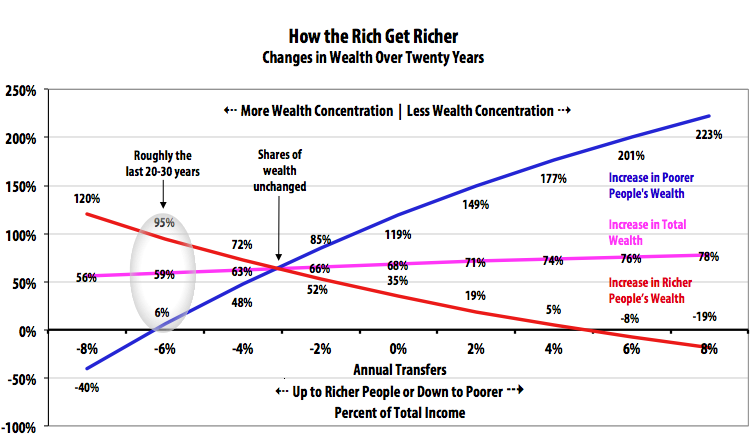
Perfect markets concentrate wealth. It’s their nature. But at some point, market-generated wealth concentration strangles those very markets (compared to markets with broader distributions of wealth). If a handful of people have all the wealth, how many iPhones will Apple sell? If only a few have the wealth to buy cars, automakers will produce a handful of million-dollar Bugattis, instead of forty handfuls of $25,000 Toyotas. Sounding familiar?

…

Why, then, aren’t we spending our lives on the right side of this chart? It’s a total win-win, right? The answer is not far to find. Nassim Taleb shows with some impressive math (PDF) what’s also easy to see with some arithmetic on the back of an envelope: if a few richer people (who dominate our government, financial system, and economy) have the choice between making our collective pie bigger or just grabbing a bigger slice, grabbing the bigger slice is the hands-down winner.

…

To summarize: perfect markets, left to their own devices, concentrate wealth. Concentrated wealth results in less wealth, and far less collective well-being. (You’ll notice that I haven’t even mentioned fairness. It matters. But I’ll leave that to my gentle readers.)

This all leads one to wonder: how could we move ourselves into that happy world of rapidly increasing wealth and well-being on the right side of the graph? Hmmmm…

Emphasis Mine

Roth agrees that Marx was right about the dynamics of Capitalism. However, Roth wants to save Capitalism through the expansion of the Welfare State.

Yet, Roth points out the main impediment to the expansion of the Welfare Stete: the capture of the state by the wealthy. The plutotracy cares not whether it grows fast or slow, as long it stays in control.

Roth fails also to mention the importance of the USSR in the creation of the Welfare State in the West. The Welfare State was a political instrument to counteract Communist propaganda about a workers' paradise. Without the USSR, there is no longer a need for the Welfare State because there is now no alternative.

Or it could be as George Orwell wrote in 1984?

It was possible, no doubt, to imagine a society in which wealth, in the sense of personal possessions and luxuries, should be evenly distributed, while power remained in the hands of a small privileged caste. But in practice such a society could not long remain stable. For if leisure and security were enjoyed by all alike, the great mass of human beings who are normally stupefied by poverty would become literate and would learn to think for themselves; and when once they had done this, they would sooner or later realise that the privileged minority had no function, and they would sweep it away. In the long run, a hierarchical society was only possible on a basis of poverty and ignorance.

Emphasis Mine

A free society is a Communist one.


Read more!

2018/01/09

Steve Roth: Democracy. Capitalism. Socialism. Choose Any Three of the Above

Steve Roth writes about Democracy. Capitalism. Socialism. Choose Any Three of the Above.

None of this is to suggest that there is a political parity or symmetry among these anti-ists — at least in the United States. Anti-democrats are essentially invisible and voiceless, their message a fatal political non-starter. As for anti-capitalism, try naming one successful politician this side of the Seattle city council (one member) who even makes noises about “eradicating capitalism.” Certainly on a national stage, doing so would be political suicide. (The Bernie movement is, rather, all about the ubiquitous social institutions detailed above, and about pushbacks to corporate power within our heavily capitalistic system.) Anti-socialists, on the other hand, stand at the very pinnacles of power; their voices are manifold, loud, and widely broadcast.

But regardless of their relative political power, all of these these ill-considered, utopian, faith-based, tribalistic anti-isms are a bane on the body politic. At this point in our evolution, capitalism, socialism, and democracy are necessary for any country’s prosperity, economic freedom, and economic well-being. And they all need improvement — just as we’ve been fitfully improving things for hundreds, even thousands of years.

Emphasis Mine

Socialism has to develop out of Capitalism. This has to be a conscious development — Socialism is not inevitable. Socialism has to be chosen daily.

Democracy is vital for the functioning of Socialism and the eventual evolution to Communism.

There well may be residual pockets of Capitalism in a Socialist society as is now happening in Cuba. But the majority of the productive forces will be owned and managed by the people.


Read more!