Showing posts with label Capitalism. Show all posts

2026/08/10

Jen Cole Wright: The Moral Paradox of Extreme Wealth: Why People Oppose It Yet Are Reluctant to Take Steps to Reduce It

Conor Gallagher comments on "The Moral Paradox of Extreme Wealth: Why People Oppose It Yet Are Reluctant to Take Steps to Reduce It". The original article by Prof. Jen Cole Wright is at The Conversation.

Wright identifies a key moral dilemma:

Scholars have offered different explanations for this disconnect between what people say they want and what they are willing to do about it.

Some argue that people chronically underestimate the scale of inequality – in the 2014 study, Americans underestimated the actual pay ratio at the time as being only 30-to-1. Others argue that the primary driver of the disconnect is people’s unwillingness to abandon their beliefs in merit – that wealth is the product of hard work, talent and risk.

Some also point to the fact that people can feel compelled to defend systems as essentially good, even when those systems produce harmful outcomes – a phenomenon known as “system justification.” This is in part because of the psychological need to believe in a just world, where good people are rewarded and bad people are punished.

Emphasis Mine

I tend to believe that many people justify the current socio-political regime through the lens of a 'Just World' framing. This contributes to the inertia of any social system whether the system is Feudalism or Slavery. People are loathe to believe thay they are living in an injust society. At the micro-level, this attitude contributes to women remaining in abusive relationships, people staying at bad jobs, or living in slums.

Wright goes on to clarify this moral fault line as follows:

On one side, This is in part because of the psychological need to believe in a heart of the “American Dream”: People have the right to keep and enjoy what their own efforts, talent and willingness to take risks produces. They also have a right to make their own way in the world, without undue interference, based on their own abilities to do so. They should be free to decide what to do with the wealth they have earned, including leaving it to current and future family members after death.

On the other side, there are serious moral harms to be prevented. Past a certain point, wealth stops being only money and becomes a detrimental form of power over others: People like Elon Musk have the capacity to shape markets such as the SpaceX IPO, influence politics by donating hundreds of millions to campaigns, and control major platforms where public debate happens, such as Twitter, now X.

Emphasis Mine

I think Wright is wrong to put the "American Dream" as distinct from the current Capitalist system. This dream is a deliberate construct to maintain the system. It exists to deflect any challenges to the basis of the system. The construction of the "American Dream" is built around the operation of a Capitalist system. They are inseparable. Rejecting one means rejecting the other. That is the genius of the construct.

Wright concludes:

The challenge, then, is not to feel less protective of what people earn and their right to earn it. Rather, it is to actively promote public discussion that is grounded in an accurate understanding of how extreme wealth, while benefiting a few, can substantively harm everyone else.

If people can keep in mind that, despite our differences, we generally want a more equal society, then I believe perhaps it will be possible to strike a moral balance that better protects all of us from harm.

Emphasis Mine

I think Wright is blind to how humans are. We are a rationalising species, not a rational one (as Aristotle proclaimed). We make decisions on what we feel and then find a rational basis for that decision.

To hope for a rational route to challenging extreme wealth is to hope for the Moon. We delude ourselves if the revelations from the Epstein Files can shake our faith that wealth accummulates to 'worthier' people. We need to utilise our disgust and revulsion at their antics to challenge the system that created and enabled them.

Uncle Sam lounges on the verandah of a Southern Plantation mansion with a drink in his hand. He says that he earned this. Meanwhile, a horde of poor people peer through the front gates up at him.

AI Disclosure

Image was generated by Gemini AI.


Read more!

2026/08/09

Daniel Little: How democracies die

Daniel Little discusses How democracies die.

Little reviews Tyranny of the Minority: Why American Democracy Reached the Breaking Point (2023). Little concludes:

To be a loyal democrat, Ziblatt and Levitsky argue that political figures must honor four principles:

  • expel antidemocratic extremists from their own ranks
  • sever all ties — public and private — with allied groups that engage in antidemocratic behavior
  • unambiguously condemn political violence and other antidemocratic behavior
  • join forces with rival pro-democratic parties to isolate and defeat antidemocratic extremists (41-43)
By these standards, there are very few “loyal democrats” among the elected Republican members of Congress today. John McCain would fall in this category; so would Liz Cheney. Mitch McConnell does not, and, judging from the photo above, neither does Josh Hawley. There are a few others who have shown this kind of principle and courage; but it is not the majority. And this is a great risk to the continuing vitality of our democracy.

Like all apologists for Capitalism, Little mistakes representative democarcy for true democracy. It is true that we get a vote to choose which candidate to represent us in a democratic forum, such as a parliament. But the decisions of that body are constrained by treaties, constitutions, precendents, legal rulings, and "The Economy" (both domestic and international).

It is particularly the Economy that harbours authoritarian and anti-democratic elements. The nature of a firm under Capitalism cannot be otherwise as the owners must protect their investments. A firm does harbour some democratic elements such as boards of directors and shareholder meetings. Yet, the latter is biased towards largest capital holdings.

Little should not be surprised by so-called 'democratic' parties being fine with anti-democratic elements. These parties protect the interests of Capitalists by any means necessary. Usually, these parties spin a story that satisfy the Capitalists while distracting the rest of the population. If the latter become too 'rowdy', then these parties unmask themselves as anti-deomocratic to suppress any such tendencies.

A boyonet piercing a ballot


Read more!

2026/01/02

Yves Smith: There Are No Free Markets (Emertius Prof. Richard Murphy)

Yves Smith posts a transcript from Emertius Prof. Richard Murphy's podcast arguing that There Are No Free Markets.

Prof. Murphy concludes:

What this means is that we require a broader understanding of capital. Markets claim that they exist to serve the interests of financial capital, and the entire accounting systems that we have in our economies now are designed for that sole purpose.

The truth is, financial capital is a derivative form of capital. In other words, it has no value in itself; it only exists because there are real forms of capital which actually sustain our economy, and they are

  • productive capital, the things that we use to make stuff;
  • human capital, the investment in our knowledge and our well-being and our health and our care;
  • social capital, the institutions of state that ensure that markets can be regulated for all the reasons I’ve noted in this video, plus, of course,
  • environmental capital.

We need to look after this world that we live upon.

Ignore all of these, and we guarantee long-term failure, and yet our antisocial neoliberal system of financial capitalism ignores almost altogether the value of our productive human, social and environmental capital. So, what we need now is not deregulation; what we need is regeneration, strong institutions, effective regulation, and empowered participants in markets, which means you and me.

Markets must be redesigned to serve society and not dominate it.

This is the goal for 2026 and what I will be talking about. This requires a politics of care: care for people, care for institutions, care for the environment, care for the future. Markets are just tools. The state sets their purpose. We need to reset that purpose, and democracy provides legitimacy.

There are no free markets. There never have been. Markets only exist because states make them possible, and they fail when regulation does. So, in that case, if we want markets that work, we must rebuild the state, rethink capital, and restore democratic accountability.…

Emphasis Mine

In essence, Prof. Murphy argues that the state is critical for the formation and operation of markets:

  • Currency needed for liquidity of the market is created and regulated by the state.
  • Actors, such as corporations, are created and regulated by the state.
  • Free flow of information needed for market transparency is enforced by the state.
  • Consistency of information needed for informed participation in the market is enforced through accounting standards which are mandated and enforced by the state.
  • Contracts needed for predictable trade flows are created under laws made by the state and disputes are resolved by the state institutions such as courts.

In other words, markets cannot be free of state control. Thus, he argues that a free market is an oxymoron.

Some economists can argue that markets existed before the formation of states. Here they are referring to farmers' markets in which all participants were known to each other, and thus social pressures kept these markets functional for barter exchange. It is when markets expand beyond a tight social circle that state intervention is required.

AI Disclosure: Image was generated by Google Gemini


Read more!

2023/11/10

Seth Godin: The paradigm flip

Seth Godin discusses The paradigm flip.

Not all paradigms flip. Often, humanity is stuck with a culturally-entrenched system that’s difficult to change. But when we see an opportunity to contribute, the hard work is being willing to walk away from our reliance on how things were instead of simply trying to make a small shift happen.

Emphasis Mine

One can see Capitalism as a paradigm. It permeates everywhere: economics, politics, religion, philosophy, culture, etc. So extensive is this paradigm, many people can not see the influence of Capitalism in how they act and think about the world. Capitalism dominates the objective and subjective reality for many people.

This is why the consciousness of the working class is the paramount arena for the struggle for a better world. It is up to us to patiently explain that the discontent and suffering that workers feel is due to Capitalism. We offer an alternative in Socialim.

Change is scary. Revolution is especially so. There is comfort in the status quo despite the personal costs. The Capitalist ideologues reinforce this inertia by continually asserting that 'Socialism has failed everywhere it has been tried". This assertion is difficult to counteract given the collapse of the USSR and the ongoing poverty and underdevelopment of current Socialist states (Vietnam, Cuba, Venezuela, and Laos).

The case against 'Socialism with Chinese Characteristics' is not mentioned by Capitalism ideologues. They prefer to attribute the success of China to authoritarism, possibly bolstering their arguments for authoritarian regimes in their own countries.

The Chinese Party of China (CPC) is trying to use state capitalism to develop their economy while maintaining the facade of a Socialist state. The local communities have direct democracy while higher levels are filled by what the CPC maintains is a meritocracy. The CPC calls this 'participatory democracy'. I do not know enough to further comment on this.


Read more!

2023/11/06

Jim McIlroy: Unionists for Palestine get organised, endorse call to boycott ZIM

Jim McIlroy reports that Unionists for Palestine get organised, endorse call to boycott ZIM.

Joe Deakin, a veteran leader of the MUA, said: “We are dealing with a ruthless capitalist system in this war. The MUA has always stood up to our rulers against war and oppression. We need to stand up for Palestine together. International solidarity is crucial right now.”

Delegates and activists during discussion elaborated on how they were building solidarity with the people of Gaza in their unions.

The Palestinian General Federation of Trade Unions and a coalition of all major Palestinian unions and professional associations have called on unions and workers worldwide to boycott Israel and businesses that are complicit with its apartheid regime.

The international effort is called #BlockTheBoat. ZIM, the Israeli shipping line, in the development of the Israeli war machine has been relentless. It is a major transporter of weapons of mass destruction.

Emphasis Mine

We should support the BDS Movement as a non-violent way to stop the genocide of the Palestinians by the Israeli state.

An even better way is to replace Capitalism with Communism. But this is not possible at present.


Read more!

2023/09/09

Rob Urie: Will It Be Socialism or Barbarism for the Twenty-First Century?

Yves Smith reposts Will It Be Socialism or Barbarism for the Twenty-First Century? by Rob Urie, author of Zen Economics, artist, and musician who publishes The Journal of Belligerent Pontification on Substack

Illuminating the depravity of late-stage capitalism is a fools errand without alternatives. The US— Left, Right, and Center, is beholden to the logic of capitalism. The ‘Left’ response to the failure of Covid-19 mitigation policies has been libertarian, not ‘Left.’ Lest this come as a surprise, libertarianism is the ethos of capital that claims that corporate executives and oligarchs should be ‘free’ to exploit labor, pollute with impunity, and cheat on their income taxes. It is the ethos of unaccountable power. It is approximately as compatible with Left politics as European fascism of the twentieth century was. The point: the US desperately needs Socialist and Communist political alternatives. Deference to libertarianism will leave fascism as the only ‘logical’ alternative.

Emphasis Mine

Capitalism desperately tries to maintain the myth that there is no alternative to itslef. This is why every supporter of Capitalism repeats the mantra that "Socialism has failed everywhere it has been tried."

With the maintenance of Capitalism, the political spectrum becomes Libertaianism to Fascism. Both ends fails because they rely on Capitalism. The difference is the amount of state involvement.

This also explains why some supporters of Capitalism conflate Fascism and Socialism as they believe that government control is identical to Socialism without considering the underlying economic relations. Those economic relations are about who controls the means of production: Capitalists or workers. One could characterise Anarchism as Libertarian Communism (no state, only a confederation of worker and resident collectives).

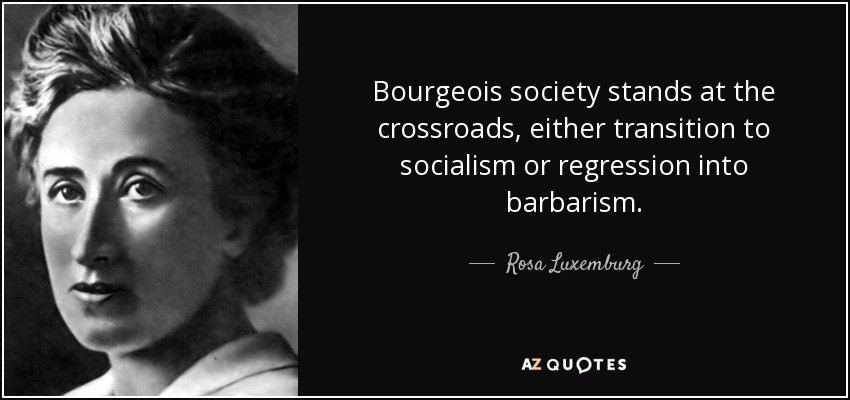
Quote from Rosa Luxemburg: Bourgeois society stands at the crossroads, either transition or regression to barbarism.


Read more!

2023/09/07

Seth Godin: The Big-O conundrum

Seth Godin discusses The Big-O conundrum

There are Big-O problems in marketing, in sales, in customer service, in finance, in production and in compliance. There’s nothing wrong with winging it–until there is.

Emphasis Mine

The main difference between Anarchists and Leninists is the amount of centralism that is needed for a Communist society to operate. The problem is that a Communist society needs an advanced industrial base to suceed. That base was built by Capitalism.

A Capitalist system operates as an aristocracy of managers for large organisations, and as a monarchy for smaller organisations. As organisations grow, they have to migrate from a monarchy into an aristocracy. The primary driver for this transition is the span of control that a person is capable of managing effectively. One could view an aristocracy as a confederation of local lords—in other words, feudalism.

The Capitalist state oversees the Capitalist organisations through a bureaucracy. The state has the necessary force to ensure compliance. In reality, the state is a battleground among Capitalists to advance their own interests. The state is not a neutral actor in a Capitalist society.

Anarchists believe that a loose confederation of communities can function for an advanced industrial civilisation. Maybe the samller organisations could transition to direct worker democracy without much problems as the workers are all known to each other, and have been exposed to the overall operation of the business. This model will fail for larger organisations as specialist functions need to be coordinated.

The Leninist model of Democratic Centralism is the best model for a post-Capitalist society in managing the large organisations. Instead of decomposing the large organisations into a confederation of direct worker democracies, the structure and efficiencies of the large organisations need to be preserved but brought under worker control through an executive committee that answers to the workers on a regular basis.


Read more!

2023/01/17

Chris Dillow: The two agendas

Chris Dillow discusses The two agendas

But there's something else. It's that actually-existing British capitalism - whether you call it neoliberalism, financialization, rentierism or whatever - has failed most people; even before the jump in gas prices real wages were barely higher than they had been 15 years previously. If you are going to talk about economics, then, you must either talk of big change or defend a system that works only for a minority. It's no wonder therefore that many on the right would rather point to a dead cat: Prince Harry is the latest one, but there'll be another along soon enough. "Culture wars" are a product of capitalist stagnation.

Emphasis Mine

This is a facet of the principle of TINA (There is No Alternative). To defend Capitalism is a tacit admission that Capitalism needs defending against viable alternatives. The big lie of TINA has to be maintained fantically. This reveals an intellectual poverty of the defenders of Capitalism.

With the economy flat-lining, tricky questions arise. Should we allow public services to deteriorate or raise taxes, if so on whom? Do we really want to cut private consumption to make room for more public consumption? Given that higher energy costs mean that the UK is poorer as a country, whose real income should take the hit: nurses and railworkers, or others, and if so whom? In short, who do we throw under the bus?

These are nasty trade-offs. Which many don't want to talk about. This is true more of the centre and right than left: whereas the latter are comfortable demanding higher taxes on the rich (maybe too comfortable) the former don't like to call explicitly for the impoverishment of nurses.

Instead, if they must talk of economics they wibble about electability or a lack of money - which is only slightly less moronic than asking about nationalizing sausages. Better for them that they retreat to the comfort zone of culture wars.

I would read Truss's ill-fated premiership in this context. Although she spoke of being pro-growth and breaking with Treasury orthodoxy, this was mere cargo-cult economics. It was language without substance, and assertion without evidence - for example that tax cuts would boost growth. Instead, it was identity politics - invoking a (partly fictitious) image of Thatcher and appealing to Tory prejudices rather than seriously engaging with genuine issues.

Whatever the reason for this divide about what we should talk about, it has an important implication. One facet of political power is control over the agenda: if we're talking about immigration or trans people or "wokesters" we are not talking about the failure of capitalism. One under-appreciated route through which the media exercise influence is in deciding what it is that we do talk about. Given this, it's not at all clear to me that it is even possible for the BBC to be truly impartial.

Emphasis Mine

The Overton window cannot include the discussions of alternatives to Capitalism. Back in 2017, I made the following comment:

Thinkers, like Kunstler, believe the superstructure is undermining the political, economic, and social system. What is happening is that the class relations are changing, and the superstucture is struggling to maintain the old system. The ideology is diverging from reality.

Calgary Women's March Naps...woke (39095060964)


Read more!

2023/01/11

Seth Godin: Build a new one

Seth Godin says to Build a new one

Entrenched cultural organizations and icons feel more permanent than they are. Network effects, brand power and the status quo can seduce us into believing that we’re stuck with what we have, but things are rarely as permanent as they appear.

…

Nothing much changes until someone cares enough to build an alternative.

Emphasis Mine

Such naivete! There are institutions that have the backing of the State with its instruments of coercion and propaganda. These institutions are essential to the current power structures. One cannot simplify replace without expecting a violent backlash.

Hotels can be replaced by AirBNB. Taxis by Uber and Lyft. These institutions are not essential to the preservation of Capitalism. Capital is merely being reallocated to different sectors chasing higher profits.

What Godin describes is dual power. During the Russian revolution, dual power existed from February until November 1917. Dual power currently exists in Venezuela. As Lenin wrote:

What is this dual power? Alongside the Provisional Government, the government of bourgeoisie, another government has arisen, so far weak and incipient, but undoubtedly a government that actually exists and is growing—the Soviets of Workers’ and Soldiers’ Deputies.

These dual organs of state power in Russia and Venezuela were able to exist because there existed military support that protected them. Dual power institutions without sufficient military support have a very short lifespan.


Read more!

2023/01/02

Seth Godin: Arguing for inaction

Seth Godin discusses Arguing for inaction

The status quo might not be ideal, but if we’re afraid of change, if we focus on the costs of doing the work to make things better, it’s tempting to simply stay still.

And the real fears of change are that it might work (which is scary) and that it might not work (which is heartbreaking).

Easier to do nothing and simply settle.

Emphasis Mine

This ignores the actions of those who benefit from the status quo. They actively persecute dissenters, propagandise for the status quo, and, sometimes, use lethal means to suppress dissent.

This explains the increase criminalisation of protests with increase prison terms, fines, and breadth of offences. Those who loudly proclaim their freedom of speech and right not to wear masks, are remarkably silent on this trend.

-0131 No Justice No Peace


Read more!

2022/12/29

Seth Godin: It’s not what you deserve, but it is what it is

Seth Godin discusses It’s not what you deserve, but it is what it is

When your client or your boss turns down a great idea, it’s tempting to focus on the idea and how right you were. It might make more sense to try to find empathy for the fear and status issues that the client has instead. Because those issues probably got in the way of them ever seeing what you had to say.

Emphasis Mine

When we do agitation and propaganda work, we often encounter the fears of the working class:

  • Homelessness
  • Poverty
  • Hunger
  • Illness
  • Prison

All the things that are reasons for overthrowing the system are also the props that hold up the system. As Machiavelli wrote (The Prince (1513), Ch 17):

Nevertheless a prince ought to inspire fear in such a way that, if he does not win love, he avoids hatred; because he can endure very well being feared whilst he is not hated, which will always be as long as he abstains from the property of his citizens and subjects and from their women. But when it is necessary for him to proceed against the life of someone, he must do it on proper justification and for manifest cause, but above all things he must keep his hands off the property of others, because men more quickly forget the death of their father than the loss of their patrimony. Besides, pretexts for taking away the property are never wanting; for he who has once begun to live by robbery will always find pretexts for seizing what belongs to others; but reasons for taking life, on the contrary, are more difficult to find and sooner lapse. But when a prince is with his army, and has under control a multitude of soldiers, then it is quite necessary for him to disregard the reputation of cruelty, for without it he would never hold his army united or disposed to its duties.

Emphasis Mine

The Capitalists have to maintain this semblance of fear without engendering widespread hatred of the system.

Macchiavelli01


Read more!

2022/12/17

Chris Dillow: Why economists need history

Chris Dillow argues Why economists need history

Reigning in monopoly power requires governments to overcome these forces. And that in turn requires the growth of either a threat to capitalism itself or at least a countervailing power to capital. It's no accident that capitalism was more equal (and productive) when there were strong trades unions and a threat of communism.

So yes, I think we do need intellectual (and social and economic) history - because it teaches us that meaningful improvements in economic policy must be a collective effort and not merely clever people proposing technocratic tweaks.

Emphasis Mine

This really requires a significant portion of the proletariat to raise its class consciousness enough to confront the forces of Capitalism. Using the ERA (experience, reflection, action) model, workers should:

1.Poverty in indiaExperience what is happening. This means articulating what is happening to them. Articulation brings the experience to the foreground. It can be simple as saying "This is sucks!". It is a realisation that things are right somehow. It may be something simple as a feeling of unease.
2.writing, book, reading, reflection, studio, silence, education, brand, cash, library, books, culture, document, publishers, Free Images In PxHereReflect upon this experience. This is when theory and a knowledge of history comes in. The current state of things has arisen from the decisions made in the past. It is vital that people understand that society is a human construct that is reproduced daily. Rules and customs exist to solve problems. We need to understand what those problems were, and why those choices were made. Theory helps us to clarify our thinking by focusing on what is important.
3.Women's March Washington, DC USA 33Act upon this reflection and experience. What happens next depends on what you perceive your capabilities to be and what reaction you can survive. Be very aware that any action you take will incur a reaction from those whose believe that they benefit from the current system. The intensity of this reaction will be proportional to the fear that they feel.
4.Eo circle blue repeatRepeat


Read more!

2022/02/03

Hyman P. Minsky: Finance and Stability: The Limits of Capitalism

Hyman P. Minsky discusses Finance and Stability: The Limits of Capitalism.

One reason capitalism won and the Soviet version of socialism lost was that the Lenin-Stalin version of socialism allowed for only one form, the highly centralized linear command model, whereas, as the call for this conference recognizes, capitalism comes in many forms. The successful capitalisms of the 1950's through the 1970's were not the same as the capitalisms that failed in the 1930's. In general a system which we can characterize as a small government gold standard constrained laissez-faire capitalism was replaced by a big government flexible central bank interventionist capitalism. As Kalecki and Jerome Levy pointed out, a government deficit is the equivalent of investment as far as the maintaining of the profits of enterprise is concerned. The big government capitalism put in place in the 1930's and after World War II were and still are protected from a severe fall in aggregate profits, such as occurred in the great contraction of 1929-33.

Emphasis Mine. pp.5-6

This was certainly the problem with Socialism after the 1917 revolution and the formation of the USSR. Given that a Socialist country had just survived a near-death experiences in the Russian Civil War and the Great Patriotic War. In both cases, the USSR was able to emerge stronger and defeat its enemies.

Unfortunately, the means that the USSR used to achieve their victories proved not to be appropriate in the post-war years. The USSR went through several phases:

Except for the period of the New Economic Policy, all of the other phases relied on centralised control of the economy. The great advantage of this was the rapid development of the productive forces which was necessary because Russia was primarily an agricultural country (indeed, a peasant-based economy).

Minksy did not realised that Capitalism has been Finance Capitalism since the early 20th century:

As a result of the security market reforms of the Roosevelt era the law caught up with the fact that modern capitalism is corporate capitalism.

Emphasis Mine. p.13

Minksy admits that Marx's thesis that the long-term trend of decreasing rates of profit without acknowledging the source:

Once current profits fall by enough, or the carrying costs of debts increases by enough, so that the cash flows earned by operations or from financial assets by highly indebted operations are insufficient to meet commitments on liabilities then the pressure of the need to validate debts (and to meet withdrawals by depository institutions) leads to a proliferation of attempts to make positions by selling out positions. The result can be a sharp fall in asset values. A downward spiral is a possibility in which investment ceases and profits evaporate: the end result of over indebtedness can be a great or a serious depression. Although the obvious flaw in capitalism centers around its inability to maintain a close approximation to full employment, its deeper flaw centers around the way the financial system affects the prices and demands of outputs and assets, so that from time to time debts and debt servicing rise relative to incomes so that conditions conducive to financial crises are endogenously generated. Such a crisis, if not contained by a combination of Central Bank lender of last resort interventions, which sustain asset prices, and government deficits, which sustain profits, leads first to a collapse of investment and then to a long lasting depression accompanied by mass unemployment. This financial flaw cannot be eradicated from the corporate form of market capitalism, in which liabilities exist that are prior commitments of the gross nominal profit flows of corporations. Reforms which constrain the possibility of using excessive debts for specified purposes were part of the new model capitalism of the 1930's. Many aspects of these constraints were relaxed by the 1980's, especially critical constraints upon the assets eligible for the portfolios of the Savings and Loan Associations were relaxed. The result was a series of crises of financial institutions and corporate indebtedness. A big depression did not happen in the early 1990's because the government validated the debts of the financial institutions that became insolvent and the huge government deficits sustained profits.

Emphasis Mine. pp.18-19

This is a succinct prescription of the current Capitalist crisis.


Read more!

2021/12/02

Claudio Katz: China: Neither imperialist nor part of the Global South

Claudio Katz argues that China is neither imperialist nor part of the Global South.

Dependency presupposes the existence of a state subject to external orders, requirements or conditioning, while imperialism implies the opposite: international supremacy and a high degree of external interventionism. These should not be intermingled in the same formula. In China the lack of subordination to another power coexists alongside great restraint in its involvement with other countries. This is neither dependency nor imperialism.

Katz is arguing is that China is not an imperialist power as it does not intervene directly in the affairs of other nations through the use of military force or economic coercion. This is a big change from the period prior to the 1990's when China tried to invade Vietnam, supported Maoist guerillas, and intervened directly into the Korean conflict.

Nor is China a dependent power like Australia in which we have to follow the lead of the USA in military and political matters.

Those who are unaware of this difference tend to denounce China and the United States alike as aggressive powers. They situate the two contenders on the same plane and stress that they intervene indifferently in those conflicts.

But this neutralism fails to note who is primarily responsible for the tensions that shake the planet. It fails to see that the United States sends warships to its rival’s coast and raises the tone of its accusations in order to generate a climate of growing conflict.

Katz is arguing that China is acting defensively. This defensiveness has to be seen in the presence of US bases in South Korea, Japan, Guam, and others. China has no comparable presence near the USA.

China does not suffer the outflows that typically drain the dependent countries. It is exempt from the trade imbalance, technological deficiency, scarcity of investment or strangling of purchasing power. There are no data from today’s China suggesting that its stunning economic might constitutes a mere statistical fiction.

This trade surplus allows some freedom of action for China on the world stage. And it is this freedom that is an affront to the US.

But these cheerful portraits overlook the fact that the consolidation of capitalism accentuates in China all of the imbalances already generated by overproduction and surplus capital. These tensions, in turn, accentuate inequality and deterioration of the environment. Ignoring these contradictions prevents us from noting how China’s defensive international strategy is undermined by the competitive pressure imposed by capitalism

Katz puts this contradiction as the core problem for China. While Capitalism has delivered stunning economic growth and properity for China, the need for ever-expanding markets brings it into sharp conflict with the hegemonic power of the USA.

In the short term, there is the robust rise of China in the face of an obvious decline of the United States. China is winning the dispute in all areas and its recent management of the pandemic is a confirmation of this. Beijing quickly achieved control over the spread of the infection while Washington coped with an overflow of cases that left the country with one of the highest numbers of deaths.

The pandemic has hastened the decline of the USA. And it is this decline that makes the USA more dangerous as it tries to maintain its hegemony. But we should also be wary of China as the Capitalist contradictions impel it towards imperialism.


Read more!

2020/07/01

ABC News: Getting people to follow coronavirus restrictions is harder the second time around

Getting people to follow coronavirus restrictions is harder the second time around.

The research also examined factors that predicted who was most likely to comply with restrictions.

The two primary predictors were feelings of "duty to obey the government" and "personal morality".

Simply, people were most compliant if they felt a stronger duty to obey government instructions, and if they thought it was morally wrong to flout the rules. These findings suggest social norms, rather than fear of COVID-19, motivated compliance the most.

The findings also revealed age and gender both had a bearing, with older participants and women being more likely to comply.

Those who perceived a greater health risk from COVID-19 were also more willing to follow the rules, as well as those who felt there was a higher risk of being caught and fined for breaking them. However, these factors were nowhere near as important as feelings of duty to obey or personal morality.

Emphasis Mine

The survey referred to is described in "Morals, duty or risk?: Examining predictors of compliance with COVID-19 social distancing restrictions". The implication for policy is:

Authorities often rely on sanctions such as fines and arrests to enforce laws (this has also occurred during the COVID-19 pandemic to enforce social distancing restrictions). However, our findings suggest that while sanction risk predicts compliance, authorities cannot rely solely on legal sanctions to force compliance. Authorities need to continue to persuade citizens that it is both morally right to abide by the restrictions and that we all have a duty to protect those most vulnerable to the disease. In other words, people should be asked to obey the COVID-19 social distancing restrictions because they have a moral responsibility to act to protect others.

Emphasis Mine

This is a searing indictment of Capitalism. That moral responsibility has to be urged upon people implicates Capitalaism as being an amoral system. A personal morality is not expected of people in a Capitalist system.

We need to envision and create a political and economic system that encourages and rewards personal morality and responsibility.

Circle of people placing their hand at the centre


Read more!

2020/06/22

Bob Lefsetz: Barr/Berman

Bob Lefsetz writes about the crisis between Barr/Berman.

So, we’re heading for a crisis. And it won’t be a Constitutional crisis, it won’t be based on law, it won’t be about legalities, but hearts and minds. Trump will do everything to stay in power, and he will call out the military. And your face will be recognized and you will be put in jail as the corporations stand aside and…

And what?

We’re heading for a revolution. Or complete authoritarianism. Don’t keep telling me it can’t happen here. Or shrug and say you’ll be fine no matter what happens. Look at the history of the world, the American experiment has been relatively brief. When are we going to take the temperature of the youth and stop the insanity? If not now, when?

Emphasis Mine

Informed capitalists, such as Ritholtz and Lefsetz, are worried that a revolution is brewing or a reactionary backlash can happened. They lack the insight of Marxist-Leninist theory to understand the class dynamics behind current events.

The successful neo-liberal onslaught since the 1980s has crushed the proletariat. The organic organs of class struggle (trade unions and labour parties) have been weakened or subverted. These organs are being bypassed by the mass movements to express their demands.


Read more!

2020/06/18

Barry Sheppard: United States: High stakes in Trump's attacks on Black Lives Matter protests

Barry Sheppard writes that United States: High stakes in Trump’s attacks on Black Lives Matter protests.

Trump’s threat to use the military to smash the uprising, if carried out, would have been a major step towards a military-Bonapartist dictatorship. The power of the uprising led retired generals and admirals to publicly back away from such a step, causing Trump to retreat. Mark Milley, chair of the armed forces Joint Chiefs of Staff - and an active duty general - in effect joined them.

It’s unlikely that the ruling class, reeling from the protests and the huge support for their demands, would support such a move.

Emphasis Mine

The political problem for the US Capitalist class is that there is no clear alternative to Trump: Biden is a pitiful excuse for a leader. Bernie Sanders would now be an acceptable alternative if it were not for the fact that the establishment has stopped the process of Sanders getting the Democratic Party nomination.


Read more!

Marguerite Ward: Only 25% of Americans think capitalism is good for society

Marguerite Ward writes that Only 25% of Americans think capitalism is good for society.

In May, the Harris Poll and Just Capital, an independent research firm founded by the billionaire investor Paul Tudor Jones, surveyed 1,000 people on their thoughts about capitalism amid the pandemic. Only 25% of respondents said they believed our current form of capitalism ensures the greater good of society.

For many this doesn’t come as a surprise. Prominent voices ranging from a top Harvard economist to the billionaire hedge-fund manager Ray Dalio have warned that capitalism would soon face a crisis because of the massive inequality exposed by the pandemic.

Emphasis Mine

The report on the survey concluded:

Americans overwhelmingly agree that we as a society need to use this crisis as an opportunity to fix what’s broken and find a better way of living. Americans are looking for companies to take the lead on key policy issues like paid sick leave, paid family leave, wage increases, healthcare, and increased flexibility to work from home. And the American public believes we need a more evolved form of capitalism to tackle the shift.

This more evolved capitalism must be based on our learnings from this time – that our economy has not been working for the majority of Americans, that business must play a key role in protecting the public, and that certain populations, including Black and Brown Americans, are tremendously vulnerable to both the health and economic impacts of crisis. When asked if they had been personally impacted by COVID-19, Black survey respondents identified as having been furloughed, laid off, or given a zero-hour schedule at double the rate of White respondents (Black respondents: 22%, 20%, and 21% vs. White respondents: 10%, 11%, and 5%, respectively).

We have faced unprecedented challenges over the last few months – and it’s not over yet – but we have the opportunity today to build better coming out of this pandemic, and deep social unrest. These views from the public provide a roadmap to how we can reset capitalism to truly serve all Americans, and build a more equitable society for tomorrow.

Emphasis Mine

This view is hampered by the blinkers that Capitalism is the only gmae in town. Socialism or Communism is not even considered. Fifty (50) years on neo-liberalism has led us here. What the magazine wants some form of Capitalism to survive this crisis. They are implicitly recognizing that the neo-liberal project has led to this series of crises: massive busfires; glaobal pandemic; economic depression; unrest in the streets.

People have to realize that asking Capitalists to be nice will not work. We have seen what utter bastards thry are throughout the 1980s and onwards. We need to take control of our own lives and our work. We need to work and struggle towards a more just and equitable society. Capitalism has shown that it cannot achieve that outcome.


Read more!

2020/06/16

Sam Williams: The Crisis (Pt 9)

Sam Williams describes The Crisis (Pt 9).

But the dangers of what Roubini calls “populism,” by which he essentially means fascism, are very real. The danger of fascism will grow if the current demonstrations and rebellions don’t lead to a rapid revival of the workers’ movement, not only in the trade union sense but above all in the political sense. If the workers’ movement revives, it will open the door to the resolution of the current ecological-biological, economic, and political crises in the form of the U.S. and global socialist revolution. This is not, however, an outcome that Mr. Roubini particularly relishes. Instead, he hopes for a solution that will somehow revive capitalism without fascism and war.

Emphasis Mine

The danger in the USA is that Trump loses control of his base of lumpen-proletariat and petite-bourgeoisie classes. This would open the door to a more Fascist leader. Trump is an opportunist. Some say he is a Bonapartist except that he does not unify the nation.

Already, I am seeing videos on Youtube decrying the surrender of the state to the BLM protestors with the modest reforms being proposed. These reactionaries are most affronted by footage of police kneeling with protestors. The reactionaries call this act kow-towing. They are outraged. They do not see the inherent meaninglessness of the act.

And, most dangerously of all, there are fantasists putting out videos of them saying that they have turned back busloads of Antifia activists from pillaging and burning their communities. No actual footage of this is provided. These fantasists are fuelling the propaganda on the Right.

However, no-one is blaming Trump for the failure to reign in the current insurrection. Whereas in the UK, people are blaming the Conservatives for the failure to do so. This may account for the renewed urgency on Brexit negotiations.

Will opines further:

This is why the current rebellion sweeping the United States of America, still by far the most powerful imperialist country in the world, is so important. Will this rebellion be a herald of a movement towards the socialist transformation of the United States and the world, or will it end in a new, if brief, stabilization of American and world capitalism such as Roubini is hoping for in the 2030s? If something like this were to occur, it would very likely be but a prelude to the final collapse of our civilization. And this as far as capitalism is concerned is the very best case.

Emphasis Mine

Yes, there is economic and ecological instability within Capitalism, but there is no political instability as the overwhelming majority is still in favour of Capitalism. At this stage, some minor political realignment may occur.

My main fear is with the possible rise of right-wing paramilitaries who see themselves as replacing the police in quelling the insurrection as in the case of the Freikorps.

Members of the Freikorps posing with an armoured car

By unknown photograther - http://farm4.static.flickr.com/3160/3053216221_576264dcf2.jpg, Public Domain, Link


Read more!

2020/06/12

Chris Slee: Capitalism and workers struggle in China

Chris Slee writes about Capitalism and workers struggle in China.

Picture of Chinese strikers

China's economy is now essentially capitalist, as indicated by the privatisation of the bulk of the means of production, and the conversion of labor power into a commodity. Workers can only survive by selling their labor power to an employer.

But the most extreme ideologues of neoliberalism (both in China and elsewhere) are not satisfied with the degree of privatisation that has occurred so far. State-owned enterprises remain dominant in certain strategic industrial sectors such as iron and steel, electricity and telecommunications, and in the banking sector. The neoliberals want more complete privatisation, and unfettered access to all areas of the economy for local and foreign capital.

The Chinese Communist Party has up to now resisted these pressures. A strong state sector helps China maintain a degree of independence from the Western imperialist powers.

…

If this is the case, it is not unprecedented in the history of capitalism. State ownership of key industries can sometimes be beneficial for the functioning of the capitalist system as a whole. The British government nationalised the coal mines after the second world war. This did not mean that Britain had become socialist. Similarly, China's economy remains fundamentally capitalist, despite some cases of re-nationalisation in the wake of the global financial crisis.

Emphasis Mine

Slee concludes:

Despite the partial reversal of some neoliberal policies, China remains a highly unequal society, where workers are ruthlessly exploited and lack job security. The state remains capitalist. It represses the resistance of the workers to capitalist exploitation.

The air and water are extremely polluted. Despite significant investment in renewable energy, the use of fossil fuels continues to expand, and China is now the world's biggest producer of greenhouse gases.

Minorities such as the Tibetans and Uighurs continue to be oppressed. Freedom of speech continues to be restricted.

A struggle for genuine socialism still remains necessary. This struggle will need to bring together workers, students and other oppressed groups. An example of such unity is the solidarity of university students with workers at Jasic Technologies. This kind of solidarity, if repeated on a much larger scale, can help take China on the road to socialism.

Emphasis Mine


Read more!