Showing posts with label Karl Marx. Show all posts

2018/01/10

Steve Roth: The winners have us all playing a loser's game

Steve Roth writes that The winners have us all playing a loser’s game.

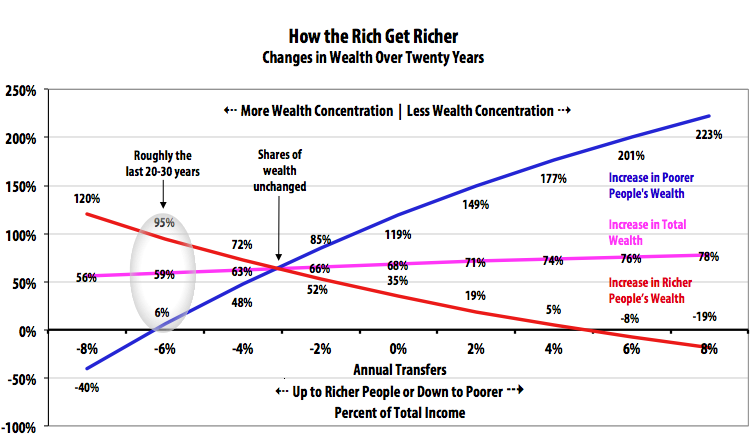
Perfect markets concentrate wealth. It’s their nature. But at some point, market-generated wealth concentration strangles those very markets (compared to markets with broader distributions of wealth). If a handful of people have all the wealth, how many iPhones will Apple sell? If only a few have the wealth to buy cars, automakers will produce a handful of million-dollar Bugattis, instead of forty handfuls of $25,000 Toyotas. Sounding familiar?

…

Why, then, aren’t we spending our lives on the right side of this chart? It’s a total win-win, right? The answer is not far to find. Nassim Taleb shows with some impressive math (PDF) what’s also easy to see with some arithmetic on the back of an envelope: if a few richer people (who dominate our government, financial system, and economy) have the choice between making our collective pie bigger or just grabbing a bigger slice, grabbing the bigger slice is the hands-down winner.

…

To summarize: perfect markets, left to their own devices, concentrate wealth. Concentrated wealth results in less wealth, and far less collective well-being. (You’ll notice that I haven’t even mentioned fairness. It matters. But I’ll leave that to my gentle readers.)

This all leads one to wonder: how could we move ourselves into that happy world of rapidly increasing wealth and well-being on the right side of the graph? Hmmmm…

Emphasis Mine

Roth agrees that Marx was right about the dynamics of Capitalism. However, Roth wants to save Capitalism through the expansion of the Welfare State.

Yet, Roth points out the main impediment to the expansion of the Welfare Stete: the capture of the state by the wealthy. The plutotracy cares not whether it grows fast or slow, as long it stays in control.

Roth fails also to mention the importance of the USSR in the creation of the Welfare State in the West. The Welfare State was a political instrument to counteract Communist propaganda about a workers' paradise. Without the USSR, there is no longer a need for the Welfare State because there is now no alternative.

Or it could be as George Orwell wrote in 1984?

It was possible, no doubt, to imagine a society in which wealth, in the sense of personal possessions and luxuries, should be evenly distributed, while power remained in the hands of a small privileged caste. But in practice such a society could not long remain stable. For if leisure and security were enjoyed by all alike, the great mass of human beings who are normally stupefied by poverty would become literate and would learn to think for themselves; and when once they had done this, they would sooner or later realise that the privileged minority had no function, and they would sweep it away. In the long run, a hierarchical society was only possible on a basis of poverty and ignorance.

Emphasis Mine

A free society is a Communist one.


Read more!

2017/12/27

Dan Little: Social consciousness and critical realism

Daniel Little argues that Social consciousness and critical realism are interrelated. The material basis of social structures exposed through Critical Realism can explain the subjective reality constructed by agents in their Social Consciousness. Little omits the reproduction of the objective reality by agents reproducing their subjective reality.

Little argues that the subjective view of one's social identity is constructed …through interaction with other individuals, and many of those interactions are determined by enduring social structures and institutional arrangements. We do not have a sense of who and what we are in isolation. My concept of being male is built as distinct from what I perceive femaleness to be, and what others perceive femaleness to be.

So ideas and identities are objective in at least two senses, and are therefore amenable to treatment from a realist perspective. They have objective social determinants that can be rigorously investigated; and they have a particular grammar and semiotics that need to be rigorously investigated as well. Both kinds of inquiry are amenable to realist interpretation: we can be realist about the mechanisms through which a given body of social beliefs and values are promulgated through a population, and we can be realist about the particular content of those belief systems themselves.

Emphasis Mine

In a patriarchal society, the idea of gender is expressed as either male or female. How this gender is expressed is through a particular set of signs, and an acceptable set of language and actions. An example would be wearing pants for males, and wearing dresses for females. One would say that a male wearing a dress to be taboo.

Ironically, this position seems to converge in an unexpected way with two streams of classical social theory. This approach to social consciousness resonates with some of the holistic ideas that Durkheim brought to his interpretation of religion and morality. But likewise it brings to mind Marx's views of the determinants of social consciousness through objective material circumstances. We don't generally think of Marx and Durkheim as having much in common. But on the topic of the material reality of ideas and their origins in material features of social life, they seem to agree.

Emphasis Mine

In Marx's case, this is usually expressed as the Objective creating the Subjective. Reality creates our ideas about reality. If one sees two (2) genders, then one has the idea that there are only two (2) genders. This is reinforced when others report that there are only two (2) genders.

These considerations seem to lead to a strong conclusion: critical realism can be as insightful in its treatment of objective social structures as it is in study of “subjective” features of social consciousness and identities.

Emphasis Mine

What Little omits is that Marx also said that the Subjective creates the Objective. What we see as reality is not the true reality: it is only an approximation. Our ideas inform what we see. In this case, the existence of other genders is considered to be an impossiblity. This idea of impossibility precludes any discussion of other genders.


Read more!

2017/11/10

Dan Little: Worker-owned enterprises as a social solution

Dan Little writes that Worker-owned enterprises as a social solution.

The central insight of Marx's diagnosis of capitalism is couched in terms of property and power. There is a logic to private ownership of the means of production that predictably leads to certain kinds of outcomes, dynamics that Marx outlined in Capital in fine detail: impersonalization of work relations, squeezing of wages and benefits, replacement of labor with machines, and — Marx's ultimate accusation — the creation of periodic crises. Marx anticipated crises of over-production and under-consumption; financial crises; and, if we layer in subsequent thinkers like Lenin, crises of war and imperialism.

The shorthand for this is alienation.

The logic is pretty clear. When an enterprise is owned by private individuals, their interest is in organizing the enterprise in such a way as to maximize private profits. This means choosing products that will find a large market at a favorable price, organizing the process efficiently, and reducing costs in inputs and labor. Further, the private owner has full authority to organize the labor process in ways that disempower workers. (Think Fordism versus the Volvo team-based production system.) This implies a downward pressure on wages and a preference for labor-saving technology, and it implies a more authoritarian workplace. So capitalist management implies stagnant wages, stagnant demand for labor, rising inequalities, and disagreeable conditions of work. 

When workers own the enterprise the incentives work differently. Workers have an interest in efficiency because their incomes are determined by the overall efficiency of the enterprise. Further, they have a wealth of practical and technical knowledge about production that promises to enhance effectiveness of the production process. Workers will deploy their resources and knowledge intelligently to bring products to the market. And they will organize the labor process in such a way that conforms to the ideal of humanly satisfying work.

Emphasis Mine

Who owns the means of production greatly affects how workers are treated.

Worker management has implications for automation in a different way as well. Private owners will select forms of automation based solely on their overall effect on private profits; whereas worker-owned firms will select a form of automation taking the value of a satisfying workplace into account. So we can expect that the pathway of technical change and automation would be different in worker-owned firms than in privately owned firms.

In short, the economic and institutional realities of worker-owned enterprises are not entirely clear. But the concept is promising enough, and there are enough successful real-world examples, to encourage progressive thinkers to reconsider this form of economic organization.

Emphasis Mine

Getting workers to voluntarially increase their productivity was a big problem user USSR Socialism. We need to understand this problem in greater detail.


Read more!

2015/11/28

Noah Smith: A big sweeping theory of modern history

Noah Smith describes his version of A big sweeping theory of modern history.

Here's a Big Sweeping Theory that I've been toying with. There are lots of theories of the cycle of rise and decline of empires in the agricultural, premodern world. I'd like to create a parallel theory of low-frequency cycles (or, more accurately, long-term impulse responses to stochastic technology shocks) in the modern, industrialized world.

It's possible to see the convulsions of the World Wars and the Great Depression as a one-time event — part of the growing pains of the industrial revolution, not to be repeated. But what if some of the core features of those events are actually part of a cycle? Here's a sketch of how that cycle might work:

Smith's model consists of seven (7) main phases:

  1. Technological Change.
  2. Globalization.
  3. ?
    1. Inequality.
    2. Cultural Change.
    3. Financialization.
    4. Geopolitical Shifts.
  4. Rise of Extremism.
  5. Economic Slowdown.
  6. War.
  7. New Order.

The interesting thing is that Smith does not have an explanation for Phase 5: Economic Slowdown. Marxists do: the rate of profit declines below the necessary rate required for reproduction of Capital. In other words, Capitalists will not invest if the rate of return does not allow to get their money back within the foreseeable future. In normal times, this future is about five (5) years. In times of stress, this can drop to little as a year.

The alternative view of history is provided by Marx in which the driver of human history is class conflict. The economic organization of society creates classes which come into conflict over the distribution of the economic output. A political and ideological superstructure is created to contain this conflict. Breakdown of the system occurs when this superstructure cannot adapt fast enough to the changes in the economic organization of society.


Read more!

2015/10/01

Dan Little: Marx on peasant consciousness

Dan Little writes about Marx on peasant consciousness.

From this description we can draw several positive ideas about the foundations of collective solidarity. Here are the elements that Marx takes to be crucial in the formation of collective consciousness in this passage:

  1. The group needs to possess "manifold relations" to each other.
  2. There needs to be effective communication and transportation across space, not just local interaction.
  3. There needs to be a degree of economic interdependence.
  4. There need to be shared material conditions in the system of production.
  5. There needs to be an astute appreciation of the social and economic environment.
  6. There needs to be organization and leadership to help articulate a shared political consciousness and agenda.

And Marx seems to have something like a necessary and sufficient relation in mind between these conditions and the emergence of collective consciousness: these conditions are jointly sufficient and individually necessary for collective consciousness in an extended group.

There are several crucial ideas here that survive into current thinking about solidarity and mobilization. So Marx's thinking about collective consciousness was prescient. It is interesting to consider where his thoughts about collective solidarity came from. How did he come to have insightful ideas about the social psychology of mobilization and solidarity in the first place? This isn't a topic that had a history of advanced theory and thinking in 1851.

Emphasis Mine

The problem is why only the Bolshevik Revolution was led by workers while other revolutions were led by peasants. (Little is mistaken in characterising the October Revolution as a peasant one.)

In a way, the Chinese Revolution was led by the remnant of the Shanghai working class that survived the Long March. The Vietnamese and Korean revolutions started in the more industrialised parts of the country.

I would have to disagree with Little's assertion that all of the revolutions in the 20th Century were peasant ones. The peasant were integral parts of those revolutions, but the conditions described by Marx prevented them from developing their revolutionary consciousness by themselves. They needed the political leadership of the revolutionary workers.

So, why don't workers in the advanced industrialised countries develop their own revolutionary consciousness? That is a question that baffles Socialist parties in the West.


Read more!

2015/06/13

The Education-Deficit Does Not Explain Rising Inequality

Mark Thoma posts an extract from Discussion of Matthew Rognlie: "Deciphering the Fall and Rise in the Net Capital Share": The Honest Broker for the Week of June 14, 2015, b J. Bradford DeLong.

So what, then, is going on and driving the sharp rise in inequality, if not some interaction between our education policy on the one hand and the continued progress of technology on the other? Thomas Piketty (2014) has a guess. Piketty guesses that the real explanation is that 1914-1980 is the anomaly. Without great political disturbances, wealth accumulates, concentrates, and dominates. The inequality trends we have seen over the past generation are simply a return to the normal pattern of income distribution in an industrialized market economy in which productivity growth is not unusually fast and political, depression, and military shocks not unusually large and prevalent. …

Emphasis Mine

So, economists are rediscovering the key insights of Karl Marx about Capital.

What is also missing from Piketty's insight is that the period of 1917-89 was when an alternative political and economic system severely challenged the legitimacy and hegemony of Capitalism. This system crushed Nazi Fascism by destroying its armies at Stalingrad, Kursk, Belorussia, and Berlin.

While this system of Russian Socialism was fatally flawed through the dominance of the bureaucracy of the central planning, it was viable for over seventy (70) years. A feudal country of peasants was rapidly modernised to a point that it could crush the second largest industrialised country in the world: Nazi Germany.

The USSR also challenged the USA in the realm of scientific advance and research. Remember the space race!

The October Revolution was indeed one of the great political disturbances.


Read more!

2015/03/29

Alienation: the non-issue

Chris Dillow writes about Alienation: the non-issue.

This poses the question: why isn't there more demand at the political level for fulfilling work?

The question gains force from two facts. First, autonomy at work is a big factor in life-satisfation. Politicians who want to improve well-being - as Cameron once claimed to - should therefore take an interest in working conditions. Secondly, workers who are happy - less alienated - are more productive. Less alienation should therefore help to close the productivity gap between the UK and other rich nations, which in turn should raise real wages.

Despite all this, working conditions are barely on the agenda at all in this election. Politically, the workplace is, as Marx said, a "hidden abode."

One reason for this is that politics has largely ceased to be a vehicle for improving lives. It is instead a form of narcissistic tribalism and low-grade celebrity tittle-tattle: when will Cameron resign? Who'll replace him? What does Miliband's kitchen look like?

And in this way, politics serves the interests of the boss class and not workers. Capitalist power is exercised not just consciously and explicitly, but by determining what becomes a political demand and what doesn't. Here's Steven Lukes:

Is it not the supreme exercise of power to get another or others to have the desires you want them to have - that is, to secure their compliance by controlling their thoughts and desires?...Is it not the supreme and most insidious use of power to prevent people, to whatever degree, from having grievances by shaping their perceptions, cognitions and preferences in such a way that they accept their role in the existing order of things?

Emphasis Mine

Workers should be struggling to make working the supreme achievement in life. It is through labour that we create a more just and harmonious society. Workers should determine what use the fruits of our labour are put to.


Read more!

2015/02/26

Be Calm, Robots Aren’t About to Take Your Job

Mark Thoma comments on Be Calm, Robots Aren’t About to Take Your Job, MIT Economist Says..

I've been arguing for a long time that in coming decades the major question will be about distribution, not production. I'm not very worried about stagnation, etc. — we'll have plenty of stuff to go around. I'm worried about, to quote the title of a political science textbook I used many, many, many years ago as an undergraduate, "who gets the cookies?" not how many cookies we're able to produce So I agree with Autor on this point:

Mr. Autor … added, “If we automate all the jobs, we’ll be rich—which means we’ll have a distribution problem, not an income problem.”

Emphasis Mine

Karl Marx made the same point in discussing Capitalism. The main problem has always been one of distribution.


Read more!

2015/02/21

Exploitation in the lab

Chris Dillow finds experimental evidence for Exploitation in the lab.

Experimental evidence suggests that Marx was right.

In Capital, Marx describes the selling of labour power thus:

He, who before was the money-owner, now strides in front as capitalist; the possessor of labour-power follows as his labourer. The one with an air of importance, smirking, intent on business; the other, timid and holding back, like one who is bringing his own hide to market and has nothing to expect but — a hiding.

And here's a recent paper by Nikos Nikiforakis, Jorg Oechssler and Anwar Shah:

We have designed a game in which exploitation can result from the hierarchical relationship between players and, in particular, from the fact that the senior worker has the power to coerce a junior worker into exerting high levels of effort. Using a laboratory experiment, we find that senior workers often attempt to exploit junior workers.

This is not an isolated finding: it's consistent with an earlier paper by Ernst Fehr and colleagues.

Emphasis Mine

Exploitation is built into the hierarchy. To remove the exploitation requires removal of the hierarchy, or to make the hierarchy accountable to everyone.


Read more!

2015/01/27

The mode of production as society's structure

Dan Little supports Marx's view on The mode of production as society's structure.

The template of historical materialism as a "Gray's Anatomy" for modern capitalism has often been criticized as being mechanistic, over-simplified, and even fictional. But in its heart the scheme is a perfectly intelligible hypothesis about how several aspects of contemporary society fit together. Property relations define individual interests, and the system of wage labor defines the opportunities available to working people. Legislative and governmental policies have effects on the property system, and the class that owns the bulk of this property is perfectly capable of recognizing the consequences of this policy or that. Having the means to influence government, the owning class is able to shape government policy and personnel in ways that are compatible with its interests. Likewise, owners of property are able to recognize the advantage of being in a position to influence public consciousness and the terms of public debate. So the components of the "ideological apparatus" — think tanks, newspapers, publishing houses, television networks — are intensely contested, and the power of the owning class to influence the content of these outlets is great. Here again we have a fairly simple empirical argument for the conformance of the organs of social consciousness to the needs of the propertied class. And if it seems far fetched to hold that the owners of wealth are very willing to exert their power in these ways, just look at the recent announcement of the 2016 election-year budget of the political network funded by the Koch brothers — $889,000,000 (link)!

It is no longer common in sociology to find value in Marx's theory of capitalist society. But really, the structuralist view he arrived at in the 1850s and 1860s seems pretty prosaic today in the context of an economic system that systematically creates astronomical wealth for the one percent and stagnant poverty for the majority of society. Median household income in 2012 in the United States was $51,371, and almost all states showed a decline in median household income between 2000 and 2012 (link). And it is almost tautological to say that the property system explains both facts — the explosion of the wealth and income of the one percent and the stagnant or declining incomes of the majority of the population.

Or as Marx concludes Chapter Six of Volume I of Capital:

On leaving this sphere of simple circulation or of exchange of commodities, which furnishes the “Free-trader Vulgaris” with his views and ideas, and with the standard by which he judges a society based on capital and wages, we think we can perceive a change in the physiognomy of our dramatis personae. He, who before was the money-owner, now strides in front as capitalist; the possessor of labour-power follows as his labourer. The one with an air of importance, smirking, intent on business; the other, timid and holding back, like one who is bringing his own hide to market and has nothing to expect but — a hiding.

Emphasis Mine

In essence, the mode of production defines how a society operates, and what is considered property. In a slave society, property includes slaves, land, and money. In a feudal society, property includes serfs, land, castles, and armed retainers. In a capitalist society, property includes land, factories, machines, patents, financial instruments, and money.

Property ownership defines the composition of the ruling class. Those who owned slaves were the rulers in a slave society, Those who had serfs, castles, and armed retainers were the feudal lords and ladies in a feudal society. And so on.

And the state exists to defend and extend those property rights. This defense is ideological, legal, and physical.

The ideological defense of any society has been that it is natural. This was true of slave and feudal societies as well as capitalist ones. Each of these societies was argued to be the best fitted to human nature. The problem is that our understanding of what human nature is develops over time in response to material improvements in society.

The legal and physical defense of property lies primarily with the criminal justice system which is backed up by the military.


Read more!

2015/01/15

Explorations in plain Marxism: revolutionary theory, practical action

Paul Le Blanc writes about Explorations in plain Marxism: revolutionary theory, practical action.

It could be argued that a more useful definition of capitalism (perhaps more consistent, also, with the perspectives of Marx and Engels) might posit four fundamental elements in the capitalist economy, three of which are relatively simple: the economy (means of production combined with labour) is privately owned, more or less controlled by the owners (in the sense that they make decisions regarding economic policy), and the guiding principle of economic decision-making involves maximizing profits of the owners. The fourth element is far more complex: the economy involves generalized commodity production — a buying-and-selling economy, or market economy. Generalized commodity production means that more and more and more aspects of human needs and human life are drawn into commodity production, into the production of goods and services that are created for the purpose of selling them, in order to maximize the profits of the capitalists over and over and over again. Capitalists are driven to develop technology and the production process to create more and more profits. And more and more people in society are forced to turn their ability to work (their life-energy, their strength, their intelligence, their abilities and skills) into a commodity, selling their labour-power in order to “make a living” (to be able to buy commodities they need in order to live, and additional commodities that they want in order to make life more tolerable). This more “open” way of defining capitalism allows for considerably more diversity in the form that capitalism takes, and it captures the incredibly fluid, dynamic “all that is solid melts into air” quality of capitalism referred to in the Communist Manifesto.

Emphasis Mine

This is a much more complex definition of Capitalism to what I have been using. But as LeBlanc writes, this definition allows us to see the early development of Capitalism from the Eighteenth Century onwards. The definition I have been using reflects a mature Capitalist economy.

All of this is in contrast to the simple, more “open” definition offered by Frederick Engels in an 1888 footnote to the Communist Manifesto: “By bourgeoisie is meant the class of modern capitalists, owners of the means of social production and employers of wage labour. By proletariat, the class of modern wage labourers who, having no means of production of their own, are reduced to selling their labour power in order to live.”

Emphasis Mine

Instead of restricting the proletariat to workers of Department II, this wider definition allows for a greater participation in the revolutionary movement. This is necessary given the shrinkage in the labour force of Department II due to automation throughout the world.

If we stuck to the traditional definition of the proletariat, a socialist revolution would have become impossible, in theory, with the disappearance of the workers in Department II through complete automation.

Yet the working class reality must be understood not simply as an abstract category but as a process, associated with the ongoing dynamics of capitalism, through which the class is formed and re-formed from a massive body of people who are shaped by a variety of identities, subject to a variety of cultural and historical influences, involving a complex network of relationships and varying elements of consciousness related to these dynamic realities. We are shaped by the simultaneous influences of race, class, gender, sexuality, and more — many of which involve, in our historical context, various distinct and intense forms of oppression. Some activist-theorists have called this complex reality “simultaneity” or “intersectionality.”

In terms of practical revolutionary strategy, the central category of working class must be understood in all of its vibrant intersectional diversity, with each struggle by its various component parts being understood as a vital and necessary element of the overall class struggle.

Emphasis Mine

This is why the party is involved in multiple struggles against racism, sexism, homophobia, xenophobia, and other forms of discrimination. The primary reason is to make contact with people as they struggle against oppression. A secondary is pedagogical—someone who is oppressed in one struggle can be an oppressor in another struggle. An example would be a gay who is sexist. By being invovled in multiple struggles, one can confront and start to correct one's own prejudices.

This strategic orientation — an uncompromising struggle for thoroughgoing democracy flowing into an unstoppable upsurge toward socialist revolution — becomes effective only when it animates substantial sectors of our class, and this will not happen automatically. Those of us who share this vision must organize ourselves, and join with other like-minded forces to organize struggles through which such revolutionary class consciousness can assume mass proportions. As enough people in the diverse and multifaceted working-class majority become “conscious” workers, organized as a political force capable of bringing about a revolutionary power-shift, possibilities will open up for the flowering of a society of the free and the equal.

Emphasis Mine

This is the idea behind the Leninist model of a revolutionary party.


Read more!

2015/01/10

Freedom's supporters

Chris Dillow looks for Freedom's supporters.

Herein, though, lies my question. Where are the real, honest, defenders of freedom?

We'll obviously not find them in the police or security services who forever want to expand their powers. Nor are the main political parties unequivocally on the side of freedom. The coalition, like New Labour, has actually increased the number of new criminal offences. And the next election is likely to be a competition for who can most restrict freedom of movement. Nor should we expect companies to support freedom. Those bloggers who have criticized newspapers for not reprinting Charlie Hebdo's cartoons miss the point - that people become bosses by surrendering principle to pragmatism, which is no basis for a vigorous defence of freedom. More generally, as Nick says, companies use libel laws to suppress critics.

It's in this context that we should remember one of Marx's insights. Ideals, he thought, triumph not because of their intellectual strength but because of their political power: capitalism, he thought, would be overthrown not by sweet reason but by the power of the working class. The problem that we supporters of freedom have is that whilst we have right on our side, we don't have might.

Emphasis Mine

In the class war against Capitalism, we should always remember whose side we are on. We should be wary when the Capitalists cry out for the freedom of the press. We should what their agenda is.

The ideological superstructure of the Capitalist system, of which the press is a part, exists to preserve and defend the Capitalist system. The press continually extols the virtues and saving grace of Capitalism, follows the heroics of the Capitalists, wonder at their titantic battles. We are to be mesmerised by the wonders of Capitalism.

Capitalism can do no wrong, but it is a fragile thing for any interference results in malfunctioning of the system. And any criticism also threatens the system by upsetting the delicate natures of these heroic and valiant Capitalists.

But we should remember that freedom of the press means freedom to attack the enemies of Capitalism. But this does mean that the enemies of Capitalism have the same freedom to attack Capitalism.

The weapons used against the critics are economic, political, and police. The economic ones include deny employment to political cartoonists, like Ted Rall, and suppressing their work from being published. The political and police tactics include equating criticism with terrorism.

It is up to people like us to:

  1. Support Ted Rall
  2. Support Green Left Weekly


Read more!

2015/01/06

What is a European?

Dan Little asks What is a European?.

One of the theorists who believed that a pan-European identity was possible was Karl Marx. His view was partial but emphatically trans-national: he believed that international working men and women could come to have a shared class identity that transcended national boundaries. But the mobilization of working class men and women into the armies of Britain, France, Italy, Germany, and Russia in 1914 provided a harsh reality check on that notion, at least in the historical circumstances of the early twentieth century. It appeared that nation and patriotic feelings trumped class and international solidarity. (Here is a very interesting collection edited by Marcello Musto, The International Workingmen's Association, that provides some of the founding documents and later discussions of Marx's version of internationalism.)

Emphasis Mine

Nationality and patriotism are weapons for the Capitalists to divide the working class everywhere. Instead of recognising the Capitalist as the enemy, we are taught to hate the foreigner. Un-Australian is an insult even though it applies to 99.5% of the world's population.

One hundred years ago, the ideals of the Second International were betrayed by the social-democratic parties who rushed to prove their loyalty to the homeland by rushing off to war.

The anti-war stance of the Bolshevik Party helped it to win over the workers, soldiers, and peasants during the Russian Revolution. Most of the other socialist parties tried to keep Russia in the war, and lost support and members as a result. It was this consistent and clear focus on who the real enemy is, that helped develop the political consciousness of the working class and its allies.

We should remember we are human beings first, but it is the necessity that we have to work that defines our political consciousness. Being a worker defines how we see the world. We cannot rely on non-workers to look to our interests. We must do that ourselves.


Read more!

2015/01/03

Income Inequality Author Turns Down Prestigious Award; Can you Solve a Problem When You Don't Know the Cause?

Mike Shedlock writes Income Inequality Author Turns Down Prestigious Award; Can you Solve a Problem When You Don't Know the Cause?.

Mish Comment: Already his thesis is suspect. One need only look at the developers of Google, Microsoft, and countless other extremely successful individuals who became the world's wealthiest by their actions, not their inheritance. Piketty attempts to explain this away later, but for now let's continue with the Guardian.

Emphasis Mine

Shedlock overlooks the influence of white male privilege because fish cannot water. The examples he gives all had tremendous advantages of being born into the right families, having sufficient income to indulge hobbies and attend good schools followed by universities, and having the right connections to get the right jobs or attract the right investors.

Piketty proposes solutions to economic problems even though he does not know what drives economic growth. He also confuses symptoms of problems with the problem.

Rising income inequality is a symptom of government interference in the free markets, of increasing government percentage of GDP growth, and of inane central bank inflation policies.

Emphasis Mine

Shedlock does not understand that the state supports the majority of the Capitalists. The vocal miniority of Capitalists are complaining because they are being screwed by the majority.

Shedlock is correct in saying that we have to understand how Capitalism works before we start proposing solutions. And the best explanation for this is from Karl Marx and Frederrick Engels in "Capital". And inequality is a sign that the system is working well for the Capitalists.


Read more!

2014/12/28

The Deadly Reign of the Animate Object: Capitalism and Sociopathy

Stephanie McMillan writes on The Deadly Reign of the Animate Object: Capitalism and Sociopathy.

Capitalism is not just an economic process, but it’s the whole way our society is arranged, an ensemble or matrix of social relations. These comprise three main fields: economic, political, and ideological.

The economic field is determinate; profit is the point, and everything else is set up to solidify the relations of production that keep it coming.

Capitalist ideology, centered on competition and individualism, is designed to make the way we live seem normal and inevitable. It’s forced on us by its institutions: school, the church, the nuclear family, media, and culture. Why would we need advertising, for example, if they didn’t need to convince us to participate? Ideological domination is unrelenting conditioning and indoctrination to naturalize capitalism, to make us compliant, passive, greedy and self-centered. To make us identify with it, instead of understanding it as the enemy that it is.

Political domination, the job of the state, has two main aims. The first, performed by the government and its laws, is to regulate the relations within and between classes to keep the flow of capital smooth and free of obstacles. The second is for when ideological domination fails: when we can no longer accept living this way, the state turns to coercion through terrorism. This function is performed by the state’s armed forces, its military and police. If we don’t comply, the guns come out.

The entire purpose of this set-up is economic: the accumulation of wealth for a small minority of people, those who own the means of production, namely factories, tools and land. This ownership was not ordained by a god. Nor is it because capitalists are smarter or worked harder than anyone else and earned this right. It is because they took it. They started with trading, which many societies understood as thievery since it’s the exchange of unequal values. This is still the way that mercantile capitalists accumulate wealth. They continued with land theft, backed up by war and genocide.

Emphasis Mine

Workers have to understand how Capitalism works. That is why Karl Marx wrote Capital. It was to make the laws of motion of Capital comphresionable to ordinary people.

Then Vladimir Lenin developed the Bolshevik party into a tool for the working class to overthrow a Capitalist country.

The fundamental contradiction of capitalism, reproducing it and driving it forward, is capital vs. labor in the production of surplus value for private accumulation. This process is what produces class divisions, class domination, and class struggle. It also uses oppressive practices like racism and patriarchy, and has terrible effects like ecocide and war, which we all have to deal with. It is a global system that dominates all of social life, and all the dominated classes and social groups struggle against it in their own ways.

But the core of this is embodied in the struggle of workers against exploitation. Workers are the ones who face capital in their daily struggle for existence, in an inherently antagonistic relationship. They are the only ones able to offer an alternative to capitalism; other classes can resist but can’t break its framework. So if we are to actually destroy capitalism, the working class needs to lead all the dominated classes in a revolution, to overthrow the capitalist class.

Emphasis Mine

In order for the working class to do so, workers have to identify with the working class. They will have to surrender their aspirations of joining the Capitalist class. They will have to overcome the indoctrination of racism, sexism, homophobia, and xenophobia, in order to see other people as human beings.

This requires intense personal and social development which is best achieved through self-education, reflection, participation in mass movements, and action on the streets. We cannot be instantly and flawlessly tranformed into the people who can overthrow this Capitalist system. We must endure the daily political struggle in our own lives, and with others.

We must accept that mistakes will be made. We must be ready to quickly identify these mistakes, own up to them, and rectify them. We must be able to forgive ourselves and others for making these mistakes.

There is no magic formula for this transformation. It requires what we workers have done all of our lives: long, hard work.


Read more!

2014/12/13

Paul Krugman: Mad as Hellas

Mark Thoma posts an edited version of Paul Krugman: Mad as Hellas.

The important point here is that it’s not just the Greeks who are mad as Hellas (their own name for their country) and aren’t going to take it anymore. Look at France, where Marine Le Pen, the leader of the anti-immigrant National Front, outpolls mainstream candidates of both right and left. Look at Italy, where about half of voters support radical parties like the Northern League and the Five-Star Movement. Look at Britain, where both anti-immigrant politicians and Scottish separatists are threatening the political order.

It would be a terrible thing if any of these groups — with the exception, surprisingly, of Syriza, which seems relatively benign — were to come to power. But there’s a reason they’re on the rise. This is what happens when an elite claims the right to rule based on its supposed expertise,… then demonstrates both that it does not, in fact, know what it is doing, and that it is too ideologically rigid to learn from its mistakes.

Emphasis Mine

Krugman presents an example of the argument that the system is sound, it is only failing because there are idiotic/moronic/corrupt/greedy/evil people in charge. Change the rulers and the system will become good again.

People, like Krugman, seem to have argued that it is our fault that these people are in charge. But they ignore the whole ideological superstructure that includes the media, that works to ensure that these people stay in charge.

The system is working! But you have to ask: for whom the system is working? My answer is those same idiotic/moronic/corrupt/greedy/evil people who are in charge! They love the system because they are doing so well out of it.

As Karl Marx wrote over 160 years ago, the laws of motion for Capitalism ensure the increasing accumulation of capital in a decreasing number of Capitalists. This is a consequence of how the system works. The system is not failing when the rich get richer; it is working as intended.

It is only when Capitalism is under attack from alternatives, that this behaviour is modified. The Capitalists have found that the workers can be brought off for a period. But, then they want their money back, so a period of austerity ensues.

Unfortunately, one of the alternatives to Capitalism is seen to be some form of Fascism. Fascism arises when the petite bourgeoise (aka the middle class) sees their position in society eroding, and fight back by returning Capitalism to a purer form.

However, the Fascists see the workers as their natural enemy, and so continue the class war between the Capitalists and the workers more intensely. And in the end, the Capitalist system is strengthened through Fascism by weakening the workers.


Read more!

2014/12/06

The World's Dumbest Idea

Barry Ritholtz has John Maudlin's comments on The World's Dumbest Idea by James Montier.

SVM is Shareholder Value Maximisation.

Our intrepid author then explains how in the 1970s the Gospel According to Milton translated into the challenge of how to get corporate executives to focus on maximizing the wealth of shareholders. The solution: pay them a s***load of money (but not just cash — stock and options now constitute about two-thirds of total CEO compensation).

But, alas, there is pretty good research to suggest that larger incentives actually translate to lower performance, for reasons that James runs down for us. To make matters worse, both the average tenure of a corporate CEO and the average lifetime of an S&P 500 company have plummeted since the 1970s.

Bottom line: SVM has pretty well laid the kingdom to waste. James focuses on three areas of damage: (1) declining and low rates of business investment, (2) rising inequality, and (3) a low labor share of GDP. James takes these outcomes on one at a time, in his usual convincing manner. …

Emphasis Mine

But the question Maudlin and Montier do not ask: whom does the kingdom benefit? If they were to ask the question, I suggest their answer would be, based on their criticism, everyone.

One example Montier gives of the alleged distortion of Capitalism by this SVM paradigm is that of business investment. Here, funds that should have been used for investment are given to the shareholders instead:

This diversion of cash flows to shareholders has played a role in reducing investment. A little known fact is that almost all investment carried out by firms is financed by internal sources (i.e., retained earnings).

Emphasis Mine

Isn't the right of the owners to determine how their capital is used? If it is the short-term interest of the Capitalists to have their capital in money rather than machinery or such like, then why shouldn't it be so?

As Karl Marx wrote, one of the laws of motion in Capitalism is the reproduction of Capital. Capital is reproduced through investment. However, if the rate of return on investment is too low (subjective view of the individual Capitalist), then Capital is manifested as money.

This is what is happening here. The rate of return on investment has dropped below a certain threshold, and individual Capitalists are realising their Capital as money through the running-down of the firm's retained earnings (aka past profits).

Montier's conclusions are:

Shareholder’s Lesson

Firstly, SVM has failed its namesakes: it has not delivered increased returns to shareholders in any meaningful way, and may actually have led to poorer corporate performance!

Corporate’s Lesson

Secondly, it suggests that management guru Peter Drucker was right back in 1973 when he suggested “The only valid purpose of a firm is to create a customer.” Only by focusing on being a good business are you likely to end up delivering decent returns to shareholders. Focusing on the latter as an objective can easily undermine the former. Concentrate on the former, and the latter will take care of itself. As Keynes once put it, “Achieve immortality by accident, if at all.”

Everyone’s Lesson

Thirdly, we need to think about the broader impact of policies like SVM on the economy overall. Shareholders are but one very narrow group of our broader economic landscape. Yet by allowing companies to focus on them alone, we have potentially unleashed a number of ills upon ourselves. A broader perspective is called for. Customers, employees, and taxpayers should all be considered. Raising any one group to the exclusion of others is likely a path to disaster. Anyone for stakeholder capitalism?

Emphasis Mine

Is stakeholder capitalism really another way of saying that the means of production should be in the hands of the public? In other words, is Montier calling for Socialism? I do not think Montier and Maudlin have really thought this through.

Anyway, in any class society, the rulers are one very narrow group of our broader economic landscape. That is the nature of class society. And the rulers rule in their own interests.

Only if their survival is threatened and blatant oppression is not an option, then do they consider the minimum possible to quieten down the masses. Reform is is inly the placebo of oppression.

The workers must realise that only when the means of production are in their own hands, then they can start building a most just and humane society.


Read more!

2014/11/16

Michael Hoexter: Naomi Klein's "Hard-Money" Ideas Undermine Her Laudable Climate Action Goals

From Yves Smith, there is a repost of Michael Hoexter: Naomi Klein’s “Hard-Money” Ideas Undermine Her Laudable Climate Action Goals which is a review of This Changes Everything: Capitalism vs. the Climate (TCE).

Hoexter derides Klein's attempt to use the profits from the Carbon-extraction industries (Coal, Oil, Gas, etc):

Of course, this is well-meaning economic freestyling on a number of different levels made to serve Klein’s, all-too-typical Left and liberal, preference to reduce economics to a simple morality play of victimizers and victims. For one, even within the terms of Klein’s stated policy preferences, Klein skims over that what she is proposing is akin to a complicated carbon tax, though Klein seems to think that this will be simply a matter of “taking” the fossil fuel industries’ ill-gotten gains as punishment. Klein seems to believe that fossil fuel companies will still continue to exist and function to a degree, generating profit and revenues, to in turn supply the money for climate action. In reality, not only would there be legal complexities in terms of corporate accounting and governance associated with such government actions but also the economic behavior of these companies and the fossil fuel sector overall after such fining or taxing is not explained in TCE.

Hoexter is correct in saying that a correct understanding of the role of money in the social-political system is essential for effective political action. This is why Marxist theory (which he also derides) is essential for the growing of the political consciousness of the working class.

This is not an issue to be left to our “betters”. We have to spend the time and effort really understand what Marx was writing about when he described the laws of motion for Capitalism.

My understanding of money is that it is a commodity just like any other. Its value derives from what be exchanged for it. This seems to be in contrast to the fiat currency view expressed by Hoexter.


Read more!

2013/05/17

What about Marx?

Dan Little asks What about Marx?.

Little concludes that:

So what about it? Is Marxism relevant today? Yes, if we can avoid the dogmatism and rigidity that were often associated with the tradition. Power, exploitation, class, structures of production and distribution, property relations, workplace hierarchy -- these features certainly continue to be an important part of our social world. We need to think of Marx's corpus as a multiple source of hypotheses and interpretations about how capitalism works. And we need to recognize fully that no theoretical framework captures the whole of history or society. Marxism is not a comprehensive theory of social organization and change. But it does provide a useful set of hypotheses about how some of the key social mechanisms work in a class-divided society. Seen from that perspective, Marxist thought serves as a sort of proto-paradigm or mental framework in terms of which to pursue more specific social and historical investigations.


Read more!

2013/03/04

Karl Marx (5)

Following on from my post on Karl Marx, I want to argue against the idea that automation has changed the way Capitalism works.

Since before Capitalism emerged from Feudalism, machines were part of the landscape. The machines automated simple tasks like hammering or weaving. These machines could be crafted by a tradesman.

As machines grew more complex with the addition of steam power, the Capitalist came into their own by supplying capital that was beyond the means of a single tradesman.

The expense of machines gave rise to the factory system to defray the cost.

Automation is a natural outcome of this trajectory of economic development. It is nothing new. It is not radical.

What is radical is the disappearnce of labourers from Department II.


Read more!