Showing posts with label Worker-Owner. Show all posts

2026/01/01

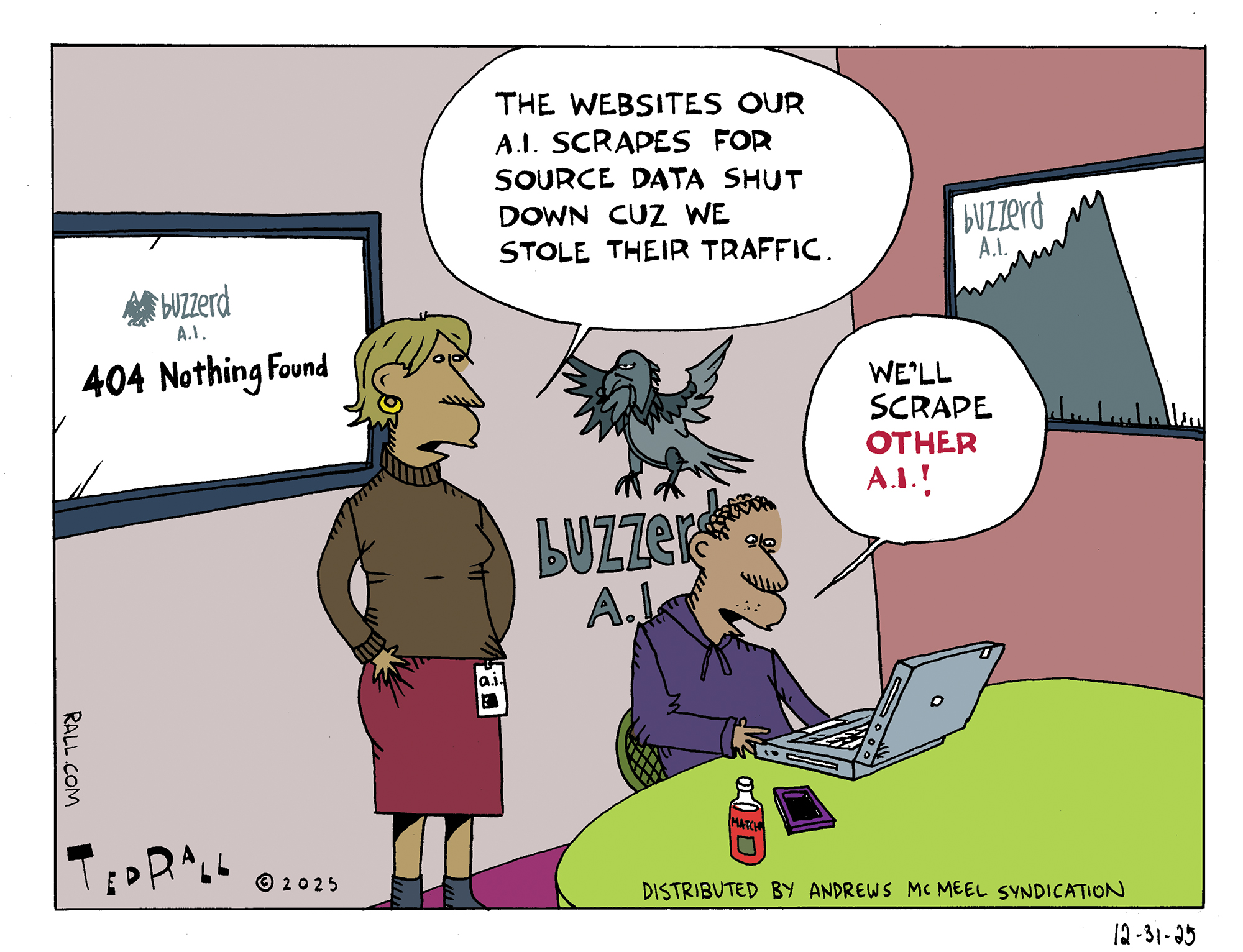
Ted Rall: Scraping the Bottom

Ted Rall discusses how AI is Scraping the Bottom

In the same way that companies like Facebook’s habit of scraping news from news websites helped drive traditional news organizations out of business, leaving Facebook with little original news to send out to its users, A.I. models are scraping websites for content, which will deny them the traffic they need to survive. Then, what will A.I. do?

Emphasis Mine

We have a fundamental contradiction over the digital commons. Content is generated by people who need money to survive in a Capitalist society. But AI needs vast amounts of freely available content to train itself in order to move up the value chain. If the AI is capturing all of the revenue, then none goes to the content creator. Eventually, this revenue starvation will cut off the very content the AI needs to survive and thrive.

Solutions include:

  • Revenue sharing in which the AI pays a percentage of their income to the content creators. However, not all content creators can be identified or want to be identified.
  • Universal Basic Income in which the basic needs of the content creators are taken care of by the state. In this case, revenue sharing is indirectly done through taxation of AI companies.

Unfortunately, both of these solutions leave out companies. These could be replaced by worker cooperatives in order to leverage the sharing of knowledge and skills found in companies.

Buzzerd A.I. staff are complaining that the websites their AI scrapes for source data have shut down because they have stolen all of their traffic. The proposed solution is to scrape other AI.


Read more!

2023/09/07

Seth Godin: The Big-O conundrum

Seth Godin discusses The Big-O conundrum

There are Big-O problems in marketing, in sales, in customer service, in finance, in production and in compliance. There’s nothing wrong with winging it–until there is.

Emphasis Mine

The main difference between Anarchists and Leninists is the amount of centralism that is needed for a Communist society to operate. The problem is that a Communist society needs an advanced industrial base to suceed. That base was built by Capitalism.

A Capitalist system operates as an aristocracy of managers for large organisations, and as a monarchy for smaller organisations. As organisations grow, they have to migrate from a monarchy into an aristocracy. The primary driver for this transition is the span of control that a person is capable of managing effectively. One could view an aristocracy as a confederation of local lords—in other words, feudalism.

The Capitalist state oversees the Capitalist organisations through a bureaucracy. The state has the necessary force to ensure compliance. In reality, the state is a battleground among Capitalists to advance their own interests. The state is not a neutral actor in a Capitalist society.

Anarchists believe that a loose confederation of communities can function for an advanced industrial civilisation. Maybe the samller organisations could transition to direct worker democracy without much problems as the workers are all known to each other, and have been exposed to the overall operation of the business. This model will fail for larger organisations as specialist functions need to be coordinated.

The Leninist model of Democratic Centralism is the best model for a post-Capitalist society in managing the large organisations. Instead of decomposing the large organisations into a confederation of direct worker democracies, the structure and efficiencies of the large organisations need to be preserved but brought under worker control through an executive committee that answers to the workers on a regular basis.


Read more!

2023/09/05

Daniel Little: A horrendous massacre in Tamil Nadu, 1968

Daniel Little discusses A horrendous massacre in Tamil Nadu, 1968

This event illustrates the workings of oppression involving both caste and class. The landless workers were predominantly dalit — the lowest caste. And they were the poorest of the poor, with very little power to assert a fair share of the harvest. Land owners were in a position to resist increases in wages (the primary demand of the workers in this dispute), both through their structural advantage within the property system (land ownership) and their coercive power (through their ability to call upon armed thugs to carry out their violence against the dalit protests). A solution for the property disadvantage for the dalit workers is land reform, and during the years following the Keezhvenmani massacre there was a reasonably strong organization dedicated to land reform and dalit land ownership, the Land for Tillers Freedom (LAFTI). However, land reform based on NGO activism is likely to remain small-scale, in comparison to state-wide land reform programs.

Kanagasabai quotes V Geetha and Kalpana Karunakaran in the introduction to Mythily Sivaraman's Haunted by Fire (2013):

That episode and visit brought home to Mythily the starkness of life in this grain rich part of Tamil Nadu… She realised that the price for dignity, for daring to declare oneself a communist was very high in these parts – many had paid with their lives… Unsurprisingly, in her subsequent reflections, she refused to concede that the monstrous incident at Kilvenmani was only a wage dispute gone wrong, and argued passionately for it to be recognised for what it was: class struggle in the countryside. (Geetha & Karunakaran, 2013)

Class struggle in the countryside, indeed — landlords exercising horrendous violence against landless workers.

Emphasis Mine

Without the control of the means of production (in this case, land), workers are unable to defend themselves against the violence of others. The state only defends the interests of the ruling class (in this case, landlords). Little cites examples of the courts and police siding with the landlords against the farm workers.

Little acknowleges that this is an example of class war with the resolution lying in the control of the means of production by the workers.

Photograph of Indian Express front page reporting on 42 burnt alive in Thanjavur village. To the left is a movie poster for the movie, 'Ausaran'.


Read more!

2019/07/28

Chris Dillow: The Technology Trap: a review

Chris Dillow writes about The Technology Trap: a review.

Instead, [Dillow] suspect[s] Diane Coyle is right to argue that Frey treats technical change as exogenous when in fact it isn’t. For example, the distinction between labour-replacing and labour-enabling technical change, whilst insightful, distracts us from another type – the sort that enables capitalist exploitation such as the power-biased technical change discussed by Skott and Guy. We should ask: if we have greater worker ownership, what sort of technical change would we see? Mightn’t it be more labour-enabling?

Emphasis Mine

Michael Lebowitz, in The Contradictions of "Real Socialism": The Conductor and the Conducted, writes

In 1975, David Granick argued that the right to a job in the Soviet Union involved far more than full employment at the macro level—it also functioned at the micro level. “It is considered impermissible, except in very rare circumstances,” he indicated, “to dismiss workers on any grounds other than those of gross incompetence or continued violation of factory discipline.” In short, “workers have had virtually complete job security. More than anything else, it is this feature which has given content in the mind of the ordinary worker to the slogan of a workers’ state.”

The “political unacceptability of dismissals” thus gave workers real security; they were “protected, not only against the reality of unemployment, but also against the need to change either occupation or place of work under the threat of unemployment.” This characteristic, which Granick called the “micro-economic full employment” constraint (but which he would later call “job rights”), meant that workers were “virtually immune from pressure to undergo job changes which they personally regard, for whatever reason, as reducing their individual welfare.”

Emphasis Mine

The Contradictions of "Real Socialism": The Conductor and the Conducted
Michael Lebowitz
Kindle Location: 929

To reconcile Dillow's and Lebowitz's points, I would see workers having advanced their conciousness from work as being a source of income to being contribution to society. Under Capitalism, an ordinary person needs to work in order to get money for sustenance. Under Communism, an ordinary person contributes to society through their work.

Would seeing work as contribution enable workers to embrace productivity improvements through technical change? I would hope so.


Read more!

2017/11/15

Dan Little: Capitalism's bad incentives

Chris Dillow writes about Capitalism's bad incentives.

Now, I’m not saying that these bad incentives will bring down capitalism or that they are all eliminable: there is a great deal of ruin in a nation. They do, however, raise an important possibility — that there is abundant room for a leftist government to consider alternative governance structures that reduce agency problems and produce better incentives. As John McDonnell notes, such structures might (pdf) well include more cooperatives, as these give control to workers who have both skin in the game and local knowledge of particular working practices.

Unfortunately, the Capitalists will see the development of worker cooperatives as a threat to their power as these cooperatives are a contending centre of power in the political and economic system. And their existence undermines the Capitalists' contention that there is no alternative.


Read more!

2017/11/10

Dan Little: Worker-owned enterprises as a social solution

Dan Little writes that Worker-owned enterprises as a social solution.

The central insight of Marx's diagnosis of capitalism is couched in terms of property and power. There is a logic to private ownership of the means of production that predictably leads to certain kinds of outcomes, dynamics that Marx outlined in Capital in fine detail: impersonalization of work relations, squeezing of wages and benefits, replacement of labor with machines, and — Marx's ultimate accusation — the creation of periodic crises. Marx anticipated crises of over-production and under-consumption; financial crises; and, if we layer in subsequent thinkers like Lenin, crises of war and imperialism.

The shorthand for this is alienation.

The logic is pretty clear. When an enterprise is owned by private individuals, their interest is in organizing the enterprise in such a way as to maximize private profits. This means choosing products that will find a large market at a favorable price, organizing the process efficiently, and reducing costs in inputs and labor. Further, the private owner has full authority to organize the labor process in ways that disempower workers. (Think Fordism versus the Volvo team-based production system.) This implies a downward pressure on wages and a preference for labor-saving technology, and it implies a more authoritarian workplace. So capitalist management implies stagnant wages, stagnant demand for labor, rising inequalities, and disagreeable conditions of work. 

When workers own the enterprise the incentives work differently. Workers have an interest in efficiency because their incomes are determined by the overall efficiency of the enterprise. Further, they have a wealth of practical and technical knowledge about production that promises to enhance effectiveness of the production process. Workers will deploy their resources and knowledge intelligently to bring products to the market. And they will organize the labor process in such a way that conforms to the ideal of humanly satisfying work.

Emphasis Mine

Who owns the means of production greatly affects how workers are treated.

Worker management has implications for automation in a different way as well. Private owners will select forms of automation based solely on their overall effect on private profits; whereas worker-owned firms will select a form of automation taking the value of a satisfying workplace into account. So we can expect that the pathway of technical change and automation would be different in worker-owned firms than in privately owned firms.

In short, the economic and institutional realities of worker-owned enterprises are not entirely clear. But the concept is promising enough, and there are enough successful real-world examples, to encourage progressive thinkers to reconsider this form of economic organization.

Emphasis Mine

Getting workers to voluntarially increase their productivity was a big problem user USSR Socialism. We need to understand this problem in greater detail.


Read more!

2015/09/29

Barry Ritholtz: Hurting the Rich Won't Help the Poor

Barry Ritholz writes that Hurting the Rich Won't Help the Poor.

The bottom line is simply this: There are enormous problems facing the nation, and as long as we keep electing the same people, and allowing the same influencers to fund their campaigns, there is unlikely to be any significant change from the status quo anytime soon. This paralysis seems to have made some billionaires very nervous. But the last thing we should do is delude ourselves into thinking that making the rich less rich does a lot for the poor in the absence of better government. 

Emphasis Mine

Socialism is not about taking wealth from the rich—it is about taking control of the generation of wealth away from the Capitalists and giving it to the workers.

Let those who sweat earn the wealth!

Ritholtz is correct in that the transfer of wealth solves nothing. He is wrong in that changing the complexion of the political system can fix things.

The State exists to protect the ruling class and their interests. The structure of the economy determines who comprises the ruling class. In a Capitalist economy, it is the Capitalists. In a Socialist economy, it is the workers.

However, transferring control directly to the workers will result in failure because the workers have not developed themselves sufficiently politically and ideologically. Workers have to work through Marxism to understand how Capitalism works, and they have to work through Leninism to understand how political change comes about.

And they have to review history to understand the mistakes of the past.


Read more!

2015/09/25

Paradoxes of control

Chris Dillow discusses three (3) Paradoxes of control.

Which brings me to a second paradox. Although voters want the government to expand its sphere of control, they don't want to expand their own control. There is pitifully little demand at the political level for greater worker control of firms.

I say this is a paradox because of a simple principle: control should be exercised by those who know the most and who have the most skin in the game. Many workers — those with job-specific human capital — have a lot to lose if their firm is badly managed and have the dispersed fragmentary knowledge to improve management. But the same isn't true for politicians: for example, George Osborne doesn't know better than the market or Low Pay Commission what is the right level for the minimum wage, and it's no great loss to him if he gets it wrong. We'd therefore expect to see more political demand for worker control than state control. But we don't. Which brings me to…

Paradox three. Although there's no political demand for worker control, many people vote for it with their own feet. Since current records began in 1984 the numbers of self-employed have risen by 67.5% to over 4.5m — an increase from 11.1% to 14.5% of all those in work.

Emphasis Mine

Politically, worker control is seen as Communism. And Communism is seen as evil in a Capitalist society. Thus, there is no political impetus.

Economically, worker control is seen as petite bourgeoisie which is acceptable in a Capitalist society. It is something that workers aspire to — being their own boss.

Therefore, we have a conflict between political and economic aspects of worker control. Politically, movement towards worker control is progression towards the removal of the Capitalists. Economically, acceptance of worker control is acceptance of the Capitalist mode of production with the owners merging into the Capitalist class.

Workers need to have a political sense of what is happening in order to preserve their identity as workers, and work towards of society without Capitalists.


Read more!

2015/08/28

Earthworker Cooperative buys first factory in Dandenong

Earthworker Cooperative buys first factory in Dandenong.

Earthworker Cooperative was formed to respond to the challenges of climate change and the need for local job creation, by establishing worker-owned cooperatives throughout Australia in sustainability-focused industries.

…

The first Eureka’s Future worker-owned factory has now been established through the mutualisation of the Everlast Hydro Systems factory in Dandenong in Melbourne’s south-east.B/p>

Emphasis Mine


Read more!

2015/07/25

Socialism, American-Style

Mark Thoma comments on Socialism, American-Style, by Gar Alperovitz and Thomas M. Hanna, Commentary, NY Times.

Moreover, contrary to conventional opinion, studies of the comparative efficiency of modern public enterprise show rough equivalency to private firms in many cases. …

With skepticism about capitalism growing among minorities and young voters, will we see more such endeavors in the future? Pendulums have a way of swinging, sometimes very sharply, when big economic tsunamis hit. It is possible that in the next big crisis, both sides might see the wisdom and practical benefits of public ownership, and embrace Joseph Schumpeter’s point even more boldly than they do today.

I think this would benefit from separating natural monopolies — where it is not surprising in the least that costs/prices are lower with public ownership (or strict regulation of prices if privately owned) — from the other examples. When *significant* market failures justify it, I fully support public ownership. But in most cases I'd prefer private sector ownership with regulatory oversight.

Emphasis Mine

The propaganda machine of Capitalism would never publicly admit the inherent deficiencies of markets. However, failures are sometimes too great to cover over as in the case of the GFC.

Public ownership and regulatory oversight are tacit admissions that economic forces should be subject to the popular will not to private whims. Yet, these are still far from the actuality of worker-controlled and directed enterprises under Communism.


Read more!

2015/05/09

The vision thing

Chris Dillow writes about The vision thing.

One thing makes me hopeful — that this election was not a victory for austerity. The two main austerity parties — Tories and LibDems — saw their share of the vote fall by 14.4 percentage points whilst the two clearest anti-austerity parties (SNP and Greens) gained a combined 5.9 percentage points.  

On the other hand, though, I'm pessimistic. Ukip's success* shows that there is also public support for anti-market policies: Ukippers (and indeed many other voters) favour (pdf) controls on prices and rents as well as on immigration. And whilst a slogan "we'll put you in control" should in theory be a popular and coherent way of promoting worker democracy, I see very little public demand for it.

Emphasis Mine

I think the difference between austerity in Greece and the UK is that austerity in Greece was an existental crisis. Austerity there was threatening the idea of Greece. Whereas in the UK, austerity was a way of keeping the super-rich happy enough to stay there in order to spend enough to keep some of the people happy.

It is probably very early in the development of the workers' consciousness in places like the UK to talk about worker democracy. However, the workers in places like Venezuela can see the benefit of this through the nearness of Cuba and the effects in their daily lives. Thus, they are developing their consciousness at a faster pace.

This is probably due to that the effects of colonialism was never disguised in Venezuela as it was in the UK. Only a heavy hand of the military there kept things under control. Now that the military has aligned with the workers, there is an awakening of how society can be better organized.


Read more!

2015/01/05

Who bears risk?

Chris Dillow writes Who bears risk?.

By contrast, many of City Link's drivers had to supply capital to the firm in the form of paying for uniforms and van livery, and are unsecured creditors who might not get back what they are owed. Many thus face a bigger loss as a share of their wealth than Mr Moulton. In this sense, it is workers rather than capitalists who are risk-takers.

This point is not, of course, specific to City Link. Most decent-sized businesses represent only a small fraction of a diversified portfolio for their capitalist owners, whereas suppliers of human capital usually have to put all their eggs into the basket of one firm; only a small minority of us have "portfolio careers" . All that stuff they teach you about the benefits of diversification applies in the real world to capital, not labour.

There are two implications of all this.

First, it means that the idea that capitalists are brave entrepreneurs who deserve big rewards for taking risk is just rubbish. As Olivier Fournout has shown, the idea of managers as heroes is an ideological construct which serves to legitimate power and rent-seeking.

Secondly, it suggests that ownership might in some cases lie in the wrong hands. Common sense tells us that those who have most skin in the game should have the biggest say simply because they have the biggest incentive to ensure that the firm succeeds. As Oliver Hart - who's hardly a raving lefty - says: "a party with an important investment or important human capital should have ownership rights." This is yet another case for worker ownership.

This in turn reminds us of a cost of inequality; sometimes, ownership is in the wrong hands simply because the most efficient owners can't afford to buy the firm.

Emphasis Mine

But Dillow is still arguing for the private ownership of the means of production. It is this that is the problem, no matter who owns the firm, because the focus is on profit, not on satisfying human need.

However, it is interesting for a Capitalist economist, like Dillow, to see the benefits of worker ownership, even under Capitalism. These benefits are greater productivity (and therefore greater profits), and more successful firms.

Under Communism, there is no need for the workers to purchase firms as these will be owned by the public. How this will be achieved is something that society needs to work out.

THe important difference is that the firm is held in trust from society, and is to be used for the benefit for the whole of society, instead of for the narrow interests of the private owners.


Read more!

2015/01/03

The Cuban Epic

Claudio Katz describes The Cuban epic .

Involving citizens in the direct handling of their future is the principal antidote to the dangers in the reforms. This can be achieved by supporting socialist democracy. The vitality of this system is an effective remedy to apathy. What happened in the USSR should serve as a counter example. Since the people considered themselves outside the political system they stayed on the margin of the changes that led to the restoration of capitalism.

Cuba has levels of real democracy superior to any capitalist plutocracy. Its leaders are not elected by an elite of bankers and industrialists, nor do they emerge from the cosmetic advertising constructed by the news media. They do not rule with terror against the population or the intimidation that dominates in some police regimes in Central America. But there are innumerable manifestations of insufficiency of democracy in Cuba’s political system and its media. The reforms are the opportunity to correct those deficiencies.

If the economic changes manage to combine appropriately the cooperatives, small property and state priority, the recovery of the economy will renew optimism. The productive and commercial transformations could result in visible improvements in the standard of living of the population. The big challenge is to speed up those advances with the market while at the same time preventing the restoration of capitalism.

The immediate key to avoiding that danger is to limit social inequality through maintaining public and universal education and health systems. The exemplary nature of the leadership, combined with this support, will help in finding the way through the new crossroads facing the country.

The Cuban people have demonstrated an extraordinary capacity to cope with the difficulties, regaining confidence in the revolution. It is a country that requires great caution when it comes to making forecasts. It was often said that it would not withstand the blockade, the invasions, the shortages or the isolation, and it always emerged with elegance. I am sure they will again win the war.

Emphasis Mine

It is interesting how a third-world country, such as Cuba, has survived such terrible hardships while achieving a better health-care system than the most advanced Capitalist state: USA. And they have a free education system through to university, while the Australian universities degrade themselves by becoming a major export-earner.

This resiliance and achievement comes about from an active socialist democracy. Although it is a one-party state, the debates are intense about how Cuba should face the future.

And the move away from centralised planning to more local control at the co-operative and factory level. It would appear that not all economic activity is amenable to socialist ideals, and that petty bourgeoisie should be harnassed.


Read more!

2014/12/11

For worker control

Chris Dillow argues For worker control.

Neal Lawson is absolutely right. Social democracy is "hopelessly prepared for the 21st century."

This is because it is yet another example of an idea that has outlived its usefulness. Social democrats used to think that they did not need to challenge the fundamental power structures of capitalism because, with a few good top-down economic and social policies, capitalism could be made to deliver increased benefits for workers and the poor in terms both of rising real wages and better public services.

Emphasis Mine

Dillow goes on to argue that the harsher economic climate means that reformism can no longer deliver for the workers. Working within the system will not garner benefits for workers. He goes onto to say:

Times have changed. So the left must change. Neal says:

Instead of pulling policy levers, the job is to create the platforms so that people can collectively change things for themselves.

There's one context in which this is especially necessary — the workplace.

Both Dillow and Lawson think that the Left only consists of Reformists. Revolutionaries have been removed from the political discourse.

Dillow lists three (3) reasons why worker control of the workplace directly benefits workers:

  1. Increased power for workers directly raises their well-being.…This points to a case for workers choosing their bosses, to increase the chances of them getting good ones.
  2. There's a good body of evidence to show that worker ownership and control can raise productivity.
  3. A feeling of control at work might have favourable cultural effects.…This could eventually improve the quality of our democracy generally.

But Dillow ignores the greatest obstacle to worker control—private ownership of the means of production. Until a substantial proportion of the economy is under the control of workers, it can be said that we have worker control. In other words, worker control can only start to exist under Socialism, and reach it mature form under Communism.

And Dillow ignores the political implications of worker control—the loss of power by the Capitalists. No ruling class has ever voluntarially relinquished power. Such contests are always violent.

Dillow concludes that:

My point here is a simple one. The days when the leftist politics could ignore the "hidden abode of production" because lightly modified capitalism would deliver the goods have gone. Our new times require new politics. The fact that the Labour party is ignoring the question (pdf) of how to empower workers is lousy politics as well as lousy economics

Emphasis Mine

Being left-wing used to mean that there was agreement about the economy benefiting people in general. Now, left-wing, in the authorised discourse, means making neoliberalism socially acceptable.


Read more!

2013/05/27

Workers of the world unite!

James Adonis suggests that it is time for the Workers of the world unite!

The democratisation of the workplace, I suspect, is the way of the future. And by ‘democratisation’ I’m not referring merely to equality among employees and leaders when making decisions. I’m referring to employees themselves being both the owners and the leaders of the organisation. It’s already happening.

Besides referring to the standard example of Mondragon Corporation in Spain, Adonis refers to C-Mac Industries (Aust) as an employee-owned business. The website, however, says that it is a family and staff owned Australian company.

Adonis contends that employee-owned businesses perform better:

Data sourced by Employee Ownership Australia, a non-profit association helping organisations make the transition, show that these businesses have a higher rate of survival than other forms of enterprise. Employees, meanwhile, are four times less likely to be retrenched during a downturn. They also earn more than their peers working elsewhere.

And Adonis has the cheek to suggest that:

Putting people before profits. Surely that’s a good thing, right?


Read more!

2013/04/18

Some Thoughts on Worker Control

Some thoughts on worker-control under Capitalism.


The examples cited in yesterday's post about how Occupy Sandy boosts worker-run coops amid rebuild are really sparse.

Except for Spain and Venezuela, the other examples are about workers who have been forced out of the Capitalist system by the closing of businesses, and they are filling a gap in the economy that the Capitalists are unwilling to fill.

My concern has been about the lack of political education that has occurred in these cases. The difference in Venezuela seems to be that the political ideological is driving the change to worker-control, instead of workers taking control because they have no other choice. There the education of the workers seems to be proceeding along with the take-over of businesses.


Read more!

2013/04/17

Occupy Sandy boosts worker-run coops amid rebuild

Peter Rugh writes that Occupy Sandy boosts worker-run coops amid rebuild.

Rugh gives a brief overview of worker-run co-ops around the world, especially in the coastal neighbourhood of Far Rockaway in New York City:

One of those bigger projects is a worker-run cooperative initiative, organised by Occupy Sandy and supported by the Working World, a group that specialises in incubating collectively owned businesses.

The initiative is well suited to Far Rockaway because worker-run enterprises have a history of flourishing in environments of economic distress or political upheaval.

In 2001, when Argentina defaulted on its international loans and the country’s ownership class fled, Argentines took over abandoned factories and established networks of producers and distributors.

In Venezuela, worker-run cooperatives were at the heart of the vision for 21st-century socialism, and Hugo Chavez’s administration helped create tens of thousands of collectively owned businesses over the last 14 years.

Most notably, Spanish workers in the Basque region created the Mondragon Corporation, the world’s largest federation of cooperatives, during the Franco dictatorship in the 1950s. Today more than 250 enterprises operate under the Mondragon banner. The federation, which spans 77 countries and employs 83,000 workers, has been widely praised.

As noted yesterday, Australia is beginning to see some progress in the adoption of worker co-ops.

Rugh argues that one important, immediate advantage of work co-ops is that:

Worker-run cooperatives, in contrast, could offer a way for community members to sell the products of their labor without selling their labor itself — a shift that would keep capital within the community and cash in the pockets of workers.

On the political development of workers' consciousness, Rugh writes that:

Richard Wolff, professor of economics at the New School and author of Democracy at Work, a study of cooperative businesses, argues that forming cooperatives can be the first step in enacting a sweeping social and economic shift.

Wolff envisions a transformation, similar to the social shift from feudalism to capitalism, in which cooperatives replace corporations and goods are distributed through a democratically planned economy.

The cooperatives that Wolff talks about, and the ones that Occupy Sandy is aiming to establish, are more accurately known as worker self-directed enterprises: businesses that organise democratically collective ownership at the point of production.

I would think that Wolff is naive to believe that the Capitalists are going to let the worker co-ops take over without a fight. As I noted in Argentine Factory Wins Legal Battle:

The main problem is that of dual power in Argentina. Some factories are controlled by the workers but they are relying on the Capitalist state for legitimacy through the parliamentry system. This deprives the workers' movement of a growth in consciousness in the hope of accomodation within the Capitalist system.

Unfortunately, one cannot accelerate the education of the workers about the Capitalist system, and the mythologies that are maintained about it. The workers will learn at their own pace.

Read more!

2013/04/16

Worker-owner sustainable industry one step closer

Susan Price writes that Worker-owner sustainable industry one step closer.

Price writes that:

After a successful crowd-funding campaign that raised the funds for a manufacturing licence, Earthworker Cooperative Australia and Eureka’s Future Workers Cooperative will install their first solar hot water unit in Melbourne on April 15.

Australia definitely lags behind the world with development of manufacturing co-operatives. Australia does have a history of co-operatives in agriculture (especially dairy farming, and sugar cane), and financial institutions (credit unions, and building societies).

It will be interesting to see how this co-operative develops in the future, and how the workers develop their consciousness about their place in the Capitalist system.


Read more!

2013/04/08

Mexico: Can worker-owners make a big factory run?

Jane Slaughter investigates Mexico: Can worker-owners make a big factory run?

Slaughter asks:

How does a workers' cooperative with 1050 members function? It’s hard enough for workers' ownership to succeed at any size, because any company that competes in a market is subject to the same cost-cutting rat race as a capitalist firm. Workers are impelled to hammer themselves and cut their own pay or be driven out of business. And most workers here have just a middle-school education.

Yet the TRADOC co-op translation: Democratic Workers of the West—is thriving. Enthusiastic worker-owners have modernised their plant, increasing productivity and quality through their skilled work. Those factors together with their admittedly low prices have made it possible for them to compete on the world market.

The workers have done away with foremen because they supervise themselves. The management of the plant is at three (3) levels:

  1. “TRADOC holds a general assembly only twice a year, but that assembly holds veto power over important decisions such as selling assets, making investments and buying machinery.”
  2. The day-to-day running is handled by an administrative council consisting of:
    • Cooper Tyre of Findlay Ohio has four (4) members;
    • TRADOC Co-op has three (3) members
  3. A general manager who is not a member of the co-op.

Despite what Slaughter portrays, TRADOC is not really a worker-owned factory. The co-op is a minority shareholder with a capitalist firm as the majority shareholder.

Slaughter concludes that:

But once the co-op started: it’s a pleasure to relate that workers really do run a factory better than the bosses. Not only do they control the plant floor, with no need for overseers, they come up with ideas to improve production in both senses: more and better tyres, less scrap — but also fewer backbreaking jobs.

This the same experience as the FASINPAT Zanon plant in Argentina as reported in Argentine Factory Wins Legal Battle. However, the Mexican experience has not exposed the workers to the same political battles as seen in Argentina.

The Argentine experience is more interesting politically because the workers expropriated the property of the Capitalists. They had to be more politically conscious to do this. They were assisted in their struggle with the Capitalists by the local government. So, a true workers' movement has not been born yet. But the workers can reflect upon this experience.

It would be interesting to see how Pope Francis I interprets this Argentine experiences in his teachings.


Read more!

2009/08/15

Argentine Factory Wins Legal Battle

Maria Trigona reports that the workers of an Argentine Factory Wins Legal Battle: FASINPAT Zanon Belongs to the People::

The workers at Argentina's occupied ceramics factory FASINPAT won a major victory this week, the factory now definitively belongs to the people in legal terms. The provincial legislature voted in favor of expropriating the ceramics factory and handing it over to the workers cooperative to manage legally and indefinitely. Since 2001, the workers at Zanon have fought for legal recognition of worker control at Latin America's largest ceramics factory which has created jobs, spearheaded community projects, supported social movements world-wide and shown the world that workers don't need bosses.

The main problem is that of dual power in Argentina. Some factories are controlled by the workers but they are relying on the Capitalist state for legitimacy through the parliamentry system. This deprives the workers' movement of a growth in consciousness in the hope of accomodation within the Capitalist system.

This reliance on the parliamentry system is perilous as shown by the case of the textile factory in Buenos Aires:

While the victory of FASINPAT brings hope to many of the 200 occupied factories currently operated under worker self-management in Argentina, many are still facing legal attacks. Early yesterday morning, just hours after the Zanon victory, a police operative evicted the factory Textil Quilmes, a thread factory occupied in the new wave of factory occupations in 2009. The four workers on night guard were evicted violently. The Buenos Aires provincial government is currently debating an expropriation bill for Textil Quilmes and several other new occupations in the Buenos Aires province. The textile workers are resisting the eviction at the factory's doors, rallying support to re-enter the factory despite police presence. They also had temporary legal protection, following an expropriation bill that was approved unanimously by the lower house in the provincial legislature.

The reactions of the ruling class has been mixed:

Zanon and others from the occupied factory movement have proven that they are capable of doing what bosses aren't interested in doing: creating jobs and work with dignity. This may be why government representatives, industry leaders and factory owners have remained silent and often times reacted with hostility on this issue; they are afraid of these sites multiplying and the example they have set.


Read more!