Showing posts with label Australian History. Show all posts

2023/12/11

Paul Gregoire: Labor votes down Lidia Thorpe’s bill to uphold First Nation’s rights in law

Paul Gregoire discusses Labor votes down Lidia Thorpe’s bill to uphold First Nation’s rights in law.

Senator Lidia Thorpe had introduced the United Nations Declaration on the Rights of Indigenous Peoples Bill 2022. This was defeated in the Senate 27-10 despite the essence of the bill being just requiring the PM to report to parliament how well the Australian government is complying with the UNDRIP.

“Australia is especially violent when compared amongst the other English-speaking settler colonies,” Mununjali Yugambeh and South Sea Islander Professor Chelsea Watego, author of Another Day in the Colony, told the UNDRIP roundtable.

“We are familiar with terra nullius. We were deemed so subhuman that we lacked any Indigenous political sovereignty. And while we had the Mabo decision, that idea that our Indigenous political sovereignty not be recognised still remains firmly intact, as we saw today.”

The “violence is enacted” against First Peoples via all Australian institutions, she said. The UNDRIP held an opportunity for a way forward, and the current “needs-based approach” taken to First Nations affairs restricts self-determination.

This rights-denying system, Watego said, results in local First Peoples remaining the most incarcerated people on the planet. “The evidence base is clear here: the state is insisting on perpetrating violence on Indigenous peoples.”

Emphasis Mine

We, white Australians, have to accept that we are beneficiaries of a racist system. We are not the primary beneficiaries as these are the Capitalists and Rentiers. However, we are enough of beneficiary to be complicit in this racist violence.

With the failure of the Voice to Parliament referendum, the momentum towards greater recognition of Indigeneous rights has slipped back. We have to educate ourselves about the truth of Australian history and support movements for Indigineous rights.


Read more!

2023/11/17

Michelle Berkon: Australia has a problem with truth-telling

Michelle Berkon discusses Australia has a problem with truth-telling.

In colonial settler projects the world over, language and law are the tools of white supremacism, glorifying the colonial entity, erasing Indigenous ownership of coveted land and property, and criminalising resistance.

The inscription on Governor Lachlan Macquarie’s statue in Hyde Park is a perfect example.

This man arrived on these shores with child slaves — two young boys purchased in India. He authored the Appin Massacre, the murder of 14 Dharawal and Gundungurra men, women and children.

He strung up on trees the corpses of two of these men, Cannabaygal and Dunnell; and had the skull of one sent to Scotland as a trophy.

This man is described as “a perfect gentleman, a Christian and supreme legislator of the human heart”.

Emphasis Mine

As we are witnessing the genocide in Palestine, the Western media is promoting the colonial-settler project in Israel by:

  • downplaying the atrocities committed by the IDF;
  • portraying Palestinian resistance as terrorism;
  • downplaying the confiscation of Palestinian land by Israeli settlers;
  • denying the existence of Palestine.

No wonder the ruling class wants to protect statues as the statues justify the current status quo of a white supremist culture.


Read more!

2023/10/30

Isaac Nellist: 'Killers of the Flower Moon': Murder, deceit and genocide

Isaac Nellist reviews 'Killers of the Flower Moon': Murder, deceit and genocide.

Oil was later discovered on Osage land, making them “the richest people per capita in the world” as they retained “headrights” (communal mineral rights).

However this also made them the target of exploitation as white Americans and the US government sought to take control of the valuable oil-rich lands through murder, manipulation and brutality.

…

Ernest and Mollie’s marriage is central to the film, beginning with a genuine chemistry and spark that is undermined by Ernest’s involvement in her family’s murders.

Ernest and his uncle want to ensure that Mollie’s family’s headrights go to her, and by extension Ernest, so they begin a horrifying plot to murder Mollie’s sisters, their partners and anyone else who threatens their claim to the wealth.

Mollie, her sisters and the other Osage women are well aware that the white men around them are pursuing their wealth. Mollie reads Ernest almost immediately: “Coyote wants money,” she tells her sisters with a smirk.

Emphasis Mine

What struck me about this movie is the line, "It is easier to convict a white man of kicking a dog than for murdering an Indian." This line illustrates the structural racism built into any criminal justice system for a settler colonial state, such as USA, Canada, Australia, and Israel.

The sobering truth is that events portrayed in this film are not confined to the past. The murder of First Nations women continue today as documented in The Highway of Tears in British Columbia, Canada, and here, in Australia, a TV report, "How Many More?", says:

Four Corners can reveal at least 315 First Nations women have either gone missing or been murdered or killed in suspicious circumstances since 2000.

But this is an incomplete picture. We will likely never know the true scale of how many First Nations women have been lost over the decades.

This is because there is no agency in Australia keeping count, and there is no standard way of collecting this important data in each state and territory.

Canada calls it a genocide. The United States considers it an epidemic. But here in Australia, we’re only just waking up to the scale of the crisis.

Emphasis Mine

The reluctance to investigate the murder of First Nations women as depicted in the film continues to this day. The Four Corners report continues:

There is an alarming pattern of what’s known as “under-policing” of Indigenous women who end up dead, says Noongar academic Hannah McGlade, a member of the United Nations permanent forum on Indigenous issues.

Research published by the British Journal of Criminology this month [2022] shows that almost 75 per cent of First Nations women who were killed “experienced police reluctance and inaction following domestic violence”.

Emphasis Mine

References

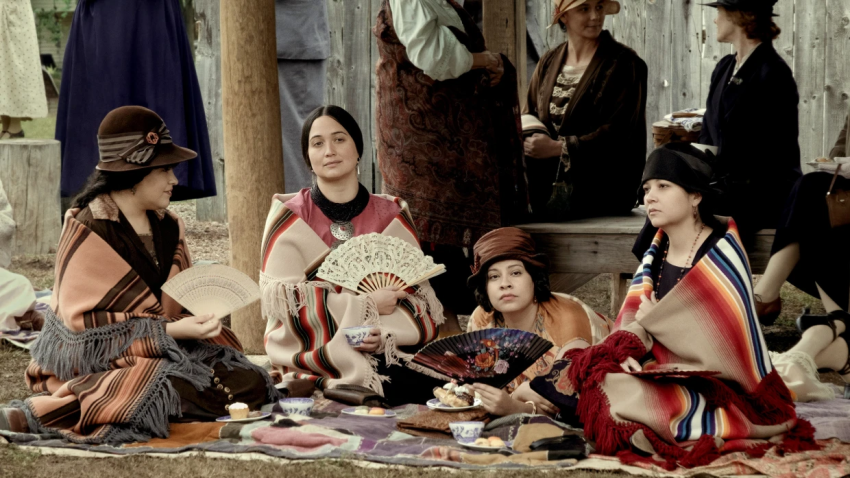
Still from the film, Killers of the Flower Moon, showing Mollie sitting with her sisters on a large blanket on the ground. All of them are holding fans.


Read more!

2023/10/14

Juan Cole: Israel’s Colonial Revenge Genocide in Gaza is only the latest in a Long History of such Massacres

Juan Cole discusses Israel’s Colonial Revenge Genocide in Gaza is only the latest in a Long History of such Massacres

Such vendettas against civilian populations have been routinely pursued by colonial militaries in the wake of a forceful challenge to their control. We must be clear-eyed and recognize that such revolts have sometimes been characterized by the deployment of the most horrific terrorism against the settler population by the indigenous resistance. The main characteristic of the phenomenon, however, is the disproportionate response by the settlers and their colonial military, so that the number of indigenous people killed is orders of magnitude higher than the casualties among the settlers. Another frequent trope is the patriarchal justification of subsequent massacres by pointing to settler women and children killed. This rhetoric drove London’s repression of the first Indian Great Rebellion against British rule in 1857-1858.

Emphasis Mine

As Cole points out, this disproportionate response is a feature of a settler-colonial society. One example from List of massacres of Indigenous Australians is:

March 1797. After Aboriginal Australians killed two British settlers, a large punitive expedition was organised which surprised and dispersed a native camp of about 100 people, killing an unknown number. The armed group then returned to Parramatta to rest. Pemulwuy, a noted Aboriginal resistance leader of the early frontier, followed them into the town, demanding vengeance for the dispersal. A skirmish (known as the Battle of Parramatta) then occurred between Pemulwuy's group and a collection of British soldiers and settlers. One of the settlers was injured, but at least five Aboriginal Australians were shot dead with many more wounded, including Pemulwuy.

Emphasis in Original

This example does not explain why the two (2) settlers were killed as part of Battle of Parramatta. This is the standard history of a settler-colonial society in which all atrocities start with the actions of the colonised, never in the context in which the actions occurred. One is left with the impression that the colonised are just blood-thirsty barbarism who act without reason. Consequently, the settlers believe that they are left with no other option than genocide. For to admit a rational basis for the actions of the colonised is to undermine the settler-colonial project.

In his book, "The Battle of Parramatta: 21 to 22 March 1797", Jonathan Lim argues the settlers killed were a soldier and his common-law wife (pp.20-21). These murders occurred during raids by Aboriginals to destroy the economic basis for settler encroachment on Aboriginal lands by destroying the grains just before harvest (p.17). These raids have been going for a couple of years. The increasing levels of reprisals by settlers, and the presence of a military garrison on the frontier points to the success of economic warfare.

Street view of Palestinian families walking and in cars mving towards the viewer overlaid with the caption, Israel-Palestine: Palestinians flee after warning


Read more!

2020/06/18

Jim McIlroy: Slavery endemic to Australia’s colonial history

Jim McIlroy writes that Slavery endemic to Australia’s colonial history.

Slavery, as a system of forced labour, dates back to antiquity. Slavery, Australia-style, includes the original convict system, First Nations people being forced to labour on pastoral stations, the Blackbirding of South Sea Islanders and the Stolen Wages program in Queensland and other states.

While wage theft is the capitalist system’s standard business model and the colonisers generally accepted slavery, it nevertheless sat uneasily on their conscience. This is why the ideology of “scientific” racism, the belief that one skin colour was superior to another, allowed First Nations people to be enslaved for so long. It also underpins the right’s culture wars, currently taking a hammering with the rise of the Black Lives Matter-Stop Deaths in Custody movements.

Emphasis Mine

Racism is the ideological justification for slavery. It is not the economic or political justification. The economic justification is the maximum possible extraction of labour value from workers. The political justification was to create a collaborator class of poor whites to uphold the system of slavery.


Read more!

2019/07/12

IPA and Race Provisions in Constitution

In Pauline Hanson unleashes on airlines over mid-flight Welcome to Country speeches, the IPA is quoted in such a way to give the impression that it is ignorant of the Australian Constitution.

The right-wing think tank the Institute for Public Affairs said any Indigenous voice to parliament was “a divisive ideology based on race” and that “race has no place in the Australian Constitution”.

Emphasis Mine

This quote would lead the reader to believe that the IPA is ignorant of the race-based provsions in the Australian Constitution. This is not so as the full IPA news release shows:

“Reports that Prime Minister Scott Morrison would veto a divisive indigenous-only ‘voice to parliament’ represents a win for the principle that all Australians are equal,” said Daniel Wild, Director of Research at the free market think tank the Institute of Public Affairs.

“This position affirms the democratic values on which Australia was founded. The Australian Constitution should treat all Australian citizens as individuals, with equal rights and equal responsibilities.”

“This represents a repudiation of a divisive ideology based on race. Race has no place in the Australian Constitution.”

“If the government chooses to pursue any changes to the constitution it should remove the provisions that currently refer to race — section 25, and section 51 (xxvi),” said Mr Wild.

Emphasis Mine

The quoted sections are:

25 Provision as to races disqualified from voting

For the purposes of the last section, if by the law of any State all persons of any race are disqualified from voting at elections for the more numerous House of the Parliament of the State, then, in reckoning the number of the people of the State or of the Commonwealth, persons of that race resident in that State shall not be counted.

…

51 Legislative powers of the Parliament

The Parliament shall, subject to this Constitution, have power to make laws for the peace, order, and good government of the Commonwealth with respect to:

…

(xxvi) the people of any race, other than the aboriginal race in any State, for whom it is deemed necessary to make special laws;

There is a contradiction in the IPA statement—Australia was founded as a racist state. This is shown by the two (2) parts of the constitution.

The repeal of section 51 (xxvi) would imperil all or part of the Racial Discrimination Act 1975 because that act relies on that section among others for its authority:

AND WHEREAS it is desirable, in pursuance of all relevant powers of the Parliament, including, but not limited to, its power to make laws with respect to external affairs, with respect to the people of any race for whom it is deemed necessary to make special laws and with respect to immigration, to make the provisions contained in this Act for the prohibition of racial discrimination and certain other forms of discrimination and, in particular, to make provision for giving effect to the Convention:

Emphasis Mine

Section 51 (xxvi) is problematic as it can be either used to persecute a race or to redress past wrongs done to a race. The section's very nature is discriminatory, but that should not be used to remove the section from the constitution.

A recent example was the Northern Territory National Emergency Response Act 2007 which was directed at aboriginal people in the Northern Territory.


Read more!

2015/10/19

Noah Smith: Racial bias in police killings

Noah Smith has a hypothesis about Racial bias in police killings.

Let me offer an explanation I see as more likely: Cops often tend to shoot (or otherwise brutalize) people not out of fear, but out of wrath.

My hypothesis goes like this. Cops pull out their guns and their nightsticks when they see suspects as having challenged their authority. They are determined to maintain power and control at all costs (i.e., South Park nailed it). Black people are more commonly seen as challenging cops' authority, probably because a lot of black people grew up in a state of relative anarchy and therefore lack other people's conditioned response of instant meek submission to police.

This seems to be exactly what happened with Eric Garner. He wasn't threatening at all; he's obviously a big teddy bear, he doesn't have any weapon, and he wasn't making any move to attack anyone. But he's an insubordinate teddy bear, who thinks he can reason his way out of an unfair arrest. So the cops grab him and choke him to death.

It also explains why so many suspects get shot in the back. For example, Walter Scott. A man who's running away is not a threat. He is not a source of fear. He is, however, flouting authority. Same with Samuel Dubose. Type "police shoot black man" in Google, and "police shoot black man in the back" is one of the first results that come up.

Here the police shoot a black guy in a wheelchair.

This psychologically plausible hypothesis is also parsimonious, because it allows police racism to explain both racial profiling and excess unjustified brutalization of black people. It also implies that in areas with entrenched racial conflict—say, the South—white police will be more likely to kill black people, because they view blacks as socially subordinate (hence any backtalk or resistance will be seen as more unacceptable if it comes from a black person than if it comes from a white person). So that would be an interesting test.

Emphasis Mine

In Australia, the legacy of the frontier wars is an element in the resistance by Aborigines and the brutal oppression they suffer.

As is happening in Israel now, racial oppression engenders resistance, both non-violent and violent. Both forms are treated the same way because they challenge the authority of the state.

Remember that the state exists to oppress the non-ruling classes—whether they are slaves, serfs, or workers. This is why the Capitalist state can never be captured; it can only be destroyed.


Read more!

2015/08/15

Adam Goodes case reveals bad case of historical amnesia

Nisha Thapliyal writes that the Adam Goodes case reveals bad case of historical amnesia.

In short, booing Goodes becomes possible when we separate the football player from his family, community, culture and history. What this debate underlines is a form of historical amnesia that marks societies where nation-building has occurred on the foundations of colonisation, exploitation and outright destruction of indigenous peoples.

It strikes me that part of what is revealed by the Goodes saga is a fierce and enduring struggle over remembering and forgetting. In this debate about sportsmanship and invisible spears, whose histories are being remembered and whose are we distancing ourselves from? Whose histories are we avoiding taking responsibility for?

The subtext in the Goodes debate is about acknowledging or denying Aboriginal accounts of what it means to be Australian today — and what it has meant since 1770. If we recognise this, then, to paraphrase historian Chris Healey, Goodes’ actions are simply and steadfastly a refusal to allow himself and his people to be “erased” yet again from Australian history and contemporary culture.

Emphasis Mine

Remembering is resistance.

Remembering that we are humans first, Australians second, challenges the Capitalist dogma that we live under.

Remembering that we are workers united in toil is the basis of a new society.


Read more!

2015/04/09

Warriors of Aboriginal Resistance burns butcher's apron in defiance of racist 'Reclaim Australia' rally

Warriors of Aboriginal Resistance burns butcher's apron in defiance of racist 'Reclaim Australia' rally.

In more recent times, this flag also represents the malicious and racist treatment of ethnic minorities. The flag represents a white nation, a nation built by white people for white people.

Members of WAR didn't just burn the Australian flag, we set fire to an expression of Australian racism in an act of anti-colonial resistance. Burning the Australian flag is an act of defiance against the colonial state, a symbolic gesture of our continual fight for freedom and a message that is hoped to reverberate outside of the monopolised media within this country.

Our ultimate goal is to end the colonial control of our lands and lives and to restore our tribal sovereignty. We want freedom and independence and we will continue to fight to rid our people and our communities of the interfering and oppressive hands of the colonial Australian state. We call on Australian government to cease violent domination of Aboriginal lives and immediately stop all destruction of Aboriginal land and culture across this continent.

Emphasis Mine

Other symbols of Australian nationalism, such as the Southern Cross and the Eureka Stockade, are also symbols of colonial oppression and racism. The miners at the Eureka Stockade raised the Southern Cross flag and went on a pogrom against the Chinese miners and merchants in a nearby settlement.

Even in the resistance to state oppression, the oppressed found time to oppress others.


Read more!

2015/02/18

Walking Back the American Twenty-First Century?

Tom Engelhardt wonders if the USA is Walking Back the American Twenty-First Century?.

Since 2013, the Pentagon has transferred for free more than 600 mine-resistant ambush-protected vehicles, or MRAPs, worth at least half a million dollars each and previously used in U.S. war zones, to various “qualified law enforcement agencies.” Police departments in rural areas like Walsh County, North Dakota (pop. 11,000) now have their own MRAPs, as does the campus police department at Ohio State University.  It hardly matters that these monster vehicles have few uses in a country where neither ambushes nor roadside bombs are a part of everyday life.

Post-Ferguson, a few scattered departments have actually moved to turn these useless vehicles back in.  It's clear, however, that police forces “kitted out with Marine-issue camouflage and military-grade body armor, toting short-barreled assault rifles, and rolling around in armored vehicles” — that is, almost indistinguishable from soldiers — are now the future of American policing and there’s no walking that back.  Since Ferguson, President Obama has essentially refused to do so and Congress certainly won’t.  Despite a small uproar over the pile of military equipment being transferred to the police, there is no indication that the flow will be stanched.

When it comes to all this militarized equipment, as the president has emphasized (and the task force he appointed to look into these matters will undoubtedly reemphasize), “reform” is mainly going to be focused on “better training” in how to use it.  In other words, reform will prove to be a code word for further militarization.  And don’t count on anyone returning those 94,000 machine guns either in a country that seems to be in some kind of domesticarms race and in which toddlers now regularly find their parents’ loaded guns and wound or kill them.

Emphasis Mine

Back in 2005, I made an observation in 4GW and Police Work, that:

I have come to the conclusion that Fourth Generation Warfare (4GW) is simply police work. Third Generation Warfare (3GW) aimed to convince people who owned assets to obey your orders. 4GW aims to do the same with people who have no assets. In other words, normal everyday police work.

Maybe the police are worried about what nearly happened on Palm Island back in November 2005.

So Lex was organising a protest against the inadequate Coroner's report. There was anger at the blatant lies and cover-up of violence against Aborigines.

As the protest got out of control with the Police station and Sergeant's residence being burnt down, the police were barricaded inside their barracks, the green zone of Palm Island. They thought they were about to be massacred by the islanders. At point, a truce is negotiated (p.68):

But Lex Wotton, who had been trying to jemmy open the gate's padlock, now ordered the crowd to stop throwing rocks. They did so. 'You've won! You've won! [Senior Sergeant Roger] Whyte called. He negotiated for sixty minutes' grace, sixty minutes to get off the island. The Torres Strait Islander cop, Bert Tabaui, heard Wotton yell, 'We'll give you an hour to get off the island, then we'll kill you!'

The police managed to retreat to the hospital (p.69)

Lex faced the police. He was still angry, but the anger was now controlled. 'Time's up! he called to the cops. 'All I wanted was for you to get off the island!'

Emphasis Mine

However, the women objected to this demand. They wanted police protection against the men. (p.69) The police said they could not leave because [t]hey had no transportation Lex arranged for two cars to made available for their escape, but the police were fearful of an ambush on the way to the airport. (p.70)

The confrontation ends with the timely arrival of the airborne (p.71):

The thunder of helicopters filled the smoke-clouded sky. Extra police had now arrived and still more were coming. Inspector Richardson came outside and told Lex. 'We are not leaving this island. We are the police. You are the ones causing the problem...we are not going anywhere! No way in Australia!'

Lex Wotton froze. He turned around and faced the crowd. The revolution had failed. His idea that the police would leave the island had been biblical in ambition and naivete, a declaration of war that he had no chance of winning. His actions would draw national attention to Cameron Doomadgee's death, but at that moment he knew he would soon be the one inside a jail cell.

'The party's over,' he called, 'we'll all go home!' Then he turned around to the police. 'You can come around later and pick me up.'

Emphasis Mine

The occupier is not easily dislodged from his conquests. No dissent is allowed.

However, in case, the resolve of the occupier is weakened by the crackdown and the relative leniency of Lex's sentence. Future oppression is assured but it could be one foot on the throat too many.

Chloe Hooper: The Tall Man (3)
Page references are to The Tall Man by Chloe Hooper


Read more!

2015/01/31

Rally mourns invasion, calls to change the date

Shaine Stephen writes that Rally mourns invasion, calls to change the date.

Several hundred Aboriginal community members and their supporters gathered on Hobart parliament house lawns to mark Invasion Day on January 26. There was a one minute silence observed whilst a wreath was slowly walked down two rows of those who gathered and placed on the steps to parliament house.

People were welcomed to country and reminded that the Aboriginal people do not recognise today as Australia Day, that they do not celebrate this day, and that their land was stolen, that they will never give up and will never go away.

Aboriginal leader Michael Mansell spoke about how Australia is the only country that celebrates a day when a country was invaded. He asked how immigrants can feel part of a nation when the day marks the coming of one race displacing another — it is not a basis for unity, it is a basis for division. He said the day is "race based and based on a white Australia policy".

Emphasis Mine

A settler society, such as Australia, cannot readily let go of the myth that the indigenous people do not matter. The logic of settlement cannot admit to the rights of the original inhabitants, nor to the crimes that were committed during the invasion.

Yet, other settler societies, such as Canada, have recognised the original inhabitants in treaty and in law. Will Australia have the same maturity as Canada to do the same?


Read more!

2014/12/28

The bloody history of Australia's race riots

Peter FitzSimons writes The bloody history of Australia's race riots.

In Sydney, the phrase "race riots" conjures up the disgraceful images of Cronulla Beach in 2005, and many have the mistaken impression that our history of such riots starts and finishes there, apart from the odd flare-up. But the truth of it — and it is the foundation stone on which the whole series rests — is that Cronulla was not an aberration, but simply the latest in a long series of race riots we have had.

…

Throughout, we Australians have shot at each other, thrown stones and insults, knifed and clubbed each other, thrown Molotov cocktails, demonised particular races and religions, and even sworn to wipe certain among us from the face of the earth.

But here is the strange and wonderful thing. After each riot, there has been an extraordinarily uniform response. That is, the broad mass of people reel in horror, get their bearings, and then use the ugliness of the riot as a clear sign of the direction we should not be heading henceforth.

Emphasis Mine

Yet, Muslim women are still harrassed for the way they dress. It is the families of Muslims that are being raided by the anti-terrorist police. It is the non-white refugees that are still being locked up in detention centres, having their boats turned around, dumped on remote islands, or left to drown at sea. It is Aborigines who are demonised and deprived of dignity and neccessities of life.

FitzSimons is part of the same ideological superstructure that they tried to convince the US that racism was dead because Barak Obama was elected president. How many more Fergusons are people going to tolerate before they wake up?

Racism is essential is the survival of Capitalism. As Malcom X said, "You cannot have Capitalism without Racism."


Read more!

2014/11/25

Reynolds punctures the 'great Australian silence'

John Rainford argues that Reynolds punctures the 'great Australian silence'.

Reynolds is one of a pioneering group of historians, anthropologists and others who have transformed our understandings of traditional Aboriginal society and the relationship between Indigenous and settler Australians.

In his latest book, he provides evidence that supports his contention that it was the war of conquest fought against Aboriginal people that made the nation, not the 1915 ill-fated invasion of Turkey.

Conflict came within weeks of the foundation of Sydney and was apparent on every frontier for the next 140 years.

Yet while the large-scale killing of Warlpiri people by police at Coniston in Central Australia in 1928 can be used as a convenient date to mark the end of officially endorsed killing, the brutality has never ended.

This is the brutal reality of a settler society such as Australia, USA, or Israel. The indigenous population is subjected through genocide and their land is expropriated by the settler elite. Yet all settlers bears the guilt of this atrocity because we have benefited from the crime.

It is at an unconscious level that most white Australians condone this ongoing violence against Aborigines. They do not have to do themselves, just merely accept the system that does it for their benefit.

We cannot be truly free of the guilt of the past until we overthrow this racist system and reform ourselves so that we become human beings rather than black-fellow and white-fellow.


Read more!

2014/11/05

Australia: How and why the Gough Whitlam government's far-reaching reforms were won

Jim McIlroy opines about Australia: How and why the Gough Whitlam government's far-reaching reforms were won.

These reforms were the reactions to the radicalisation of the masses:

However, it is important to emphasise that the Whitlam victory occurred on the crest of a wave of popular mass struggles — most centrally the anti-Vietnam War moratoriums — and the rise of a new youth radicalisation that began on the university campuses and spread to broad layers of society from the 1960s to the early 1970s.

This upsurge also involved the new wave of women's liberation, the growing Aboriginal rights movement, the start of gay liberation and the modern environment movements. The youth revolt also challenged traditional authority roles in the family, education, morality, culture and politics.

…

In Australia, the anti-war movement grew from a small minority to a mass movement expressed in the Moratoriums of 1970 and 1971. General anti-war sentiment gradually increased to become a large majority by the time of the 1972 election.

It was in this tumultuous social context that the Whitlam Labor government came to power, carried on a huge wave of popular demand for real change.

As Capitalism has shown time and time again, it can co-opt these movements into the mainstream where they can be safely defused. Radicals are turned into reformist then into bureaucrats. From the barricades to the warrens of the bureaucracy. This has happened with the environmental, feminist, and Aboriginal radicals. They now fill in forms to get funding to keep going on. Thus, the slow grinding down of youthful vigour into middle-age malaise begins.

McIlroy writes that there are three (3) important lessons from the Whitlam Era:

First, that progressive change is possible — if we could afford free education in 1974, for instance, we surely can now.

Second, that the corporate elite will not accept any challenge to its interests, however mild. It will violate democracy to protect its interests.

And third, that the Labor Party is not an appropriate vehicle to achieve social change. Faced with a challenge to its mild reformist agenda in the mid-70s, Labor capitulated.

The problem with the ALP since its very beginnings was that it was not a party of the working-man but of a would-be petite burgeoisie. Their dream was not of an international working class, but of owning their own little business.

McIlroy concludes that:

We should remember the progressive gains from Whitlam's government, but remember they were not handed down but won by the struggles of ordinary people. And we can win them again — and more — in the future.

We now need to accelerate the vital task of building an alternative political movement to eventually challenge the status quo of big business rule, and to struggle for a socialist society.


Read more!

2013/05/07

Suffering of Aboriginal people continues

John Pilger says that the Suffering of Aboriginal people continues.

In Western Australia, the brutal past of Rottnest Island is hidden away from the tourists who visit it.

What was done was the torture, humiliation and murder of the First Australians. Wrenched from their communities in an insidious genocide that divided and emasculated the indigenous nations, shackled men and boys as young as eight endured the perilous nine-hour journey in an open longboat. Cold, sick and terrified prisoners were jammed into a windowless "holding cell", like an oversized kennel.

Today, an historical plaque refers to it as The Boathouse. The suppression is breathtaking.

This suppression continues today:

During the boom, Aboriginal incarceration has more than doubled. Interned in often rat-infested cells, almost 60 per cent of the state's young prisoners are Aboriginal — out of 2.5 per cent of the population. While their mothers hold vigils outside, aboriginal children are held in solitary confinement in an adult jail.

A former prisons minister, Margaret Quirk, told me the state was now "racking and stacking" black Australians. Their rate of incarceration is five times that of apartheid South Africa.

The Aboriginal stereotype is violent, yet the violence routinely meted out to black Australians by authority is of little interest. Deaths in custody are common. An elder known as Mr. Ward was arrested for driving under the influence on a bush road. In searing heat, he was driven more than 300 miles in the iron pod of a prison van run by the British security company GSL. Inside the mobile cell the temperature reached 50 degrees centigrade. Mr. Ward cooked to death, his stomach burned raw where he had collapsed on the van's scorching floor.

Yet Australians condemn Indonesia for its treatment of prisoners (only if they are young, white women).

And people wonder why Australia is violent and racist because that is what the governments practice daily against the Aborigines. State violence becomes normal behaviour.


Read more!

2008/11/16

Still sings loudly

Jonathan Strauss reviews Gone for a Song: A Death in Custody on Palm Island by Chris Waters in Still sings loudly. The book is available at these Australian libraries.

Waters discusses the circumstances of Mulrunji’s death and the two coronial inquests into it. But he also expands from this to concise accounts of the record of race relations in Queensland, the history of Palm Island as a state concentration camp for Indigenous people resisting their oppression, and current social conditions on the island.


Read more!

2008/11/10

Chloe Hooper: The Tall Man (3)

In another chapter of the saga started in The Tall Man, Peter Robson & Paul Benedek write that:

Palm Island Aboriginal man Lex Wotton was sentenced to six years’ jail for “riot with destruction” on November 7 — just four days after 22 police officers received “bravery awards” for their role in the 2004 Palm Island protests.

This juxtaposition of sentencing a protestor and awarding the police is a political statement of the Queensland government about the occupation of Aboriginal lands.

Sam Watson says to Protest Lex Wotton's shameful conviction!

Testimony from Robinson and other Palm Island police alleged that Wotton was wielding weapons, smashing police station windows, and distributing tins of petrol.

Watson commented: “Wotton's barrister, Clive Steirn, accused Queensland police of ‘lying through their teeth’ to convict his client. He said that ‘not only was Lex Wotton never a part of any riotous assembly, he did his level best to stop the violence.”

Watson concluded: "A white police officer admits he caused an Aboriginal man's death, yet he walks free. A black man, who can't be connected to anything except that he was on Palm Island on the day, is fitted up for jail.

At the meeting called on 26 November 2005, Chloe Hooper writes (p,64), that after the mayor had read out the Coroner's saying that the death was an accident,:

'Come on, people!', Lex calls. 'Will you accept this as an accident? No! I tell you people, things are going to burn. We'll decide when. I'm not going to accept it and I know a lot of you other people won't. So let's do something!' Half of Lex's eloquence is in his body. Instead of decrepitude there is strength and muscle and presence. He is a fantasy of a figure before white contact.

Emphasis Mine. Italics in original.

So Lex was organising a protest against the inadequate Coroner's report. There was anger at the blatant lies and cover-up of violence against Aborigines.

As the protest got out of control with the Police station and Sergeant's residence being burnt down, the police were barricaded inside their barracks, the green zone of Palm Island. They thought they were about to be massacred by the islanders. At point, a truce is negotiated (p.68):

But Lex Wotton, who had been trying to jemmy open the gate's padlock, now ordered the crowd to stop throwing rocks. They did so. 'You've won! You've won! [Senior Sergeant Roger] Whyte called. He negotiated for sixty minutes' grace, sixty minutes to get off the island. The Torres Strait Islander cop, Bert Tabaui, heard Wotton yell, 'We'll give you an hour to get off the island, then we'll kill you!'

The police managed to retreat to the hospital (p.69)

Lex faced the police. He was still angry, but the anger was now controlled. 'Time's up! he called to the cops. 'All I wanted was for you to get off the island!'

Emphasis Mine

However, the women objected to this demand. They wanted police protection against the men. (p.69) The police said they could not leave because [t]hey had no transportation Lex arranged for two cars to made available for their escape, but the police were fearful of an ambush on the way to the airport. (p.70)

The confrontation ends with the timely arrival of the airborne (p.71):

The thunder of helicopters filled the smoke-clouded sky. Extra police had now arrived and still more were coming. Inspector Richardson came outside and told Lex. 'We are not leaving this island. We are the police. You are the ones causing the problem...we are not going anywhere! No way in Australia!'

Lex Wotton froze. He turned around and faced the crowd. The revolution had failed. His idea that the police would leave the island had been biblical in ambition and naivete, a declaration of war that he had no chance of winning. His actions would draw national attention to Cameron Doomadgee's death, but at that moment he knew he would soon be the one inside a jail cell.

'The prty's over,' he called, 'we'll all go home!' Then he turned around to the police. 'You can come around later and pick me up.'

Emphasis Mine

The occupier is not easily dislodged from his conquests. No dissent is allowed.

However, in case, the resolve of the occupier is weakened by the crackdown and the relative leniency of Lex's sentence. Future oppression is assured but it could be one foot on the throat too many.

Other posts in this series are at:


Read more!

2008/07/13

Chloe Hooper: The Tall Man (2)

I have finished reading Chloe Hooper's latest book, The Tall Man.

I had posted my reactions to a radio interview with Chloe Hooper: The Tall Man

Hooper leaves out one word from her story: occupation. The State of Queensland is engaged in an occupation of Aboriginal lands in North Queensland for the benefit of white settlers.

The Wild Time was the invasion of whites into this area, and the Stolen Generations was the ethnic cleansing undertaken to consolidate white control of the area's resources. Palm Island is part of the gulag of the occupation.

And in enforcing this occupation, Senior Sgt Chris Hurley became brutalised by the frontier justice. Even though he acknowledged his own racism and worked hard for Aboriginal betterment, he could not escape the racism of the State of Queensland. In putting on his uniform, he was putting on a history of genocide, racism, and brutality.

Hurley's struggle against institutional racism showed the limits of individual change. He had to choose between his soul and his uniform. Palm Island made that choice very stark.

Cameron Doomadgee's taunt of "Fucking cunts" and his punch to Hurley's face caused Hurley to explode into a rage that killed Doomadgee. Doomadgee saw a blue uniform. Hurley saw an insolent, ungrateful blackfellow. They could not see each other as human beings.

Hurley may have been coerced into pleading not guilty to the charge of manslaughter in order to protect the honour of the Queensland Police. Hooper seems to imply that Catholicism guides Hurley's career in the Police Service as a mixture of duty and using power for social justice. He could have been persauded to cover up to protect the progress being made by the reforms in the Police.

My reading of Hooper's story is that the cases when Hurley was brutal towards Aboriginals, he was either enforcing frontier justice or he was under stress in a dangerous situation. One case could even have been an accident when he backed over a woman's foot. The failure to acknowledge the incident or to apologise made the situation worse. These cases became easy to cover up and Hurley was drawn into this world of half-truths and denials.

The problem is not with the Police nor with the Government, it is with the white people of North Queensland. This was shown by the quick verdict of not guilty returned by the jury.

The wealth of North Queensland depends on the secure title of land there: mining, agriculture, tourism. Racism justifies the theft of land from the Aboriginals and the exploitation of those stolen resources. If the Police and Government did not support this racism, they would be replaced by those who would.

Hurley was wrong to attempt to change the racism of the Police from the inside. The economic forces that depend on racism are just too strong for individuals to overcome. And now he has to live with the blood of an innocent man on his hands. Hurley would have done better to plead guilty and accepted his punishment. Even better would have been to control his temper and not killed Doomadgee.


Read more!

2005/11/12

Remembering The Gulag

Washington Post columnist Anne Applebaum concluded Gulag: A History with:

Already, we are forgetting what mobilized us, what inspired us, what held the civilization of 'the West' together for so long [during the 'Cold War']: we are forgetting what it was that we were fighting against. If we do not try harder to remember the history of the other half of the European continent, the history of the other twentieth-century totalitarian regime, in the end it is we in the West who will not understand our past, we who will not know how our world came to be the way it is.

And not only our own particular past. For if we go on forgetting half of Europe's history, some of what we know about mankind itself will be distorted. Every one of the twentieth-century's mass tragedies was unique: the Gulag, the Holocaust, the Armenian massacre, the Nanking massacre, the Cultural Revolution, the Cambodian revolution, the Bosnian wars, among many others. Every one of these events had different historical, philosophical and cultural origins, every one arose in particular local circumstances which will never be repeated. Only our ability to debase and destroy and dehumanize our fellow men has been - and will be - repeated again and again our transformation of our neighbours into 'enemies', our reduction of our opponents to lice or vermin or poisonous weeds, our re-invention of our victims as lower, lesser or evil beings, worthy only of incarceration or expulsion or death.

The more we are able to understand how different societies have transformed their neighbours and fellow citizens from people into objects, the more we know of the specific circumstances which led to each episode of mass torture and mass murder, the better we will understand the darker side of our own human nature. This book was not written 'so that it will not happen again', as the cliche would have it. This book was written because it almost certainly happen again. Totalitarian philosophies have had, and will continue to have, a profound appeal to many millions of people. Destruction of the 'objective enemy', as Hannah Arendt once put it, remains a fundamental object of many dictatorships. We need to know why - and each story, each memoir, each document in the history of the Gulag is a piece of the puzzle, a part of the explanation. Without them, we will wake up one day and realize that we do not know who we are.

Applebaum, Anne (2004), Gulag: A History of the Soviet Camps, Penguin Books:Australia, pp.513-514.

Emphasis Mine

Our PM, John Howard, refers to parts of Australian history as the black-arm view. Other historians have played down the brutality of the frontier. The Australian ruling class wants people to forget about the ugliness of Australia's past. But as Ms Applebaum wrote in the end it is we in the West who will not understand our past, we who will not know how our world came to be the way it is. To fully understand the current state of Australia, we have to confront those ugly facts. Henry Reynolds

...has researched and explained the high level of violence and conflict involved in the colonisation of Australia, and the aboriginal resistance that resulted in numerous massacres of indigenous people. Reynolds, and other historians, estimates that up to 3,000 Europeans and 20,000 indigenous Australians were killed directly in the frontier violence, and many more aborigines died indirectly through the introduction of European diseases and starvation caused by being forced from their productive tribal lands.

It is this blindness towards the atrocities that have been committed in the past that blinds many Australians to the crimes being committed today by governments (both Liberal and Labour). We now have:

  • Indefinite administrative dentention. This has been upheld by the High Court for the case of refugees. Capitalist legal used to hold that only a judge, in open court, could deprive a person of liberty. Now a bureaucrat can now do the same thing subject to appeals to other bureaucrats.
  • A crime is now whatever the Executive determines it to be. A ministerial edict can classify an organisation as a terrorist one, and anyone who had any sort of dealings with it are then subject to arrest and trial. Stalin would have understood the logic of that. Specific acts and proveable intent are no longer needed to condemn someone of a crime.

The brutality of the past continues today for the same reason it existed in the past: to protect the interests of the ruling class.


Read more!