Showing posts with label Movie Review. Show all posts

2023/10/30

Isaac Nellist: 'Killers of the Flower Moon': Murder, deceit and genocide

Isaac Nellist reviews 'Killers of the Flower Moon': Murder, deceit and genocide.

Oil was later discovered on Osage land, making them “the richest people per capita in the world” as they retained “headrights” (communal mineral rights).

However this also made them the target of exploitation as white Americans and the US government sought to take control of the valuable oil-rich lands through murder, manipulation and brutality.

…

Ernest and Mollie’s marriage is central to the film, beginning with a genuine chemistry and spark that is undermined by Ernest’s involvement in her family’s murders.

Ernest and his uncle want to ensure that Mollie’s family’s headrights go to her, and by extension Ernest, so they begin a horrifying plot to murder Mollie’s sisters, their partners and anyone else who threatens their claim to the wealth.

Mollie, her sisters and the other Osage women are well aware that the white men around them are pursuing their wealth. Mollie reads Ernest almost immediately: “Coyote wants money,” she tells her sisters with a smirk.

Emphasis Mine

What struck me about this movie is the line, "It is easier to convict a white man of kicking a dog than for murdering an Indian." This line illustrates the structural racism built into any criminal justice system for a settler colonial state, such as USA, Canada, Australia, and Israel.

The sobering truth is that events portrayed in this film are not confined to the past. The murder of First Nations women continue today as documented in The Highway of Tears in British Columbia, Canada, and here, in Australia, a TV report, "How Many More?", says:

Four Corners can reveal at least 315 First Nations women have either gone missing or been murdered or killed in suspicious circumstances since 2000.

But this is an incomplete picture. We will likely never know the true scale of how many First Nations women have been lost over the decades.

This is because there is no agency in Australia keeping count, and there is no standard way of collecting this important data in each state and territory.

Canada calls it a genocide. The United States considers it an epidemic. But here in Australia, we’re only just waking up to the scale of the crisis.

Emphasis Mine

The reluctance to investigate the murder of First Nations women as depicted in the film continues to this day. The Four Corners report continues:

There is an alarming pattern of what’s known as “under-policing” of Indigenous women who end up dead, says Noongar academic Hannah McGlade, a member of the United Nations permanent forum on Indigenous issues.

Research published by the British Journal of Criminology this month [2022] shows that almost 75 per cent of First Nations women who were killed “experienced police reluctance and inaction following domestic violence”.

Emphasis Mine

References

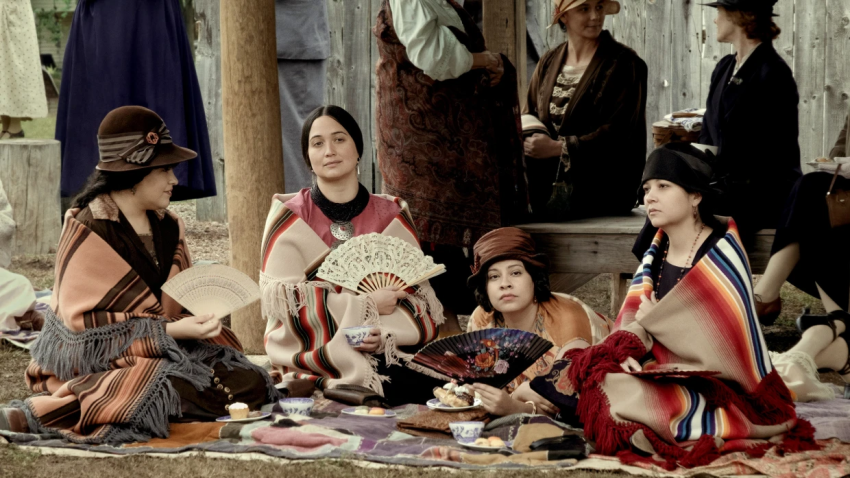
Still from the film, Killers of the Flower Moon, showing Mollie sitting with her sisters on a large blanket on the ground. All of them are holding fans.


Read more!

2018/01/01

Movie Review: Star Wars: The Last Jedi

I review Star Wars: The Last Jedi movie.

I was intrigued by Keith Knight's theory about how the First Order was able to track the Resistance through hyperspace. But this was a risky strategy given that the Resistance fighter pilots have a high attrition rate (close to 100% by the end of the movie).

The main tension in the movie is between direct action (Poe Dameron and Finn) and survival (Leia Organa and Vice Admiral Holdo). This is the quandary that affects all guerrilla groups. Direct action attracts new members and supporters while harming the oppressors. This entails retaliation which threatens the survival of the group. The movie closes on the importance of political action over military action.

Direct military action had been successful for the Resistance and Rebel Alliance in the past. Then they were strong enough to tackle the enemy in open battle to either prevail, or to retreat in good order. Now, the losses in personnel and materiel has become critical and harder to replace. The First Order can easily win any battle of attrition. This is demonstrated in the movie as the First Order is able to recover from the losses of two (2) of the largest ships and several Star Destroyers, and force the resistance to escape on a single ship.

This materiel and personnel advantage of the First Order discourages forces in the Outer Rim from coming to the aid of Leia's group on Crait. There is the known cruelty of the reprisals by the First Order. People would make the rational decision to keep their heads down, and bend with the prevailing wind. DJ exemplifies this by striking a deal with the First Order and escaping to live another day.

Yet the movie closes on a very important point: political education. Three (3) children are re-enacting the heroic stand by Luke Skywalker on Crait. It is through their mythologising that the Resistance grows. Trotsky once wrote that the success of the October Revolution came about through the dedication of single Party workers scattered throughout the Russian Army, factories, villages, etc. They did not attack the State, but rather they patiently educated their fellows on Socialism and Capitalism.

The Resistance will not grow until it grasps the necessity of political action over military action. And it must grow if it is defeat the First Order in open combat.


Read more!

2015/04/07

Movie Review: Home (2015)

The movie, Home, is Anti-American propaganda.

I have decoded the movie as follows:

  • The Boov are the Americans
  • The Gorg are the Muslims
  • Oh is Edward Snowden
  • Captain Smerk is the American Government

Captain Smerk steals a valuable artifact from the Gorg, This artifact is literally the future of the Gorg. Smerk does not understand why the Gorg want this artifact so badly, but uses his possession of it as his claim to power.

In a similar way, the American government steals the future of the Muslim Arabs from them by controlling their oil reserves. It is this control of oil that allows the USA to dominate the world's economy. The US government cannot understand why the Arabs want to use their oil for their own development rather than for the maintenance of US power.

In terror, the Boov flee the Gorg. The mere mention of the Gorg sends the Boov into panic. Captain Smerk proposes the invasion of Earth as the solution to their problem. He assures them that the population of Earth would be well taken care of, and would welcome the Boov as liberators. Since Boov technology is far superior to anything on Earth, the invasion is easily accomplished.

The panic after 11 September 2001 sent the US government on a series on invasions and interventions around the world: Afghanistan, the Phillipines, Iraq, Iran, Pakistan, Libya, Uzbekistan, Tajikistan, etc. The superiority of US weaponery made these easy for the US military. In Iraq, especially, the US troops were told that they would be welcomed as liberators.

What is striking about the movie is the Boov invade homes and snatch terrified people. The Boov round up all of the Earth's population and resettles them in refugee camps in the middle of the Australian desert. (This would infuriate any Australian government.) The population of Earth are understandably angry at the Boov for this rough treatment.

The Boov cannot understand why the population of Earth should be so angry with them. 'Tip' is especially angry at the descretion of cerished cultural artifacts by the Boov. Her main gripe is the turning the head of the Statue of Liberty into a likeness of Smerk.

Oh causes a crisis releases an e-mail to the entire universe. This causes Oh to become a furgitive.


Read more!

2013/06/04

Compliance

Following on from Lack of Character?, I think the movie, “Compliance”, is a deeply disturbing one about how the perception of power can overcome moral scruples.

In this movie, the characters believe that they have no choice but to follow the dictates of the prank caller who calims to be a policeman. The mere assumption that teh caller is genuine is enough to give credibility to whatever lies they tell.

No matter how bizarre the request the caller makes, any moral scruples are quickly overcome by either threats or reasons. At the end of the movie, the manager is asked why didn't she stop the prank. Her reply was that the caller always had an answer to any objections she raised.

The prank only stopped when the gardener would not go along with the requests of the caller. His moral scruples were offended in such a way that he refused to comply with instructions.

What is important for me was that the higher the status of the employee or manager, the more likely they were to comply. Did this mean that advancement in a Capitalist economy requires one to overcome moral scruples? It would seem so.


Read more!

2013/03/16

Oz the Great and Powerful

The movie, "Oz the Great and Powerful", is a propaganda film that extols:

  • The usual Disney myth of the correlation between beauty and goodness;
  • The capitalist hero myth;

The younger sister, Theodora, prefers to keep her ugliness as a manifestation of the hate she feels inside.

The eldest sister, Evanora, does not have a political program to explain her rule. Why did she overthrow her father? Why did she think she was a better ruler of Oz than her father.

Her political program of control is profess the myth of a liberator, while portraying herself as the defender of Oz.

She has the caste of flying monkeys to terrorise the countryside. She has an official enemy to blame all of the acts of terror on. Thus, she would justify her rule as protector against the terror she creates in the chaos after the death of her father.

I would have to assume that she wanted power and wealth for herself. Terror is a means to an end.

The younger sister believes the propaganda. It is only when Oz betrays her that is converted to the dark side, as it were.


Read more!

2010/02/27

Edge of Darkness

Mel Gibson's latest movie, Edge of Darkness examines the link between activism and terrorism. The movie also covers the link between the economic base of a society and the resulting offical terrorism even against the state. The movie fails to follow through on its logic about the collusion between economic and political forces.

Jedburgh, who is the fixer for national security, explains to Thomas Craven (played by Gibson) that his slain daughter, Emma Craven, was flagged as a terrorist in one of the national security databases, but she was not a terrorist. Jedburgh is careful to reiterate this.

I find this exchange to be interesting because it challenges the nexus between activism and terrorism. And it opens up the question of who decides whether someone is a terrorist or not. This question is not explored further in the movie.

Another theme throughout the movie is that Emma turned to activism once she had exhausted all legal avenues for exposing the illegal activities of her employer, Northmoor. The security requirements of her job meant there were none. But this theme also explains her father's actions in uncovering the mystery for he does illegal entry, impedes police investigations, destroys evidence, break and enter, vandalism, property damage, assault, murder.

The wry comment made several times throughout the movie is that everything is illegal in Massachusetts. This comment seems justified the extraordinary actions of the main characters. The reasoning appears to that, if the law is so restrictive that one cannot be a decent human being, then one must choose to be a decent human being over the law.

The setting of the movie in Massachusetts is significant from several perspectives. The origins of the American Revolution in Boston, Massachusetts, is referred to at one point in the movie as Thomas tries to understand how Emma provided material aid to a group of anarchists who tried to break into the Northmoor facility. Another perspective is the existence of the high-technology industries, of which Northmoor is a part, that provide a significant number of jobs to the economy of Massachusetts.

Another interesting theme I find is the distinction between private and public employment. Public employment is held in higher esteem because the civil servant attempts to live up to a code of ethics, whereas the private employee does anything for money. There are several references in the movie to the private security at Nortmoor being out of control.

The economic rationale for letting Northmoor have a free reign is that the company brings jobs into the Commonwealth of Massachusetts. This is really an expression of the idea of dictatorship of the corporation - whatever the corporation needs, it gets. But also it expresses the implicit contract between the population and the corporation: you let us do what we want and you get to eat through having a job.

However, the movie fails to consider that media outlets, such as Fox News, are also corporations who follow the same logic. The movie assumes that the corporate press is a truly free press that pursues the public interest. In the battle between corporation and the people, the corporations stick together to defend their monopoly on power.

In reality, Thomas Craven and Jedburgh are anarchists for they do not abide by the laws of the state or rely on the state as an intermediary in their quest for justice. Both of them justify this defiance of the supremacy of the state by holding themselves accountable to their codes of honour. The law that they obey is internal not external. This is a symmetry with the opening of the movie with the death of three anarchists as they tried to enter the Northmoor facility.

Another symmetry in the movie is between the betrayal of the three anarchists by their mentor, and Thomas' betrayal by his boss. Both betrayals are driven by economic self-interest: the mentor to keep his comfortable liberal life-style; and the police captain's desire to provide for his family. Here economic power is one face of state (or corporate) terror: Obey and you eat; Disobey and you starve.


Read more!

2008/07/04

Mongol

In the movie, Mongol, the rise to power of Temudjin revolves his love for Borte and his religious devotion.

Temudjin is presented as a combination of Moses, Joseph, and Joshua.

Sandra Hall reviews Mongol as well and finds:

Naturally enough, they're also out to humanise their hero, a job made easier by the decision to deal only with the story of his early life, when he was yet to become acquainted with the character-altering effects of absolute power. They keep it simple. Central to everything is his love for Borte (Khulan Chuluun), his lifelong companion - which, in itself, is enough to make him unique in a society where a man's wife is not nearly as valuable as his horse. He's a 12th-century SNAG in other words, so it hardly seems fair that the Japanese actor Tadanobu Asano (from Takeshi Kitano's Zatoichi) makes him such a stolid personality.

Emphasis Mine

Ghenghis Khan a SNAG! I hate to see a Mongol Rambo, then!

Anyway, back to my religious interpretation of the movie.

Temudjin retraces part of Joseph's journey by being sold into slavery by his blood brother. Whilst in the Tangut prison, he is mocked but a Buddhist monk bargains with Temudjin for the survival of the local monastery. Temudjin agrees if Borte comes. This occurs at the cost of the monk's life.

Instead of the wife having Joseph thrown into prison, the wife releases Temudjin through bribery and threats. And the prophecy concerns the destruction of the Tangut kingdom.

The aspect of Moses' life is that Temudjin is now an escaped slave who was once a nobleman and who had killed one of the slave overseers. He takes his family back into Mongolia. There he goes up to the holy mountain to conceive of the Law for all Mongols (Yassa). The movie only presents three (3) laws.

  1. Women and children are to be spared
  2. All debts are to be paid
  3. Never betray your Khan

Moses got an extra seven. But Temudjin became the Mongol Law Giver. No burning bush or golden calf, though.

In the role of Johusa, Temudjin united the tribes to conquer the Promised Land (Eurasia). Johusa was more modest in his ambitions.

In all cultures, there are the heroic individuals who undergo great trials and betrayals (Joseph), rebel against the existing order to create a new one based on law (Moses), and unite their people in a singular purpose (Joshua).


Read more!

2008/06/12

Heyda Fawda

Heyda Fawda is an Egyptian movie about a police officer (Hatem) stalking a school teacher (Nour) who is chasing an Assistant District Attorney (Sherif) who is sleeping with a drug addict (Shiela) who wears mini-skirts. The movie has English sub-titles but the graffiti and posters are not translated.

This was my first Egyptian and Arabic movie. So this post is made out of pure ignorance.

There are so many threads running through this movie. The main thread is the decline and fall of Hatem through his obsession with Nour. But this is against a motif of opening with police suppression of a demonstration and closing with the arrival of riot at another demonstration.

I think the best clue to this movie is the translation of the title as 'Le Chaos'. There is chaos in Egypt which the Emergency Law tries to address. The movie lays out four (4) distinct attempts to control this chaos:

  1. Hatem uses force and corruption to regulate the chaos;
  2. Sherif uses the merciful application of the law to restore confidence in the system;
  3. The headmistress uses education to control the chaos;
  4. Sheila uses drugs, sex, love, parties to block out the chaos.

Hatem uses force to convince people that order must be followed even at the expense of the law. In this, he is encouraged by his superiors. Hatem uses the chaos to enrich himself through corruption by cutting through the red tape. In Hatem, the system is defending itself against attack.

Sherif uses mercy to temper the law and so win people across to the system. He interprets the law in order to dispense justice. In Sherif, the system is paternalistic and benevolent.

The headmistress and school inspector strive to raise the education level of the students so that they are better equipped to handle the chaos. Nour tries to teach English to a class but she does not how even though she has the right qualifications. She tells the school inspector that she is a qualified idiot who was taught by other qualified idiots.

Shiela justs gets high, parties like mad, and makes passionate love to Sherif. She uses her wealth and position to hide from the chaos. She is above it while the other characters are caught up the raging currents.

Hatem descent into hell takes him through the impotence of power. He cannot make Nour love him. He can only rape her. He goes from a man who can inflict pain on others to someone cowering in an elevator while the world erupts around him. He is so self-absorbed that he does not see beauty in young love or a famous painting.

Sherif fails when he tries to use the legal system to prosecute Hatem for rape. Sherif sees his own impotence in the face of police perjury and obstruction.

Once all the legal avenues have failed, Nour's mother and the headmistress take their allegations to the street. There the people rise up and invade the police station. Eventually Hatem is sacrificed to save the system.


Read more!

2008/01/06

I am Legend

In the movie, I am Legend, I see a validation of the American exceptionalism in which the US tries to rectify mistakes it has made, but the rest of the world is just a pack of inarticulate beasts who seek nothing the destruction of the US. There is also a question about science versus faith.

Towards the end of the end of the movie, there is the racist dog-whistle:

The answer is in the blood.

The good doctor is portrayed as a heroic individual struggling against the tsunami of darkness and savagery. He is the only one to walk in the light. He has sacrificed everything for the cause: wife; child; companionship. He works relentlessly but methodically.

He has no ethical concerns about experimenting with animals and infected humans. However, he does keep a gallery of the faces of the humans he had failed to cure. This would make him a serial killer, but he would claim a higher cause to justify this slaughter.

He is blind to the intelligent adaptation of the infected humans:

  • The ability to survive three (3) winters in New York;
  • The ability to live in harmonious communities;
  • The ability to domesticate animals (especially infected dogs);
  • The ability to plan ahead;
  • Scat and garbage management to conceal locations of the hives;
  • Concept of modesty (all of them are clothed);
  • Ability to make clothing;
  • Ability to execute a complex plan (invasion of the doctor's house) at short notice (less than a day);
  • Ability to innovate quickly in the battle at the wharf;
  • Ability to set an effective trap for the doctor.

My alternate theory about why the others wanted to kill the doctor is that they saw him as a predator, and it was in their interests to kill him in order to save themselves.

Of course, the doctor does see it that way because he is only doing good in order to return them to normality. He wants to cure them of their inabilty to be a normal human.

He sees himself as a rational individual but is unable accommodate deviations from expected behaviours by the infected humans. He is unable to overcome the blind faith of the normal woman sees the hand of God in everything. Yet it she who survives and arrives at the gates of paradise.


Read more!

2007/01/14

The Nativity Story

In the November/December 2006 Edition of Annals Australasia, James Murray reviews The Nativity Story on p.22. He concludes:

The work's verisimilitude may, however, create a problem of perception. Audiences are so conditioned, particularly in English speaking countries, to the overdecorated, sentimentalised Victorian-Dickensian version of the story that there may be difficulty in fully appreciating the merits of this more austere classic.

Emphasis Mine

I disagree that this movie is ...the true story told simply an powerfully. For all its exactitude, the movie skirts around the central issue in Palestine at the time: the Roman occupation and imposition of a puppet government (Herod).

Given the current brutal occupations in Palestine, Iraq, Kurdistan, Kashmir, etc., the challenge of the movie makers is to truly depict life under occupation without today's occuping powers.


Read more!

2006/12/26

Happy Feet

The movie Happy Feet is about how a disabled penguin, Mambo, overcomes religious prejudice to undercover the cause of the environmental disaster facing the penguins and other animals. And he doesn't get the girl.

Disability

The whole premise of the movie is that Emperor Penguins need to sing in order to attract a mate. When Mambo (aka Mumbles) is born, his disability is that he cannot sing. Despite the best efforts of his parents and teachers, he is not able to overcome this disability.

His disability leads to his isolation which almost gets him killed on two (2) occasions. When he tries to join in the graduation celebrations, he is told that he is ruining it for everyone else. The movie is very effective in highlighting the isolation that the disabled face.

Another point is that the delayed development of the disabled individual as signified by the retention of down by Mambo throughout the movie. Although the amount of down decreases as Mambo matures, it is still there at the end of the movie.

Is this meant to signify that the physically disabled are also intellectually disabled, or, at least, have delayed development? I think the movie emphasises the intellectual advancement made by Mambo about the Penguin economic crisis.

However, because Mambo is unable to participate in the Penguin community life, his social development is retarded. So the conclusion of the movie is that physical disability causes social immaturity but not intellectual disability.

The character in the movie with a disability is Lovelace who has a plastic six-pack spreader around his neck. However, Lovelace is able to use this to acquire a position of influence: cultural, intellectual, and sexual. And his disability can be cured by the removal of the plastic.

Religion

The religion of the Emperor Penguins is presented as:

  • Gender Roles: the males sit on the eggs, and the females fish
  • Social Organisation: Noah and his cohorts rule the roost.
  • Funding Myth: how penguins lost their ability to fly.
  • Economic Distribution: all the males share time and warmth within the huddle.
  • Hope: throughout the long winter, Noah reminds the male penguins of the return of the Sun.
  • Explanation: the provision of fish is the will of the Great 'Guin.
  • Culture: penguins sing not dance.

What Mambo does, by the end of the movie, is to successfully challenge these last two (2) items. And, in doing so, he brings into question the social organisation.

Nowhere does he question the existence of the Great 'Guin. Except that everything he does and thinks has no reference to the Great 'Guin. It is Ovjective Atheism - he has no need of religion because it does not influence his thoughts and actions. Religion still affects him through social interaction because other Penguins do what Noah says the Great 'Guin wants them to do.

Environment and Economic Impact

The economic crisis facing the penguins is the dwindling supply of fish in the Antartic Ocean caused by overfishing by humans (the "aliens" in the movie).

The religious explanation was the Great 'Guin was holding back on the fish and will soon relent.

From the hawks, Mambo learns about the aliens who tagged one of the hawks with a yellow leg ring. Mambo makes a tentative guess that the aliens could be involved.

It is when Mambo encounters Lovelace and his alien artefact which Lovelace claims is the source of his power, that Mambo becomes more convinced that the aliens are behind the disappearance of the fish.

This hypothesis is confirmed when Mambo and the others see the great fishing fleet.

Animal Rights

Animal rights is probably the most contentious issue in the whole movie. Do animals have the right to live because they are one or more of the following:

  • Cute?
  • Useful to humans?
  • because they are animals?

The answer in the movie is the first one. This is the most dangerous reason of all because it reflects the anthrocentric view of the world (as does the second reason): humans are the most important creatures on the planet because (insert some reason here) and everything else has to accomodate it.

The third reason presupposes that humans are just another species on the planet. Life on Earth will continue in some form if the humans ever become extinct. Life is just a process without a purpose.

It is in our interests, as animals, to ensure that the planet remains habitable for all animals. We are not aliens - we are part of the ecology of the planet.


Read more!

2006/12/04

United 93

During the showing of United 93, I had a strong desire to go and kill Muslims. I was frightened by this. What had fired up my blood? It was the sight of innocent people being set up to be murdered.

No reason was given for this slaughter. There was no soul-searching by the murderers. They were just going to kill Americans.

The only indication of a motive is the picture of a Mosque the new pilot clips to the plane's rudder controls.

The armed rebellion is interesting in that the ordinary people sit passively under the violence that is inflicted on them. This is how people are conditioned in the West. We are trained to await our leaders to guide us and help us.

In a way, this movie reveals how an American revolution would unflod. The people would continue to absorb more and more alien information until they realise that the situation is completely hopeless unless they act.

The response of the hijackers, in this movie, is also instructive: they respond with increasing threats of violence to ever increasing acts of defiance. This response eventually fails.

In the real world, the ruling class relies on violence, propaganda, and bribery to maintain control. Thus the task of revolutionaries is much more difficult. Why should people risk their comfort for the unknown?

It is a bit difficult to change pilots once the plane crashes into the building


Read more!

Fearless

Jet Li's movie, Fearless, is an interesting insight into how some Chinese want to develop Capitalism in their country. They fear the foreign domination that existed in the late 19th and early 20th Centuries.

The movie is about pre-revolutionary China and the humiliations that the Chinese suffered under foreign domination. The message is that the Chinese have the strength and knowledge to take on the rest of the world. However, the relationship between China and Japan is portrayed as ambivalent.

This movie is a nationalistic propaganda film about http://en.wikipedia.org/wiki/Huo_Yuanjia">Huo Yuan Jia who defeated four (4) opponents in an epic martial arts contest in Shanghai on 14 September 1910.

According to this article at WikiPedia, this movie distorts the life of Huo Yuan Jia.

Interpretation

I am not interested in the factual nature of this movie but rather in its political interpretation. There are two (2) main classes of actors in this movie: Capitalists and fighters. These are presented as the driving force behind the events of the movie. These classes of actors are further divided by ethnicity. This classification scheme is in itself interesting because these actors are the only ones portrayed as shaping events. Everyone else is at their mercy or lack thereof.

Yet in spite of their passivity, these others create the major turning point of the movie. It is when the competitive nature of Huo Yuan Jia confronts the stoic nature of the Chinese peasants, that Yuan Jia grows spiritually and is then able to begin the journey to redeem China's honour. Action through being not doing.

Classification

In the movie, there are three (3) types of Capitalists presented:

  1. The Chinese are represented by the restauranter;
  2. The Europeans and Americans are represented by the three (3) members of the Shanghai Trade Federation;
  3. The Japanese business-man.

And there are four (4) types of fighters:

  1. The Chinese;
  2. The American O'Brien who called the Chinese the weak men of the East;
  3. The Europeans with their swords, lances, and fists; and
  4. The Japanese Tanaka.

Note that the Americans are perceived as independent fighters but undifferientated Capitalists with the Europeans.

The Chinese

The Capitalist

The Restaurant owner despairs over the constant fighting between Chinese which has allowed the foreigners to dominate the political and economic life of China. When Yuan Jia returns and announces that he wants to fight O'Brien, it is the restaurant owner who finances the challenge. When Yuan Jia wants to form the sports federation to unite all Chinese martial arts bodies, the restaurant owner sells his business to finance the project.

The Chinese capitalist puts country and honour before profit. Only he has the knowledge and wisdom to do the right thing: to be patriotic.

The Fighter

The Chinese fighter is Huo Yuan Jia, the hero of the movie. He starts out as a highly competitive individual who reaches the peak at a terrible cost to his family, his honour, his friends, and his self-respect. It is not until he healed by the Chinese peasants that he reorientates his life away from competition and to service.

In his final fight, he fights to reclaim Chinese honour at the cost of his own life.

Summary

Since this is a Chinese film, the Chinese are the heroes for their patriotism and self-sacrifice: the capitalist surrenders his wealth; and the fighter his life.

The Japanese

The Capitalist

It is the Japanese capitalist who conspires with the white capitalists to humiliate the Chinese by arranging for the fight to be fixed through the rules and through treachery. It is to be four (4) against one (1): English; Spanish; German; and finally, Japanese. If all else fails, Yuan Jia will be poisoned.

The Fighter

Tanaka is presented as a sympathetic character. He has the wisdom to see that Huo is being set up.

When Tanaka concedes the fight to Huo, Tanaka is confronted by the Japanese capitalist. Tanaka is asked why he ceded the match to Huo. Tanaka replies that he knows, in his heart, that he lost. Tanaka accuses the capitalist of not being a true Japanese because he prefers profit over honour.

Summary

This is an interesting juxtaposition between the Japanese capitalist and fighters. The latter is portrayed as more honourable than the former in spite of the brutal occupation of Manchuria and other parts of China from 1932 until 1945. The Rape of Nanking was not done by the capitalists but by the military. The Japanese were afflicted by the same racial prejudice against the Chinese as were the Westeners.

The Americans

The Capitalist

The cast lists an American capitalist but his presence has no influence on the movie. Could this be a calculated insult?

The Fighter

O'Brien is an American boxer who has proclaimed that the Chinese are the weak men of the East. This insult propels Huo on his journey of redemption to restore his country's honour. The fight ends in O'Brien proclaiming Huo to be the winner. This is similar to what Tanaka does at the end of the film.

Summary

Jet Li portrays the Americans as brawn but no brains. However, the Americans will gracefully accept defeat at the hands of the superior Chinese. I don't think so.

The Europeans

The Capitalists

These are portrayed as a cabal who act at the instigation of the Japanese capitalist. Even they balk at some of the methods of the Japanese captalist.

The Fighters

The European fighters are presented as one-trick warriors. Tanaka and Huo would several rounds with the weapons used by each European: fists, sword, and lance.

Could Jet Li be saying that Westeners can only do one thing whereas the Orientals (Chinese and Japanese) can master all of these?

Summary

The Europeans are presented as bit-players in the titanic struggle between two Oriental cultures.

Conclusion

The fading of American influence with the collapse of its Capitalist economy will only leave its military might. Even this can be overcome by the Chinese.

The conclusion could be that China can take on the world and win by using competition to find out its own weaknesses. This is the arrogance one finds among nascent Capitalist powers.

There is still the complexity of the relationship between China and Japan. The brutality of the thirteen (13) year war by Japan against China is a gaping wound between philosphical allies. The message of this movie could be that the love of money caused the Japanese to behave dishonourably.

But this is an unresolved conflict within Capitalism: how to behave honourably while making money? Jet Li is naive if he thinks that Chinese Capitalists can put the national interests above their own. A Capitalist does what is best for him not for the rest of us.


Read more!

2005/11/13

Rize

Rochelle Siemienowicz reviews the movie Rize:

Down in the slums of Los Angeles, there is a new dance movement transforming the lives of underprivileged kids. It's called 'krumping' and it's so fast and athletic that the makers of this film have to tell us that the footage hasn't been sped up. The dancers move as if possessed, both by the spirits of their African ancestors and a furious rage at their powerlessness - Rodney King is often invoked. Instead of joining gangs, they paint their faces like clowns and engage in non-violent competitive dance-offs with rival troupes.

Made by music video director and Vanity Fair photographer David LaChappelle, Rize is sometimes unfocussed and sloppy, seemingly unsure of whether it wants to glorify or objectively observe what it finds. Nevertheless, it's full of pummelling energy and arresting visuals as it traces the roots of krumping back to an ex-jailbird called Tommy the Clown, who first combined hip hop music and dance with children's birthday parties. Today, more than 100 groups practise this 'ghetto-ballet'. Their pride and courage is inspiring (and, honestly, a little scary), and you only hope that they'll find a way to move their politics beyond their beautiful, gyrating bodies.

Siemienowicz, Rochelle (2005), 'Rize', The Big Issue, No. 241, 07-22 Nov 2005, p.36

Emphasis Mine

What Dr. Siemienowicz did not mention was the racism behind the origin of the dance: this was promoted as something that black people could do that white people couldn't. This gave the dancers a sense of false pride. They have fully absorbed the racist propaganda of a Capitalist society. Malcolm X has been forgotten. The only mention of Dr. King was on the closing credits from his I have a dream speech:

I have a dream that one day this nation will rise up and live out the true meaning of its creed: "We hold these truths to be self-evident: that all men are created equal."

Towards the end of the film, a white youth and an Asian youth are shown participating in the dance, and being accepted by the black dancers.

Thoughout the film, the dancers comment that they are oppressed or discriminated against, but they do not move beyond that. When they do not try to understand the oppression or discrimination, they are accepting it as part of their life. It is just another part of their lives as is drugs and the gangs. Forty years have erased the memories of the marches and the speeches of the Civil Rights era. The dancers are angry without having any way of understanding the source of that anger. They use dance to drain that anger out.

One problem with black liberation (whatever its manifestation - marches, dance, music) is that it attracts poor whites, Asians, and Hispanics. But with this aggregation of non-blacks, the blacks feel overwhelmed. The problems of the blacks are big enough without all these other poor people tagging along. Blacks want to solve the problems of blacks not everyone else's. The blacks then try to exclude the others by saying that they should solve their own problems.

With this exclusion, the politics of blacks do not develop beyond racism. This attitude entrenches racism further by dividing people into races. Instead, the blacks should welcome the others in their struggle and expand their struggle to include all poor people as Malcolm X and Dr. King were starting to do before they were assassinated. The struggle is a class struggle of the poor against the rich. It is not black against white.


Read more!

2005/10/01

Willy Wonka

I got the latest issue of Annals Australasia (August 2005) yesterday and found a review of Charlie and the Chocolate Factory by James Murray on p.41. I had recently seen the movie so I was interested to see Mr. Murray had to say:

Not so much a remake, more a re-melt of Roald Dahl's classic tale. Johnny Depp takes on the Willy Wonka role. If Depp - too many teeth and smiles - does not have the inward weirdness of Gene Wilder in the original, he does have a back story to explain his chocaholicism.

This is one of the fresh elements introduced by director Tim Burton and writer John August. Special effects are deployed as generously as fruit and nuts in a Cadbury's bar. Deep Roy creates some kind of history with his multiple roles as Oompa Loompa (courtesy Digital Domain).

Freddie Highmore, allies ingenuousness to shrewdness as Charlie Bucket, winner of the last of five gold tickets to the Wonka factory. He is shaded by Annasophia Robb as Violet Beauregarde. The veteran, but exuberant, David Kelly is Grandpa Joe who accompanies Charlie on his factory outing. Noah Taylor makes an appearance as Mr Bucket with Helena Bonham Carter as his wife. Not a single bad performance. And never a dull moment

Nothing controversial there. Mr. Murray had also written a review (ibid.) about Kung Fu Hustle, which ends with:

... [Director Stephen Chow] sends up the hyper-violence of the kung fu genre and, despite his movie's ostensible setting in pre-revolutionary China, he gets in digs at the pretensions of China's current regime.

Emphasis Mine

James Murray can see political implications for criticisms of Communism but not of Capitalism nor Racism. In contrast, Jonathan McIntosh wrote about Willy Wonka and the Racism Factory

Moreover, the Oompa-Loompas all look exactly alike, as they are played by one actor using composite visual effects. This is a new invention by the current film's creators. The visual effect is ironic as it displays the problems at the very core of global labor issues: white populations perceive individuals of non-white populations as identical and all looking alike, lacking individual dignity. In this view, factory and sweatshop workers are ascribed no individual worth outside of the product they produce for consumers at low pay and in poor working conditions, unable to organize, form unions and improve conditions.

Many will no doubt respond to this critique disparagingly. They will say that the movie is just that, a movie. They will state that it has no social connection or cultural implications to the present western mindset. However, it is important to consider that Roald Dahl himself eventually made revisions of his story to meet the racial concerns that accompanied the changing social ethics in 1973. The fact that, in 2005, Tim Burton chose to revert back to the original description of the Oompa-Loompas as primitive "pygmies" is troubling at best. Burton has said in interviews that one of the things that attracts him to Dalh's work is the "politically incorrect" subject matter. Audiences all over the country seem to feel the same attraction.

Emphasis Mine

One reviewer sees nothing innocuous while the other sees blatant racism. This is akin to what Tim Wise wrote about White Whine: Reflections on the Brain-Rotting Properties of Privilege when whites cannot see the privileges that racism gives them.

Now for my review. The movie is propaganda for monopoly paternal Capitalism similar to that I wrote about in Robots except that the petite bourgeious are not a major player. The Capitalist is the hero - everyone else is a bit player. The Capitalist is the benevolent leader.

Willy Wonka's story begins with a youth devoted to discovering the perfect chocolate confectionery. He is seen to be following a scientific process of analysing confectioneries to discover their secrets. (Genius is 1% inspiration, and 99% perspiration, Thomas Alva Edison) He starts as a small businessman who suceeds magnificiently by providing a superior product to his customers. He then builds the world's largest factory. He has obtained a monopoly position through his superior product. This is one of the contradictions in Capitalism: competition produces monopolies. The standard solution to this problem is government intervention: either through regulation or destruction of the monopoly. In this movie, the government does not exist!

In the movie, it was the treacherous workers who pass on the secret recipes to others who become Wonka's competitors and thereby destroy Wonka's monopoly. (In the real world, I understand that the Coke-Cola Company has managed to hold onto its secrets for more than a century!) In revenge, he sacks all of his workers and shuts the factory. The workers are dispensible in true Capitalist fashion. However, it was the workers who restored competition to the confectionery industry with multiple small businesses emerging to service niche markets.

Willy Wonka is a bad capitalist for his primary concern is not the accumulation of capital but the quest for better confectionery. Indeed, the other capitalist in the movie (Mr. Salt - owner of the nut shelling factory) can disrupt the production of his factory for three days without any thought for lost profits. It is as if the mega-rich do not have to worry about business cycles. The attitude of Willy Wonka and Mr. Salt is that business is a dalliance. They do not have to worry about competitors making more money than them. Their capital is secure.

The toothpaste factory owners, on the other hand, are involved in the investment cycle. The increase profits allow for investment in machinery which allows for greater profits by reducing costs (read Mr. Bucket).

There is another difference between the three factories shown in the movie: the happy workers are shown in Mr. Wonka's factory while the mind-numbing drudgery is shown in the nut-shelling and toothpaste factories. Could this be a sublimial message that happy workers make more profits?

The workers cease to exist once pass outside the factory gates. The visibility of the poor is limited to one family (the Buckets). There is no social security. They have enough land to grow cabbages for making soup. Charlie shines shoes. The solution to their poverty is for them to get a better job. Mr. Bucket shows up at the toothpaste factory from where he was fired and gets a job as a robot technician. For a person without having showed any mechanical aptitude nor having undertaken any training to do this seems to be incredible. A more realistic scenario would have been for him to become a computer programmer. (This is me being snarky). They are suddenly seen to be having roast turkey for dinner. The message is that the poor are poor because they are lazy.

However, the workers are unable to look after themselves. They need the capitalist to guide them and provide them with the means of sustenance. This is the crisis that confronts Willy Wonka when he discovers a grey hair reminding him of his mortality. Who will look after his workers when he is gone? He needs a successor to carry on the running of the factory. Willy Wonka is who he is because he struggled to master the art of confectionery making whereas Charlie struggled to survive. This transfer of experience always seems to be difficult. Witness James Packer in PBL. Lachlan Murdoch probably made a better decision to strike out on his own.

All in all, the message of the movie is that the Capitalist is benevolent. Except for the preemptory treatment of the workers and the insulting lack of hospitality of Willy Wonka towards his guests when he publicly humilates them. The mega-rich are obviously beyond caring about others. Could the real message be that the mega-rich are all bastards?


Read more!

2005/04/09

Robots

The movie Robots is a propaganda movie for paternal Capitalism. The enemy to be overcome is the ruthless Capitalism where profit rules over all. A political revolution lead by an alliance of the petite bourgeois, elements of the labour aristocracy, and the paternal faction of the large bourgeois lead the workers and the lumpenproletariat to victory. The leading elements of the petite bourgeois are then co-opted in the restored power structure.

Rodney Copperbottom grows up believing in the propaganda put out by Bigweld Industries through the weekly television program, and through the annual parades. Mr. Bigweld, the owner, is portrayed as a benevolent being who encourages everyone to achieve their best. He is always open to new ideas. Everyone in Rivittown worships him because he is seen as the source of their prosperity. I was reminded of the large company towns like Flint, Michigan, where General Motors provided most of the jobs and social benefits. Other examples would be the large Japanese firms. These are prime examples of paternal Capitalism where the bosses knew best and looked after their workers. This was a carryover of the feudal relationship between serf and lord.

Encouraged by this propaganda, Rodney works day and night to create his invention so that he could present it to Mr. Bigweld and be amply rewarded. Here, we have the personal ambition and drive that is typically unleashed in a Capitalist society. It is people like Rodney that help drive the intellectual and technological ferment that propels a Capitalist economy. In many ways, this also describes the dot com boom: people with big ideas hoping to be brought out by large companies for obscene amounts of cash.

As Rodney grows older, he sees his invention more as making his father's life easier. The money and glory are no longer the prime motivators. He sees his invention as solving a social need. By improving his father's productivity as a dishwasher, his father will have more time to enjoy life. This conflict in motivation causes conflicts in a Capitalist society.

Rodney tries out his invention in the restaurant where he works with his father. The invention goes haywire and Rodney is fired from his job. Later on, Rodney decides to go to the big city in order to see Mr. Bigweld whom Rodney hopes will put everything right. Rodney arrives in Bigweld city and immediately encounters the lumpenproletariat when he is confronted by Fender who tries to con him out of $50.

Rodney reaches Bigweld Industries where he is refused entry because times have changed. The reason for this is that Bigweld Industries is now run by Ratchet instead of Mr. Bigweld who has mysteriously disappeared. Because Bigweld Industries is a monopoly, Rathchet has decided to stop making spare parts for the robots and make upgrades instead because of the greater profit margin. Self-image is now to be exploited to drive the purchase of upgrades whether the robots need them or not. A definite criticism of the current economy of which Hollywood is a part. Talk about biting the hand that feeds it. I was surprised that the employees were not sent off to seminars on how to deal with change. I was waiting for copies of "Who Moved My Cheese?" to appear.

The farce of the board room democracy is exposed when Ratchet quells any dissent by getting rid of the one robot who raises an objection. The other robots in the board room appear to be members of the labour aristocracy - workers who have privileges and incomes far above that of other workers. These workers are lulled into complacency by the pretense that the bosses listen to them. One of the labour aristocrats, Cappy, is the victim of sexual harrassment.

Rodney manages to find a way into the board room where Ratchet rebuffs Rodney's ideas. After Rodney escapes from Bigweld Industries, he finds Fender again and falls in the Rusties who practise primitive Communism. They have a benefactor in Aunt Fanny who has no visible means of support.

Rodney is appalled by the lack of initiative of the Rusties as all petite bourgeois are of the lumpenproletariat and proletariat. He "... finds a need and fills a need ..." when he starts his own business of repairing robots thereby threatening Ratchet's market share of 100%. So Ratchet reacts, as all monopolists do, by seeking to destroy Rodney.

The only other capitalist in the movie is Madam Gasket who recycles robot parts into ingots. She must be Bigweld's supplier. She is using her son, Ratchet, to achieve vertical integration and to increase the amount of raw material her factory processes.

Rodney, as the petite bourgeois, takes leadership in restoring Mr. Bigweld to his rightful place. He drags along a reluctant labour aristocrat (Cappy), and the even more reluctant lumpenproletariat (the Rusties). His hopes are crushed when he discovers the crushed spirit of the isolated Mr. Bigweld. But Mr. Bigweld is awaken from his torpor by Rodney, and joins forces with Rodney and his allies. Their attempt at a palace coup fails when the police side with Ratchet. Only the climatic battle between the workers led by Rodney and those led by Madam Gasket decides the issue. With Mr. Bigweld restored to his place, Rodney surrenders his independence by being coopted as Bigweld's successor. And so, all dissenting elements are assimilated into the system.

The message of the movie seems to be that raw Capitalism is an aberration, and that the paternal Capitalism is the comfortable norm.


Read more!