Showing posts with label Feminism. Show all posts

2023/11/20

Gutema Imana Keno: Some Notes on the Past of Oromo Society: The Story about Akkoo Manooyyee in Focus

Dr. Gutema Imana Keno (Haramaya University) discusses Some Notes on the Past of Oromo Society: The Story about Akkoo Manooyyee in Focus.

Summary

Imana (2023) firmly rejects Bamberger's (1974) hypothesis that the prevalence of the myths of matriarchy only justifies the existing patriarchy rather than recalling a historical transition from matriarchy to patriarchy. Imana relies on the consistency of the myths of the Oromo culture to that matriarchy was a historical fact in that culture.

While Imana (2023) is a valuable contribution for the study of matriarchical myths, the evidence presented does not convincely refute Bamberger (1974).

Historical Timeline

Imana (2023, p.4) writes:

Though the beginning and end of each of the categories of time indicated above cannot be known, the scanty but existing oral traditions of the Oromo seem to indicate the fact that for a long period before the emergence of patriarchy, Oromo society used to be matriarchal, or at least matrilineal. However, it should be underscored that the patriarchal system of the Oromo that came possibly with the gradual decline of the matriarchal system was not similar to the patriarchal system of the Westerners presented in different literature. Oromo society had never practised a hierarchical system of rule or governance, unlike western societies and the Abyssinians. Oromo society has been exposed to the Abyssinian's hierarchical political structure and alien cultures mainly since the beginning of the second half of the 19th century (Jalata and Schaffer, 2013).

The patriarchal system of the Oromo seems to have been started sometime before the beginning of the Gadaa system [>5,000 years ago] with the gradual rise of the system of private property and the development of marriage culture and the consequent men-headed families. Until then, it seems that women played unequivocal roles as mothers, leaders, and organizers of their society for thousands of years (Infs: Gabramlaak, Abduqaadir, and Ahmad Galatoo).

Emphasis Mine

Imana does not consider matriarchy and patriarchy to be hierarchical system of rule or governance. Imana is confused about these terms. Matriarchy and patriarchy are systems in which political power is vested primarily with a particular gender.

Imana follows Engels (1942, p.44) in that the patriarchy arose to take ownership of private property (herds in a pastorial society).

Against Bamberger

Imana (2023, p. ) writes:

Bamberger, in her 1974 work, specifically argued that stories and fables about female rule in ancient times do not reflect a previous history of matriarchy but instead were "social charters" created for male dominance. Considering the stories about the rule of women in Amazonian societies, she came to the conclusion that the stories themselves justify the rule of men by providing an alternative to an imagined society dominated by women. According to her, the stories justify the fact that women did not know how to handle power properly when in possession of it and, consequently, justify the inferiority of their present position. Therefore, according to her, stories about matriarchy are arguments for patriarchy. However, it is difficult to dismiss the stories about matriarchy as the orchestration of men to deny women political power. If women did not occupy any significant political power in the ancient past and if they were not threats to men’s power, what forced men to ideologically contest for power? It is also odd to discredit stories about matriarchy to functionally justify that men were in rule from the beginning and women were always subordinate to men in all aspects. The fact that stories about matriarchy exist in different parts of the world and in different societies seems to strongly suggest that there was a time when women had a certain political power, whether it was under a matriarchal system or under other socio-political arrangements. In this paper, therefore, the denial of the existence of the matriarchal period in human history is considered to be counterfeit and problematic.

Emphasis Mine

Imana does faithfully sumarise Bamberger (1974). Imana rejects Bamberger's arguments by saying the prevalence of the same structure to these myths indicates the historical reality of matriarchy.

Discussion

Both Bamberger (1974) and Imana (2023) agree on the same structure for the myths:

  1. Matriarchy existed since time eternal
  2. Men are eventually oppressed by the matriarchy
  3. Men overthrow the matriarchy
  4. There can be no return to matriarchy

There is a wide variance in the reasons and nature of the oppression of men by the matriarchy. For Bamberger, this variance indicates that these myths are ahistorical and only serve to justify the current status quo of a patriarchy.

Conclusion

The structure of the matriarchical myths from the Oromo culture matches that was articulated in Bamberger (1974). This similarity does not refute Bamberger's hypothesis, rather the similarity strengthens the hypothesis.

The existence of these matriarchical myths in both hunter-gathers and pastorialists refutes the acquisition of private property as the impetus for the rise and evolution of the patriarchy.

References

Bamberger, J. (1974). The myth of matriarchy: why men rule in primitive society. Women, culture and society, 263-80.

Engels, F. (1942). The origin of the family. Current Book Distributors.

Imana, G. (2023). Some Notes on the Past of Oromo Society: The Story about Akkoo Manooyyee in Focus. East African Journal of Social Sciences and Humanities, 8(1), 1-16.


Read more!

2023/11/15

Joan Bamberger: The Myth of Matriarchy

Joan Bamberger discusses The Myth of Matriarchy

Summary

Matriarchy does not exist today in any society. The historical existence of matriarchy remains disputed. There is no evidence from myths that the adoption of settled agriculture caused the shift from matriarchy to patriarchy. The myth of the matriarchy hampers the women's movement by diverting attention away from changing existing gender relations.

Origin of Matriarchical Studies

Bamberger (pp. 263-4) writes:

The earliest and most erudite study of matriarchy was published in Stuttgart in 1861 by the Swiss jurist and classical scholar Johann Jakob Bachofen. His Das Mutterrecht (Mother right: an investigation of the religious and juridical character of matriarchy in the ancient world) had an impact on nineteenth-century views on the evolution of early social institutions. Arguing from mainly poetic and frequently dubious historical sources (Hesiod, Pindar, Ovid, Virgil, Horace, the Iliad and the Odyssey, Herodotus, and Strabo), Bachofen tried to establish as moral and historical fact the primacy of “mother right,” which he thought sprang from the natural and biological association of mother and child. Matriarchy, or the dominion of the mother “over family and state,” according to Bachofen, was a later development generated by woman’s profound dissatisfaction with the “unregulated sexuality” that man had forced upon her. A gradual series of modifications in the matriarchal family led to the institution of individual marriage and “the matrilinear transmission of property and names.” This advanced stage of mother right was followed by a civil rule by women, which Bachofen called a “gynocracy.” The rule by women was overthrown eventually by the “divine father principle,” but not before mother right had clearly put its stamp on a state religion. Indeed, it was this sacred character of matriarchy, founded on the maternal generative mystery, that represented for Bachofen the bulk of his evidence in favor of ancient matriarchies. (Italics in original

Emphasis Mine

Bachofen started matriarchical studies by postulating that the generative power of females was the basis for the political system of matriarchy. His contributions also include:

  • Use of myths to reconstruct historical events
  • Postulate that patriarchy replaced matriarchy directly
  • Postulate that ideology initiated this replacement—this follows the Hegelian Dialects that was prevalent at the time (1860's)

Myths Used to Study History

Bamberger (pp.266-7) writes:

Since the publication of Das Mutterrecht this “virgin territory” has been explored by a horde of archaeologists and social anthropologists. Their diligent searches into the prehistory of Mediterranean cultures as well as into the present conditions of primitive societies around the world have not uncovered a single undisputed case of matriarchy. Even the Iroquois, once a stronghold for “matriarchists,” turn out to be matrilineal only, although Iroquois society still comes the closest to representing Bachofen’s ideal “gynocratic state,” since Iroquois women played a decisive role in lineage and village politics. Yet in spite of the substantial power wielded by women, men were chosen consistently as political leaders. At most, the Iroquois today are considered a “quasi-matriarchy ” (Wallace, 1971).

To have cast doubt, as I have just done, on the historical evidence for the Rule of Women is not the same thing as challenging the significance of the mythologies of matriarchy. The main issue would seem not to be whether women did or did not hold positions of political importance at some point in prehistory, or even whether they took up weapons and fought in battle as the Amazons allegedly did, but that there are myths claiming women did these things, which they now no longer do. This mythological status of primitive matriarchies poses as interesting a problem as any generated in the nineteenth century about the credibility or viability of matriarchy as a social system. Undoubtedly the false evolutionism and mistaken prehistory led to the obfuscation of any real contribution Bachofen might have made to the study of myth, since he did not consider that the “events ” related by myths need not have a basis in historical fact. (Italics in original

Emphasis Mine

At the time (1971), Bamberger could not find a case of matriarchy in existing primitive societies. This absences contradicts the hypothesis that settled agriculture allowed patriarchy to replace matriarchy.

The prevalence of myths of matriarchy and its replacement by patriarchy strengthens the hypothesis that this was a real historical event.

Bamberger (p.267) writes:

Rather than replicating a historical reality, myth more accurately recounts a fragment of collective experience that necessarily exists outside time and space. Composed of a vast and complex series of actions, myth may become through repeated recitation a moral history of action while not in itself a detailed chronology of recorded events. Myth may be part of culture history in providing justification for a present and perhaps permanent reality by giving an invented “historical” explanation of how this reality was created.

Emphasis Mine

This methodology permits myths to be interrogated in order to reconstruct the transition from matriarchy to patriarchy as an experience.

Matriarchy Myth as Tool of Oppression

Bamberger (p.280) concludes:

Myth and rituals have been misinterpreted as persistent reminders that women once had, and then lost, the seat of power. This loss accrued to them through inappropriate conduct. In Tierra del Fuego the women tricked the men into performing both male and female chores; and in the northwest Amazon they committed the crime of incest. The myths constantly reiterate that women did not know how to handle power when they had it. The loss is thereby justified so long as women choose to accept the myth. The Rule of Women, instead of heralding a promising future, harks back to a past darkened by repeated failures. If, in fact, women are ever going to rule, they must rid themselves of the myth that states they have been proved unworthy of leadership roles.

The final version of woman that emerges from these myths is that she represents chaos and misrule through trickery and unbridled sexuality. This is the inverse of Bachofen’s view of pre-Hellenic womanhood, which he symbolized as a mystical, pure, and uncorrupted Mother Goddess. The contrast between mid-Victorian notions of the ideal woman (they are not those of ancient Greece, as Bachofen supposed) and the primitive view, which places woman on the social and cultural level of children, is not as great as it appears. The elevation of woman to deity on the one hand, and the downgrading of her to child or chattel on the other, produce the same result. Such visions will not bring her any closer to attaining male socioeconomic and political status, for as long as she is content to remain either goddess or child, she cannot be expected to shoulder her share of community burdens as the coequal of man. The myth of matriarchy is but the tool used to keep woman bound to her place. To free her, we need to destroy the myth.

Emphasis Mine

Bamberger argues that since the myths of matriarchy posits an unrealistic view of women, the pursuit of a return to matriarchy (however imagined) precludes the inclusion of women into existing power structures.

References

Bachofen, J. J. (1967). Selections Myth, Religion, and Mother Right: Selected Writings. Princeton University Press.

Bamberger, J. (1974). The myth of matriarchy: why men rule in primitive society. Women, culture and society, 263-80.


Read more!

2023/11/08

Cara Ocobock and Sarah Lacy: The Theory That Men Evolved to Hunt and Women Evolved to Gather Is Wrong

Cara Ocobock and Sarah Lacy contend that The Theory That Men Evolved to Hunt and Women Evolved to Gather Is Wrong.

Males living in the Upper Paleolithic—the cultural period between roughly 45,000 and 10,000 years ago, when early modern humans entered Europe—do show higher rates of a set of injuries to the right elbow region known as thrower's elbow, which could mean they were more likely than females to throw spears. But it does not mean women were not hunting, because this period is also when people invented the bow and arrow, hunting nets and fishing hooks. These more sophisticated tools enabled humans to catch a wider variety of animals; they were also easier on hunters' bodies. Women may have favored hunting tactics that took advantage of these new technologies.

Emphasis Mine

I am confused here: are women equal to men in hunting because of physiology or technology? The authors do not appear to understand the spectrum of hunting. Hunting is far more than killing animals. There are several strategies for hunting:

  • Laying traps (passive or active): anyone, including children, can lay a passive trap in which an animal traps itself. An active trap involves driving animals into a killing zone like over a cliff or to where other hunters are waiting to strike. Both of these can involve both genders. However, an active trap increases the risk of severe injury or death for the hunters and would not be suitable for women with children in tow.
  • Tracking and killing herbivorves: these animals graze in packs and will usually run if spooked. I doubt hunting with young children in tow would be wise as a screaming match could erupt at any moment. Some of these animals can defend themselves by charging at predators. Again, hunting these kinds of animals puts children and mothers at risk.
  • Tracking and killing carnivorves: these animals tend to solitary or live in small packs. Humans were more prey to these animals before the acquisition of more sophisticated tools. Even with these tools, the risk of serious injury or death remains high.

Overall, hunting involves high risk of serious risk or death in most activities. Even though physiology and technology allows women to hunt, these risks to hunters can reduce the survivability of the group by removing women from reproduction.

What is more, females and males were buried in the same way in the Upper Paleolithic. Their bodies were interred with the same kinds of artifacts, or grave goods, suggesting that the groups they lived in did not have social hierarchies based on sex.

Emphasis Mine

This does not indicate a gender differentiation between hunting and gathering. It just means that genders were seen as equal in status.

Ancient DNA provides additional clues about social structure and potential gender roles in ancestral human communities. Patterns of variation in the Y chromosome, which is paternally inherited, and in mitochondrial DNA, which is maternally inherited, can reveal differences in how males and females dispersed after reaching maturity. Thanks to analyses of DNA extracted from fossils, we now know of three Neandertal groups that engaged in patrilocality—wherein males were more likely to stay in the group they were born into and females moved to other groups—although we do not know how widespread this practice was.

Emphasis Mine

This data is very limited (three (3) groups) and applies to Neanderthals. Whether this can be extended to Homo Sapiens is speculation at this stage. As all research papers conclude, more study is needed. If these results do hold for Homo Sapiens, patrilocality increases the likelihood of a patriarchy. Thus, the idea that hunter gathers were predominately matriarchical would have to die. And then we can no longer blame agriculture for the introduction of patriarchy. Something else must have caused the migration from matriarchy to patriarchy.

Patrilocality is believed to have been an attempt to avoid incest by trading potential mates with other groups. Nevertheless, many Neandertals show both genetic and anatomical evidence of repeated inbreeding in their ancestry. They lived in small, nomadic groups with low population densities and endured frequent local extinctions, which produced much lower levels of genetic diversity than we see in living humans. This is probably why we don't see any evidence in their skeletons of sex-based differences in behavior. For those practicing a foraging subsistence strategy in small family groups, flexibility and adaptability are much more important than rigid roles, gendered or otherwise. Individuals get injured or die, and the availability of animal and plant foods changes with the seasons. All group members need to be able to step into any role depending on the situation, whether that role is hunter or breeding partner.

Emphasis Mine

A higher population density increases the likelihood of human survivability through increased genetic diversity. This is the reason that the adoption of agriculture was so successful.

Later on, the authors write:

So much about female exercise physiology and the lives of prehistoric women remains to be discovered. But the idea that in the past men were hunters and women were not is absolutely unsupported by the limited evidence we have. Female physiology is optimized for exactly the kinds of endurance activities involved in procuring game animals for food. And ancient women and men appear to have engaged in the same foraging activities rather than upholding a sex-based division of labor. It was the arrival some 10,000 years ago of agriculture, with its intensive investment in land, population growth and resultant clumped resources, that led to rigid gendered roles and economic inequality.

Emphasis Mine

The authors repeat the theory that agriculture gave rise to class society, and, by implication, patriarchy. However, as I wrote above, the existence of patrilocality prior to agriculture may break the causality chain of agriculture to patriarchy.

References

  • Ocobock, Cara, and Lacy, Sarah (2023). The Theory That Men Evolved to Hunt and Women Evolved to Gather Is Wrong, Scientific American 329, 4, 22-29 (November 2023) doi:10.1038/scientificamerican1123-22


Read more!

2023/11/03

AA: Turkey continues to attack Kobani’s women-led reconstruction

AA discusses Turkey continues to attack Kobani’s women-led reconstruction.

The ruling Justice and Development Party (AKP) government in Turkey “steals from (Turkey’s) women for more bombs against the women of Kobani,” [Peoples’ Equality and Democracy Party (HEDEP) Women’s Assemblies Speaker Halide Türkoğlu] said.

The new model implemented in Kobani has created a new joint resistance for those who “insist on living together”, Türkoğlu said. “Kobani is proof that an equal, just and common life is possible together with all its diversity.”

While the autonomous administration in northern Syria is led by a Kurdish majority, the project aims to give equal representation and voice to all ethnicity and faith groups living in the area, including Turkmens, Arabs, Armenians and Syriacs.

“No power, no tank, no weapon is strong enough to tear down this revolution that was built with such strife,” Türkoğlu said, calling on all women to come together against Turkey’s attacks in the region.

The new model implemented in Kobani has created a new joint resistance for those who “insist on living together”, Türkoğlu said.

…

Turkey’s most recent offensive against the region was launched after an attack against the central police headquarters in the capital Ankara. While the Turkish government maintains that the attackers received training in Kurdish-held Syrian territory, the Kurdish authorities have denied any involvement.

The Turkish attacks deliberately target civilian infrastructure and have damaged vital power and water stations serving the region, affecting some five million civilians.

Emphasis Mine

While we are distracted by the genocide in Gaza and the invasion of Ukraine, another genocide is being waged by Turkiye against Kurdistan. The language and culture of the Kurds is being suppressed by the Turks.

The example of Kobani is a threat against the Capitalism and its state actors. That an alternative exists is a grave threat to Capitalism.


Read more!

2023/10/30

Isaac Nellist: 'Killers of the Flower Moon': Murder, deceit and genocide

Isaac Nellist reviews 'Killers of the Flower Moon': Murder, deceit and genocide.

Oil was later discovered on Osage land, making them “the richest people per capita in the world” as they retained “headrights” (communal mineral rights).

However this also made them the target of exploitation as white Americans and the US government sought to take control of the valuable oil-rich lands through murder, manipulation and brutality.

…

Ernest and Mollie’s marriage is central to the film, beginning with a genuine chemistry and spark that is undermined by Ernest’s involvement in her family’s murders.

Ernest and his uncle want to ensure that Mollie’s family’s headrights go to her, and by extension Ernest, so they begin a horrifying plot to murder Mollie’s sisters, their partners and anyone else who threatens their claim to the wealth.

Mollie, her sisters and the other Osage women are well aware that the white men around them are pursuing their wealth. Mollie reads Ernest almost immediately: “Coyote wants money,” she tells her sisters with a smirk.

Emphasis Mine

What struck me about this movie is the line, "It is easier to convict a white man of kicking a dog than for murdering an Indian." This line illustrates the structural racism built into any criminal justice system for a settler colonial state, such as USA, Canada, Australia, and Israel.

The sobering truth is that events portrayed in this film are not confined to the past. The murder of First Nations women continue today as documented in The Highway of Tears in British Columbia, Canada, and here, in Australia, a TV report, "How Many More?", says:

Four Corners can reveal at least 315 First Nations women have either gone missing or been murdered or killed in suspicious circumstances since 2000.

But this is an incomplete picture. We will likely never know the true scale of how many First Nations women have been lost over the decades.

This is because there is no agency in Australia keeping count, and there is no standard way of collecting this important data in each state and territory.

Canada calls it a genocide. The United States considers it an epidemic. But here in Australia, we’re only just waking up to the scale of the crisis.

Emphasis Mine

The reluctance to investigate the murder of First Nations women as depicted in the film continues to this day. The Four Corners report continues:

There is an alarming pattern of what’s known as “under-policing” of Indigenous women who end up dead, says Noongar academic Hannah McGlade, a member of the United Nations permanent forum on Indigenous issues.

Research published by the British Journal of Criminology this month [2022] shows that almost 75 per cent of First Nations women who were killed “experienced police reluctance and inaction following domestic violence”.

Emphasis Mine

References

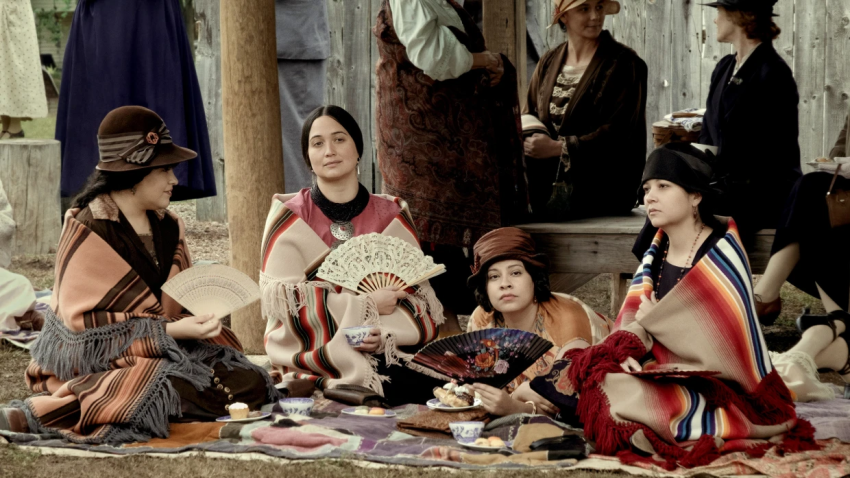
Still from the film, Killers of the Flower Moon, showing Mollie sitting with her sisters on a large blanket on the ground. All of them are holding fans.


Read more!

2023/10/05

Setri and Setiawan: Matriarchal Society in The Secret Life of Bees by Sue Monk Kidd

I discuss a paper by Setri & Setiawan (Matriarchal Society in The Secret Life of Bees by Sue Monk Kidd)

Summary

This paper is the first result returned by Google Scholar when I searched by matriarchal society. The lead author has only published one (1) article which is cited mainly by other articles in the same journal. The definition of matriarchal society is based on power distribution.

Abstract

The abstract of the paper says, in part:

…At political level, August character shows as the matriarch or the leader in community with important role for overcoming conflict and decision making process. At economical level, it shows that matriarchal society common practice has right and same position in economic affair and giving gift each other to make the economic condition balance. Last, at spiritual and cultural level, it is described that women characters in The Secret Life of Bees believe in feminine divine which is the Black Mary and doing worship for her. In conclusion, The Secret Life of Bees novel clearly depicts matriarchal society based on the theory of Matriarchy by Heide Göettner-Abendrot.

p. 28
Emphasis Mine

Definition of Matriarchy

The authors use the following definition of matriarchy:

At some points, values in a cultural context define the right and the wrong (Lina & Setiawan, 2017). Further, modern matriarchy is not merely social structure based on maternal lineage; however, it is rather a maternal value as Göettner-Abendroth (2009) stated:

“Matriarchy is mother centered society as the most important function to insure its future. This social system is based on maternal values includes care-taking, nurturing, motherliness, peace-building, in which these hold for everybody for mothers and those who are not mothers, for women and men alike.”

p. 28

In Marxist terms, the authors see a matriarchy centred on the elevation of reproductive labour. From that centering, political power flows to women. The authors (p. 29) see this political power as facilitating consensus-building. The authors (pp. 29-30) see the matriarchical economic system as communism. They clarify this as follows:

Matriarchy social system emphasizes the role of mothers within society who take over all responsible for others include economic needs, social needs, or cultural and politics. It is not just a reversal form of patriarchy in which women ruling over men, however, it is more likely complementary equality between the genders and generations and it is not necessarily need mothers’ biological relation.

p. 30

The authors used behavioural analysis to determine the structure of the society, rather than the flow of surplus value:

In conclusion, in order to know that certain society is categorized as matriarchal society, it is important to observe their behaviors and activity within their community, and then use precise theory as a guidance to find the result.

p. 32

Teta Irama Setri

Google Scholar has Setri at Universitas Teknokrat Indonesia. This author has only published one (1) article of note (the first two (2) entries in the following table from Google Scholar are duplicates):

TitleCited byYear
Matriarchal Society in The Secret Life of Bees by Sue Monk Kidd
TI Setri, DB Setiawan
Linguistics and Literature Journal 1 (1), 28-33
4942020
Matriarchal Society in The Secret Life of Bees by Sue Monk Kidd. Linguistics and Literature Journal, 1 (1), 28–33
TI Setri, DB Setiawan
3232020
SYSTEMATIC FUNCTIONAL LINGUISTICS: TRANSITIVITY ANALYSIS ON ONLINE NEWSPAPER
TI Setri, DT Erlangga
 2023
Presupposition in The Jakarta Post News Article
TI Setri, DT Erlangga
 2022

Linguistics and Literature Journal

The Linguistics and Literature Journal is not among the top 100 journals according to Google Scholar, nor among the top twenty (20) when searched by the journal name. This journal is published by the same university where the lead author is employed.

Citations

The top thirteen (13) citations are all from the same journal. This paper seems to be a niche article.

References

  • Göettner-Abendroth, H. (2009). International Academy HAGIA [Online]. Retrieved from https://www.hagia.de/en/matriarchy/
  • Lina, Desma & Setiawan, Dwi Budi. (2017). An analysis of culture shock from west to east as seen in Rielly’s The Tournament. Teknosastik: Jurnal Bahasa dan Sastra, 15(1), 14-20.
  • Setri, T. I., & Setiawan, D. B. (2020). Matriarchal Society in The Secret Life of Bees by Sue Monk Kidd. Linguistics and Literature Journal, 1(1), 28-33.
Nampeyo and Family, 1901, Adam Clark Vroman


Read more!

2023/09/12

Comments on "Cultural hitchhiking and competition between patrilineal kin groups explain the post-Neolithic Y-chromosome bottleneck"

I compare "Cultural hitchhiking and competition between patrilineal kin groups explain the post-Neolithic Y-chromosome bottleneck" with "Patriarchy and the origins of women’s oppression" by Sue Bull.p>

Bull (2023) write:

But the clan system started to break down under the pressure of a family system propelled by husband headed family units based on the individual labour of men in ploughing and herding. Boyle goes on to say: “Private property first developed through a gradual privatisation of communal property by an elite that used religion and war as cover and justification. In the process, women, like slaves, land and livestock, become their private property.”

It is in this context that inheritance became critical. Now, men wanted to prove that their children were their own, so monogamy intensified for women and their confinement became a growing requirement. Brewer notes: “inheritance led to accumulation of wealth over generations, developing the social hierarchies of class, status and power… It is ironic that while the discovery of farming by women at the beginning of the Neolithic period was such a positive leap forward, by the end of the Neolithic it had changed into a negative outcome for women… their subordination and powerlessness in the developing class society and all class formations from that time onwards.” In other words once women lost their direct role in agricultural production, they lost their status, power and equality as well.

It is likely that all of this was developing before and during the first fully formed class society of ancient Sumer, about 5000 BC, and patriarchy was developing too.

Emphasis Mine

Bull (2023) contends that the emergence of the patriarchy was a consequnce of the change of gender roles during the transition to agriculture from hunter-gatherer. Bull quotes Boyle saying that private property was the primary driver for the establishment of the patriarchy.

Zeng et.al. (2018) notes that:

In human populations, changes in genetic variation are driven not only by genetic processes, but can also arise from cultural or social changes. An abrupt population bottleneck specific to human males has been inferred across several Old World (Africa, Europe, Asia) populations 5000–7000 BP. Here, bringing together anthropological theory, recent population genomic studies and mathematical models, we propose a sociocultural hypothesis, involving the formation of patrilineal kin groups and intergroup competition among these groups. Our analysis shows that this sociocultural hypothesis can explain the inference of a population bottleneck. We also show that our hypothesis is consistent with current findings from the archaeogenetics of Old World Eurasia, and is important for conceptions of cultural and social evolution in prehistory.

Emphasis Mine

It would appear that the emergence of the patriarchy had a devasting impact on males as only about 6% were able to pass on their genes across the Y-chromosome bottleneck. What is more interesting that cultural changes were able to emerge after about a 1,000 years to remove that bottleneck. That cultural change was able to preserve elements of patriarchy while expanding the percentage of males able to pass on their genes.

This improved model of the patriarchy has been able to survive for about 6,000 years. This longevity means that patriarchy solves cultural problems. In order to overthrow the patriarchy, one must devise alternate solutions to the cultural problems that the patriarchy currently solves. And these alternate solutions need to be acceptable to enough males that the cultural changes gain traction.

The question is what cultural problems patriarchy solves. This needs further investigation.

Каменный век (1)

References

Bull, S. Patriarchy and the origins of women’s oppression, 16 July, 2023, https://links.org.au/patriarchy-and-origins-womens-oppression

Zeng, T.C., Aw, A.J. & Feldman, M.W. Cultural hitchhiking and competition between patrilineal kin groups explain the post-Neolithic Y-chromosome bottleneck. Nat Commun 9, 2077 (2018). https://doi.org/10.1038/s41467-018-04375-6


Read more!

2018/01/12

Gay Alcorn: Helen Garner's The First Stone is outdated. But her questions about sexual harassment aren't

Gay Alcorn writes that Helen Garner’s The First Stone is outdated. But her questions about sexual harassment aren’t.

Garner is “aware of the immense weight of men on women, the ubiquity of their attentions, the exhaustion of our resistance”.

But through the book, there is no sense that that could change. It just couldn’t be comprehended at the time. It is hard to overstate what a mind shift that has been over the past few months, what an explosion of insight and possibility.

For this moment is not really about sexual harassment. It is about the unfinished project of equality between men and women. That has much more to do with disadvantaged women with casual jobs than Hollywood stars with all their privileges. But most women, from all classes, all backgrounds, recognise that “weight”.

Yet Garner won’t let women off the hook, not for a moment. She reminds us that feminism is about justice.

Unjust is the word for the behaviour of men who use their position of power as a weapon in forcing women to endure their repeated sexual approaches, or who take revenge for a knockback by distorting a woman’s career or making her workplace intolerable or sacking her. Unjust does not apply to a clumsy pass at a party by a man who’s had too much to drink.

These days, it does, and mostly should, if that man is a leader in an organisation. But her point about proportion, about gradation of offence, rings true today. The hardline view that every transgression reinforces rape culture and misogyny is a hindrance, not a help. “The ability to discriminate must be maintained,” writes Garner. “Otherwise all we are doing is increasing the injustice of the world.”

Emphasis Mine

In realising the dignity of women, men realise their own dignity.


Read more!

2017/07/14

Dilar Dirik: The revolutionary feminists fighting ISIS

Dilar Dirik writes about The revolutionary feminists fighting ISIS.

Rojava’s revolutionaries are trying to formulate an identity around principles rather than ethnicity. The presence of an autonomous women’s army, unapologetically committed to women’s struggles, in a sea of militarist, patriarchal violence, constitutes the most liberationist, anti-capitalist, anti-fascist element.

By organising in cooperatives, communes, assemblies and academies, women become the guarantors of freedom.

Male domination has not been overcome entirely, but women have established a political culture that no longer normalises patriarchy and unconditionally respects autonomous women’s decision-making mechanisms.

The YPJ underlines that the most direct way of defeating religious fascism, statism and other forms of authoritarianism is women’s liberation.

Emphasis Mine

Capitalism alienates us from our work and, by doing so, alienates from each other. That product was not made by a person but by a company.

This alienation is maintained through racism, sexism, homophobia, xenophobia, nationalism, etc. I cease to be myself, but I became a white man of certain sexuality who is an Australian.

In order to build a better world, we have to take control of our identities. I need to reproduce myself every day as a worker who is working towards a Communist future. In doing so, I have to fight against the Capitalist molding of my soul.


Read more!

2016/04/23

Ruken Isik: Women struggle for a new society in Rojava

Ruken Isik writes about Women struggle for a new society in Rojava.

The idea of democratic autonomy is directly opposed to the ideology of the nation-state, which in the Middle East is tightly bound to ideas of cultural and ethnic homogeneity. The new system in Rojava is more of a multicultural, multilingual, and multireligious system that is designed to “allow the legal participation of individuals who will be able to mobilise and organise along the lines of ethnicity, religion, gender, class.”

It is a system of self-governance that rejects the model of centralised administration. This is also the model of self-rule advocated by the Kurdish movement across the border in Turkey. Women in Rojava believe that this system can and does enable them to organise, and to participate in all decision-making processes.

…

The West always presents itself as deeply invested in bringing change and democracy to the Middle East. Yet the Kurds, together with the other ethnic groups now administering themselves for a better future, have been historically and continue to be ignored by the international community, which has turned a blind eye to the Kurds in general and to Kurdish women in particular.

As they work to build a society grounded in a systemic commitment to gender equity, the women in Rojava want to be in dialogue with international women's organisations and share their experiences.

Emphasis Mine

It is in the obscure parts of the world that the real social revolution is occurring.


Read more!

2016/04/16

Lucinda Donovan: University of Queensland bake sale backlash

Lucinda Donovan writes about the University of Queensland bake sale backlash.

Shortly after the event was announced, its Facebook page was flooded with threats of death and rape, both at the event organisers specifically and at women in general. Comments such as “kill all women” were popular, as well as a meme that depicted a victim of domestic violence and her abuser with the words “women deserve equal rights, and lefts”. Other comments and threats received both on the page, and in the personal inboxes of the organisers, are too foul to reproduce here.

Once again the attempts by misogynists to devalue and disprove the relevance and use of feminism has proved exactly why it is so desperately needed. Lewis's Law — that the comments on any article about feminism justify feminism — seems to be right yet again. When something as inoffensive as a bake sale is enough to provoke such hatred, what does that say about how we view women?

The hatred received for this bake sale was not just limited to a few trolls, but many commenters, some still in high school. When such vile opinions are still so readily spewed by so many, and those so young, it becomes apparent that not only do we still desperately need a powerful feminist movement, but that we also have a massive way to go.

Emphasis Mine

Oppression is not just by the ruling class. A significant proportion of the general population must also be actively involved.

A pervasive oppression means that young people readily engage in it without critical thought. This oppression flows through the education system and mass media, and encourages teenage boys to act in horrific ways.

Heterosexuality is seen as only being expressed through violent oppression of women. Thus, rape and threats thereof are seen as normal.

This rape mentality then spreads out to all outsiders: homosexuals, prisoners, protesters. Rape signifies the power relationships within any oppressive system.


Read more!

2015/10/24

GLW: Who's to blame for Australia's domestic violence crisis?

Liah Lazarou asks Who's to blame for Australia's domestic violence crisis?.

The money exists to fund the kinds of services and programs necessary to enact the changes we desperately need. Imagine if the tens of millions of dollars allocated each day for military expenditure was redirected to vital services such as health centres, rape crisis centres, women's refuges and counselling, education, training and employment services for all women and their dependents.

Or if Australia's biggest corporations were taxed in such a way that a portion of the billions of dollars of profits they make each year had to be spent on public and community education.

Domestic violence is not incidental: it is built into a class system that profits and maintains itself through women's oppression and exploitation. Addressing the underlying cause of violence against women requires ending sexism and gender inequality.

We need a feminism that fights for programs and services to help women survive right now, at the same time as it fights the structures which perpetuate sexism and gender inequality.

Emphasis Mine

Capitalism is a violent system as any system that is based upon exploitation, has to be. Slavery was violent: Feudalism was violent.

The Capitalist's excuse is that humans are naturally violent and greedy, and the system has to accommodate these traits.

But as human beings, we have the ability to transcend our base selves and create a better society. Do we dare to do so, or just accept the current situation?


Read more!

2015/09/30

Ted Rall: Carly Fiorina, Identity Politics and the Death of Feminism

Ted Rall writes about Carly Fiorina, Identity Politics and the Death of Feminism.

In the crucible of the 1970s, identity politics had its place. Where would feminism have been without the identifier of Ms. Magazine? Trans people, the latest to step out of the shadows of historical marginalization and oppression, have gotten where they are today via an identity politics that, first things first, made it OK to be proud of who and what you are.

But that was then and this is now. Now identity politics is all identity, no politics, all image, no substance.

…

But lesser evilism, that bastard cousin of identity politics, is the first express stop on the road to ideological ruin. Bernie Sanders — old and white and male — is 50 times the feminist that Hillary Clinton will ever be. I know because I’ve read his platform, which would do a lot more than Hillary, and a zillion times more than Carly Fiorina, to help women.

And that’s leaving out the world where feminism should inhabit: the perfect ideal of total gender equality. We’re not going to get to equality under this variety of capitalism, or any other kind of capitalism. How can an identity politics that distracts real live feminists with the likes of a corporate monster like Carly Fiorina start to destroy and replace the entire system?

Emphasis Mine

The real identity politics is based upon our identity as workers. This has to be frontmost in our minds. The politics is then derived from our exploitation by the Capitalists and alienation from the fruits of our labour.


Read more!

2015/05/30

Liberal feminism's limits exposed

Meave Noonan writes that Liberal feminism's limits exposed.

A key weakness of the book is its relative silence around class, and failure to properly situate women’s oppression within the context of capitalism. A more sustained, overarching emphasis on the intersection of class with sexism, racism and other axes of oppression would help to illustrate the complex ways in which the system of capitalist accumulation benefits from the continued subjugation of women and other oppressed groups.

The changing nature of employment under neoliberalism is an issue which bears heavily on women, and it is therefore somewhat surprising that the book does not offer a more focused discussion of this issue.

Women are among those worst affected by the predominance of insecure work. The at-times outright contempt shown by both sides of Australian parliamentary politics for the disadvantage faced by single, working-class mothers casts the limits of liberal feminism into sharp relief.

The radical potential of feminist thought and action, if it is to achieve meaningful social change for all women, must be connected to the wider aim of creating a more just, egalitarian society.

Emphasis Mine

This requires the non-capitalists to see past the great national security swindle and be prepared to see why alliances for socialism must be built.


Read more!

The great national security swindle

Tony Iltis debunks The great national security swindle.

The number of fatalities from terrorist attacks in Australia is tiny. Even taking into account Australians killed overseas, such as those killed in the 2002 Bali nightclub bombing, there are far greater threats to Australian lives.

Safe Work Australia reported: “As at 26 May 2015, 65 Australian workers have been killed while at work” this year, and 38 women have been killed in domestic violence attacks since the start of the year.

The same state and federal governments that find unlimited resources to fund draconian “anti-terror” policing and prosecutions are unable to fund accommodation for women fleeing partner and ex-partner violence. “In March, there were 33,933 people on the Victorian public housing waiting list, with 9556 eligible for 'early' urgent housing, which includes many who have suffered family violence,” the May 22 Age said.

The Abbott government has responded to this threat to Australians' lives by further cutting funding to women's services and housing.

The government's response to the threat to Australians' lives from workplace accidents has been to foreshadow a further round of criminalisation of trade unions, particularly construction workers' unions, for attempting to protect occupational health and safety.

The Abbott government's attempts to convince Australians that they are threatened by terrorists was helped by the opening of the inquest into the deaths of Man Haron Monis and two hostages when he hijacked a Sydney cafe in December.

However, so far the evidence presented to the inquest suggests that Monis was an attention-seeking psychopath with a shotgun rather than an ideologically motivated terrorist.

Emphasis Mine

The issues of violence against women and the sacrifice of safety for profits do rank on the Capitalist agenda. The perpetrators are among the supporters of Capitalism: violent men and ruthless business owners. One does not attack one's own supporters.

Yet, the ruling class wants an enemy that we are all frightened of so that we need them to protect us.

We need to discover who the real enemy is.


Read more!

2015/02/01

Anti-feminist actor sparks protests by pop culture community

Leela Ford writes that Anti-feminist actor sparks protests by pop culture community.

[Adam Baldwin] has continued to use the hashtag [(#gamergate)] for other tweets promoting the idea that feminism is trying to destroy male gaming culture, among other things. The hashtag became popular among sections of the gaming community who were taking up the cause of a movement that Baldwin claims is about "ethics in games journalism".

However, the movement turned very quickly into a misogynistic attack on women in the gaming industry after a number of feminist critiques were released exposing sexism in the industry.

Baldwin proceeded to tweet personal information of Quinn and another game developer Brianna Wu, which was used by his supporters to send threats to the women. Baldwin then accused Wu of lying about being driven from her home amid safety concerns. He also accused another woman, Anita Sarkeesian of being hysterical after receiving messages threatening violence and rape.

Wu has publicly supported the petition by spreading the link on twitter while calling Adam Baldwin a “sexist bully”. She also tweeted her own feelings on the issue saying: “Something geek culture is struggling with is making the culture open to women. I think Adam Baldwin is the complete opposite of this goal.”

Baldwin is a self-professed conservative who prides himself on speaking up against what he believes are “social justice liberals” trying to silence his “dissent” and “destroy [his] personhood”. In another one of his Twitter crusades last year, he said that gay marriage would lead to incest for tax benefits.

Emphasis Mine

Feminism is a credible threat to to the patriarchy as it should be. Exposing sexism is a vital task for feminists. Without debate around what constitutes sexism, feminism cannot advance.

Those who derive their identity from the patriarchy are rightly threatened by this exposure. Thus, they respond by the only means they know how: threats of rape and other violence. Then they are dismayed when their apparently “normal” behaviour is called out as vile and reprehensible. This is how the patriarchy has always responded.

Again I reiterate my thesis as expounded in “I am not Charlie Hebdo”—freedom of speech is not an absolute right. Those, like Baldwin and the rest of the #GamerGate community, do not have freedom of speech because they are using speech to threaten and oppress others. While those, like Wu and Sarkeesian, do have the right to free speech because they are fighting against the oppression of the patriarchy.


Read more!

2015/01/24

Let's end this domestic violence epidemic

John Rainford writes Let's end this domestic violence epidemic.

The inquiry, which is to report by February next year, will be led by the Supreme Court judge Marcia Neave. It is required to focus on practical solutions to what has, so far, largely been an intractable problem.

But while the Victorian royal commission is a good start, violence against women is not confined to Victoria, or any other state for that matter. It is a national problem that accounts for 40% of police time, costs the national economy $14 billion each year and affects more than one million children.

But with Tony Abbott federal minster responsible for women's policies and programs, an announcement of a strategy dealing with it is unlikely to be made any time soon.

Emphasis Mine

Any oppressive society is enforced by violence at all levels of society. Voilence permeates the whole of society. It is in the home, in the work-place, on public transport, on the roads, everywhere.

We live in an economic and political system that solves problems through violence.

This is why we are involved in wars in Iraq, Syria, and Afghanistan. Any political solution was not acceptable to the ruling class. They had to demonstrate naked, raw power in order to intimidate all others.

This logic then flows through the rest of society. To get my own way, I have to take it. There is no negotiation. Even if there is negotiation, it has to be seen as a zero-sum game.

The Other is the enemy. They cannot never be a friend. This is the poison that is destroying humanity.

When humanity needs global action to avoid extinction, we are fighting over the scraps like rabid dogs.

Seeing the Other as a human being is hard because it requires that confront and overcome the conditioning we have undergone, and that we no longer conform to the norms of society.


Read more!

2015/01/03

Male nerd privilege

Cathy O'Neill writes about Male nerd privilege.

Would it help if we gave it another name? Basic human rights, perhaps? Because that’s what we’re talking about, at the end of the day. The right to be free, to not get shot by the police, the right to hold a good job and care for your family, stuff like that.

Of course, there are plenty of people who are unwilling to move to the next level because they don’t acknowledge the structural racism, sexism, and other stuff at all. They don’t see the current situation as problematic. But on the other hand, there are loads of people who do, and Aaronson is clearly one of them.

As for problems for women in STEM, we’ve already studied this and we all know that both men and women are sexist, so it’s obviously not a blame game here. Instead, it’s a real cultural conundrum which we would like to approach thoughtfully and we’d like to make progress on as a team.

Emphasis Mine

It is a cultural problem that can only be solved by moving to a classless society for things like sexism and patriarchy serve the interests of the ruling class by dividing people against each other. Once you accept division by gender, you are more likely to accept division by privilege.

In order to overcome such divisions, we have to mature as adults instead of being children squabbling over who's got what toys and whom mummy and daddy loves the most. This is a very painful social development, and many choose to remain as adolescents: privileges of adults with the responsibities of children.


Read more!

2014/12/18

Rolling Stone hangs rape victims out to dry

Caroline Hale chastises mass and social media as Rolling Stone hangs rape victims out to dry.

Rolling Stone let us all down, but most of all, they let Jackie down, by letting her become an example to all rape survivors of what will happen to you if you step out of line, if you don’t fit the impossible mold of a “good” victim but dare to speak out anyway.

It is disappointing to see so many progressive media outlets reinforcing the same victim-blaming narratives as conservative pundits. Such narratives have a wide-reaching impact and tell people it is okay to disregard sexual assault survivors who don’t tick all the right boxes.

…

And what a convenient way to silence survivors: say that we can be heard and believed, but set the bar so high that only a tiny percentage of us are deemed worthy of listening to. And that those of us not worthy of listening too are deemed worthy of attack.

…

But people who are serious about campaigning to end rape culture do owe solidarity to anyone who speaks out like Jackie did, especially someone like Jackie who had asked not to have her story published — a solidarity that includes challenging victim blaming myths that silence survivors.

Emphasis Mine

As John Pilger says, there are worthy victims and there are unworthy victims. People who are oppressed by the current system are unworthy victims. And those who fulfil a need for the system are worthy victims.

Compliance with the systems requires one to ignore the pain and suffering of the unworthy victims. For to accept and console such pain suffering is to challenge the inherent goodness of the system. And ruthless systems do not tolerate such challenges. Their legitimacy derives from the acceptance of their inherent goodness.

Brutality, such as rape and torture, delineates between the rulers and the ruled. The former can do what they like to the latter with presumed impunity.

One cannot accuse those fine, young men who will one day ascend to the highest echelons of our society in order to continue the benevolent rule of our masters. They cannot be such beasts to rape and brutalise other people. It that were true, it would call into question the inherent superiority and quality of our ruling class.

This is why all such claims must be quickly quashed and forgotten. Otherwise the system would be exposed for the rotting corpse that it is, and civilization would collapse because there is no alternative (TINA) to Capitalism.

This brutality serves to keep us in line, for we know what will happen to us if we dare to question the system.

Thus, there is a contradiction to brutality. We cannot believe the victims, nor publicly call it out. But we must silently acknowledge its existence through our continued compliance.


Read more!

2014/11/04

Feminism and Exclusion from Power

In Rebecca Solnit blog post, “The War Is Over (If You Want It), Feminism and Men”, she writes that:

The highest powers in the country [USA] have begun calling on men to take responsibility not only for their own conduct, but for that of the men around them, to be agents of change.

In my initial assessment of this post, I disagreed by writing that:

This war can not be won by participating in the current power structure because misogyny is the key to power. In order to have power in a Capitalist, one must be a misogynist. Becoming a feminist excludes one from power.

This is because of the fundamental authoritarianism of male culture: violence. Women see the direct violence violence through rape, murder, domestic violence, pornography, sexual harassment, office politics, slurs, glances. But there is also the hidden violence under which men live their lives.

Violence among males starts early with bullying, abuse, punishment, masculinisation. This is mainly violence for violence's sake. The message is that you can be hurt no matter what you do or say. It is important to know that violence can be inflicted and you are powerless to stop it.

Indeed, during my school years, corporal punishment was seen as a way of taming the wild beasts that we boys were seen as. This could be administered by almost anyone: parents, elder siblings, teachers, police, priests, nuns, and even total strangers. It was okay as long as there was seen to be taming the wildness or beastliness of the boys.

Looking back now, the degree of beastliness seemed to be determined by class and ethnicity. Aboriginal boys got the worst no matter how well behaved they were. And their parents believed that they deserved it. No wonder the boys turned into men with no belief in decency or society. They had been beaten into beasts.

We, of the lower orders and paler complexions, fared somewhat better. Yet, we were turned into beats. I know of two (2) boys from my youth who murdered their fathers. There was always a tension within the neighbourhood about there would be one beating too far, and an orgy of violence would erupt.

This is the sheer terror of living in a violence-saturated world. One small mistake could be your last. So, you become cautious and predictable.

And this leads to the problem of alcohol during our adolescence: the reactions are intensified and the violence becomes deadly. Mistakes are truly fatal.

Yet, this problem of hidden violence does not disappear in adulthood. I am still threatened with rape or serious injury if I get too uppity. I am more adept at avoiding it. It is a part of my life.

What can I do about it? One thing I could do is join the power structure. I could become a dispenser of violence. This would take the edge off being a victim.

And I would be rewarded for doing so. I get access to more social status, more power, more credibility, more money, more sex, and better health.

So, why don't I? If I did, I would have to become someone I truly hate. I remember almost all of that abuse I suffered. I hate the perpetrators for doing that. I understand why they did it—they were trying to survive. It was them or me. Sensibly, they chose me.

In order to be a male feminist, one has to stand outside of the power structure and be seen as being weak. Therefore one becomes a target.

Those in power are not going to seriously weaken the basis of their power. It is up to we outsiders to do that for them.


Read more!