Showing posts with label Europe. Show all posts

2023/11/10

Jörn Schütrumpf and Rosa Luxemburg: The Breakdown of Unity in the RSDLP

Jörn Schütrumpf discusses Rosa Luxemburg: The Breakdown of Unity in the RSDLP.

Lenin, by the way, was not innovative at all in this work. He merely repeated positions advocated by Marx and Engels 60 years earlier. By contrast, in 1922, three years after Rosa Luxemburg’s death, Lenin became quite enterprising and joined the list of male authors (other genders have probably signed up since) who hide behind Rosa Luxemburg quotes that they themselves made up: “‘German Social-Democracy has been a stinking corpse since 4 August 1914’ — this statement will make Rosa Luxemburg’s name go down in the history of the international working-class movement.’”

Although it is obvious that a Polish intellectual would never allow herself to come across in such a “Russian” way, unfortunately we must acknowledge that Lenin’s forgery was a successful one. Rosa Luxemburg has in fact gone down in history with this mindless nonsense, and on a global scale at that. Poor Rosa.

Emphasis Mine

Schütrumpf obviously sides with Luxemburg against Lenin. Schütrumpf and Luxemburg accuses Leninism of promoting fractionalism. Schütrumpf argues that Lenin has defamed Luxemburg in order to deflect Luxemburg's accusation.

Rosa Luxemburg writes:

Experience had convinced the overwhelming majority of Bolsheviks that the Leninist policy of organizational withdrawal into a narrow circle was extremely conducive to opportunism and detrimental to the revolutionary wing of Social Democracy: instead of attaining commanding influence over the whole party and rally it behind them, the Bolsheviks erect a factional wall that cuts them off from the party, thus condemning themselves to impotence.

Lenin’s organizational views, which had been swept from the face of Russian Social Democracy by the revolution and by the restoration of party unity, could only thrive again in an atmosphere of party disintegration, generated by the counterrevolution in general and by the liquidators in the ranks of the party in particular. Leninism, in its narrowness and with its sectarian organizational views, knows no other means of combating opportunism than to expel from the party anyone who disagrees. This is why Leninism is by its nature a policy of perpetual splits.

Emphasis Mine

When Luxemburg wrote this (1912), Lenin and the Bolsheviks were indeed swept from the vanguard of the revolutionary movement. It was only after the July days in 1917 that Lenin was able to lead the Bolsheviks to the forefront of the revolutionary movement. Between July and October 1917, the Bolsheviks emerged as the face of the revolution. The other revolutionary factions had faded or merged them selves into the Bolshevik faction of the RSDLP (especially Trotsky).

Luxemburg concludes (in July 1912):

The reunification of Social Democracy into one single party at the Stockholm Party Congress was the product and achievement of the 1905–6 revolution. Like many other accomplishments of the proletariat, this fruit of the revolution was wrested from us by the triumph of counterrevolution. The liquidationist tendency emerged and grew stronger under the impact of counterrevolution; mindless Leninism also thrived again, and the two tendencies have together brought about the collapse of party unity.

But now, a revolutionary movement has arisen among the working masses. And this movement is the surest guarantor of the imminent resurrection of the RSDLP under the banner of revolutionary Marxism.

Emphasis Mine

Luxemburg's hope were dashed by the events of 1917. Factions and persons that seemed revolutionary prior to 1917 faded or failed to maintain or adjust their revolutionary positions in reaction to the progress of the Russian Revolution.

Because of her murder during the German Revolution of 1918–1919, we don't know if Luxemburg would have reconsidered her position on Leninism in the aftermath of the October Revolution. If the German Revolution had succeeded, and a German Soviet Republic managed to survived, it is more likely the focus of the worldwide Communism would be in Berlin rather than in Moscow. Luxemburg's opinions would then have more weight than Lenin's.


Read more!

2023/10/09

Ted Rall: Clueless on Gaza

Ted Rall discusses how Americans are Clueless on Gaza

Gazans faced a choice.

They could obey Israel and its supporters. They could suffer, chafe under occupation, dodge bombs and bullets, starve, watch their friends and neighbors die, with no end in sight as the world keeps ignoring them.

They could stage protest marches that no important media outlet would cover, write firm-but-polite letters to the editor no one would publish and post to social media accounts no one would read. As they engaged in peaceful protest, they would keep starving and dying.

Or they could confront the Israelis with violence.

You can argue that violence is never the answer. You can claim that you’d be docile, that you’d live under blockade and occupation, never taking up arms or cheering those who do.

Go on, judge the Gazans. We both know you’d do the same exact thing if you were them.

Emphasis Mine

Back in 1943, there was the Warsaw Ghetto Uprising:

The uprising started on 19 April when the ghetto refused to surrender to the police commander SS-Brigadeführer Jürgen Stroop, who ordered the destruction of the ghetto, block by block, ending on 16 May. A total of 13,000 Jews were killed, about half of them burnt alive or suffocated.

Stroop reported 110 German casualties, including 17 killed.

The uprising was the largest single revolt by Jews during World War II. The Jews knew that victory was impossible and survival unlikely. Marek Edelman, the only surviving ŻOB commander, said their inspiration to fight was "not to allow the Germans alone to pick the time and place of our deaths". According to the United States Holocaust Memorial Museum, the uprising was "one of the most significant occurrences in the history of the Jewish people".

Emphasis Mine

One ghetto uprising is celebrated, while the other ongoing one is condemned.

Warsaw Ghetto Uprising (Poland) - Photo from Jürgen Stroop Report to Heinrich Himmler from May 1943. One of the most iconic pictures of World War II.


Read more!

2023/10/06

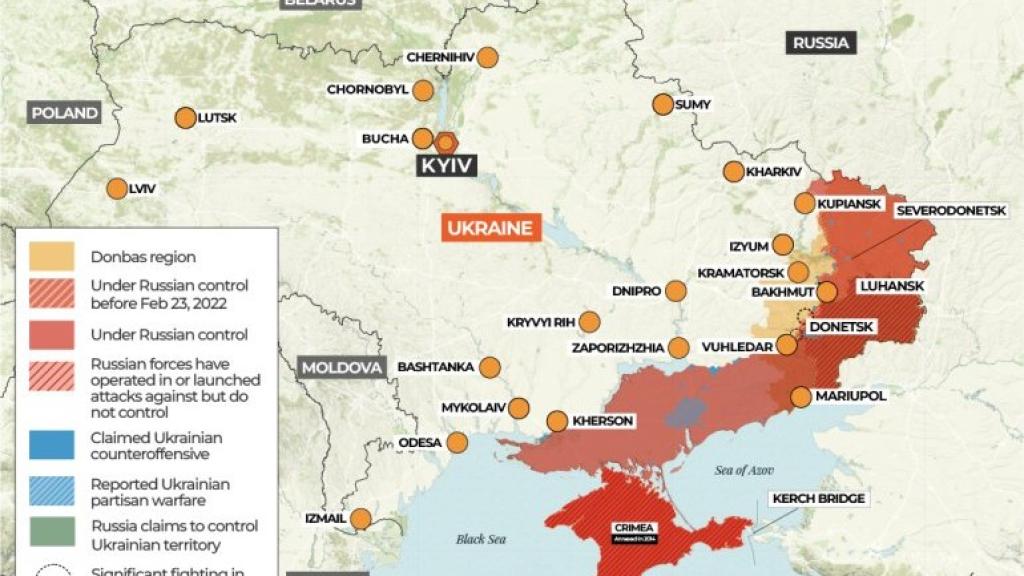
Dave Holmes: Ukraine: US proxy war in crisis

Dave Holmes discusses Ukraine: US proxy war in crisis

Much of the Western left is blinded by the deeply mistaken idea that Ukraine is fighting for self-determination against an attempted Russian takeover. I have taken up this question in a previous article (see Key issues of the war in Ukraine).

Russia is not seeking to take over Ukraine; it wants to secure its neutrality and demilitarisation. After eight fruitless years trying to achieve the implementation of the Minsk accords giving autonomy to the Donbass, Russia intervened in the already existing civil war between Kyiv and the Russia-oriented provinces in the south.

Emphasis Mine

He argues that Ukraine is in a far worse negotiating position than they were in April 2022. Now, Russia is against a freeze or cease-fire given the Russian view that they were deceived over the Minsk accords.

The Russian negotiating position now appears to be capitulation or extinction of the Ukrainian state. Some Russian voices are advocating control of Odesa, Mykilaiv, Dnipro, and Kharkiv oblasts in addition to the five (5) already annexed.

The de-industrialization of the West has weaken its ability to supply the Ukrainian Armed Forces. There is the incredible claim that Russia's military production is currently seven (7) times that of NATO.

Ukraine map


Read more!

2023/10/05

Eric Lee: Ukraine and the world’s unions — the view from Kyiv

Eric Lee discusses Ukraine and the world’s unions — the view from Kyiv

Ukrainian trade unionists cannot understand why some of their brothers and sisters — for example, those in COSATU — who helped bring down a fascist regime in their own country would today be supporting a fascist regime somewhere else. They cannot understand why people in former colonies are not supporting Ukraine in what is clearly an anti-colonial struggle against a brutal, imperialist enemy.

Ukrainian workers and their unions remain defiant. They want and expect their fellow workers and unions around the world to stand with them, in solidarity. It is the very least that we can do.

Emphasis Mine

Lee has forgotten the history leading up to World War 1 in which the international worker solidarity was smashed by nationalism. Megan Trudell writes in Prelude to Revolution: Class Consciousness and the First World War:

Such a cataclysm was bound to create social shock waves that would rock the world’s ruling classes. But it certainly did not appear at the start that revolutions would be a result of the conflict. The strength of nationalist feeling in the first year of the war is an aspect of the war that perplexes many – why was the patriotic frenzy so great and why did so many workers volunteer to fight so enthusiastically? The notion that nationalism is all powerful is often used to bolster the argument that all the ruling class has to do is wave the flag and workers will flock behind it. It is an argument not restricted to the First World War but one encountered during every subsequent war – right up to the modern examples of the Falklands, the Gulf and Bosnia. The question of whether or not nationalism is a more powerful impulse than class identification is therefore utterly bound up with any account of the war.

…

The same period also saw the growth of the national idea in the more established capitalist states, where, for example, a ‘new celebration of British nationalism, with the establishment, for the first time, of a state run educational system that indoctrinated children in the glories of “national” history, the writing of nationalist popular novels, plays, poetry and songs by literary admirers of the empire and the conscious invention of traditions aimed at encouraging popular identification with the monarchy’.

…

In part this enthusiasm was a response to ruling class propaganda about the nature of the war. Every ruling class involved argued the war was one of national defence. Germany was defending itself from Russian aggression, France from German militarism. Britain was defending ‘poor little Belgium’. Each ruling class pushed the idea that there was an outside threat to the democratic rights enjoyed by the nation’s citizens, and in part the response of each country’s working class was an identification with one’s nation and a desire to protect one’s way of life.

But it wasn’t a straightforward calculation on the part of the ruling classes involved. Such had been the scale of domestic crisis in most of the countries involved that it was not at all obvious that workers would respond to the call to arms. In Britain, against a background of social upheaval and a potentially explosive situation in Ireland where the pressure for Home Rule was mounting, the Liberal minister John Morley considered that ‘the atmosphere of war cannot be friendly to order in a democratic system that is verging on the humour of [18]48’. Ruling classes across the globe were in fact astonished by the scale of patriotic zeal. This should not be surprising: nationalism is not simply imposed from above, but has to in some way correspond to existing national sentiments among a section at least of the population – often the middle class – and grips the minds of the masses when other social change seems remote.

It is not simply the case that workers who had fought so hard for social change in the pre-war years suddenly turned their backs on their own struggles and were brainwashed by their respective governments. Much of their motivation can be traced precisely to the holding back, or even defeat, of such social struggles. The vision of war came to seem as if it were an alternative way of dramatically transforming society. Magnus Hirschfeld described the response to the declaration of war as ‘a discharge of tensions that had built up for years’. Ferro argues that the ‘worker of 1914, going off to war, had found a substitute for revolutionary hopes.’ Many workers went to fight with ‘an image of war as the antithesis of the boredom, materiality and mechanisation of every day life’. …

Emphasis Mine

We are seeing the same patterns now. There has been fifty years of retreat of workers' solidarity within countries with the advance of neo-liberalism. And the retreat of international solidarity with the advance of offshoring through globalism, and the refugee crises. Workers are being pitted against each other within countries and between countries.

Eric Lee Ukraine


Read more!

2018/01/17

Dina Khapaeva: Putin's Medieval Romanticism and Russia's Lurch Right

Dina Khapaeva writes about Putin's Medieval Romanticism and Russia's Lurch Right.

Joseph Stalin initiated the modern cult of Ivan the Terrible. But, since the mid-2000s, Russia’s Eurasia Party — a political movement led by the pro-fascist mystic Alexander Dugin — has moved to position Ivan as the best incarnation of an “authentic” Russian tradition: authoritarian monarchy.

Dugin’s brand of “Eurasianism” advocates the embrace of a “new Middle Ages,” where what little remains of Russian democracy is replaced by an absolute autocrat. In Dugin’s ideal future, a medieval social order would return, the empire would be restored, and the Orthodox church would assume control over culture and education.

Eurasianism, which was marginal in the 1990s, has gained considerable popularity in recent years by contributing to the formation of the so-called Izborsky Club, which unites the Russian far right. On several occasions, Putin has referred to Eurasianism as an important part of Russian ideology; he has even invoked it as a founding principle of the “Eurasian Economic Union,” a burgeoning trade area of former Soviet states.

Emphasis Mine

And so begins the drift to Fascism in Russia: an authoritarian state run for the Plutocrats with nationalism to keep the people in line. How Donald trump must be envious of Vladamir Putin.


Read more!

2018/01/05

Dan Little: Europe after World War II

Daniel Little writes about Europe after World War II.

Perhaps more than in most histories, Judt's narrative makes it clear that there are large moral realities interwoven with the facts and events he conveys. Individuals commit actions that are deplorable or admirable. But more profoundly, whole nations were confronted with choices and actions in these decades that were formative for generations to come. This is nowhere more apparent than in the ways different European countries dealt with their own responsibility for the extermination of the Jews during the Holocaust. Judt deals with this issue in the epilogue to the book, and it is an important piece of historical writing all by itself. (A version was published in the New York Review of Books (link).) He demonstrates that almost none of the involved nations — especially the Netherlands, Poland, Italy, France — lived up to the duty of confronting honestly the behavior of its citizens and officials during the Shoah. France's mendacity in particular on the subject of its willing deportation of 65,000 Jews created a permanent stain on French culture — and it laid the basis for the continuation of denial of French responsibility by the FN up to the present day.

Emphasis Mine

Here we encounter the interplay between subjective and objective realities. An individual's subjective reality of denying the Holocaust is bolstered by the objective reality of no offical acknowledgement of the State's historical role in the Holocaust. And the objective reality cannot be changed without overcoming the fierce resistance of these individuals.


Read more!

2016/05/12

Doug Enaa Greene: The rise of Marxism in France

Doug Enaa Greene describes The rise of Marxism in France.

Engels recognized the danger of a Boulangist dictatorship as spelling the end not only to the socialist movement in France, but the Third Republic itself. For him, the question was not just how to analyze Boulangism, but how to fight it.

Engels was enraged at the passivity of the POF, writing of the general's ties to royalists and that his threat of war would be used to kill off the workers' movement. Engels warned the socialists not to let their hatred of the radicals and the Republic blind them to the threat of dictatorship.

You will get him all the same, the good Boulanger whom you crave, and the Socialists will be his first victims. For a First Consul has got to be impartial and, for every time he lets the blood of the Stock Exchange, he will place another curb on the proletariat, if only to even things out.[39]

Engels told the workers that the defense of democracy was vital, so vital in fact, that its defense could not be left to the bourgeoisie. Rather the preservation of democratic freedoms needed to be led by the socialists, utilizing revolutionary means.

However, Engels' castigated Lafargue's tailing of Boulanger, warning that it was not the job of socialists to just go along with the tide, even if it appeared momentarily popular, stating that such a course was bankrupt. Rather, socialists needed to take a long-term view and not just follow whatever was popular:

But if we are not to go against the popular current of momentary tomfoolery, what in the name of the devil is our business?[40]

MWhat Engels stressed to Lafargue and Guesde was that the options before them were not simply between the Opportunists and Boulanger, but that there was a third option of independent political action by the working class. He urged the socialists to put up their own candidates, opposed to those of both camps. When the Marxists put up their own candidate in Paris in 1889, Engels hailed it as “at least one step in the right direction by proclaiming the necessity of an independent socialist candidature.”[41] As Engels, reminded Lafargue, “For the past twenty years we have been advocating the formation of a Party that was distinct from and opposed to all bourgeois parties.”[42]

What Engels advocated to the POF, was not renouncing the fight against Boulanger or seeing it as just another inter-bourgeois affair, but that the working class needed to protect democratic freedoms with their own revolutionary means, as opposed to relying on the good graces of the ruling class or the ballot box. And in order to defeat reaction, the working class needs their own flag in the field — an independent political party with its own revolutionary agenda.

Emphasis Mine

Engels' critique of the POF (French Workers' Party) proved to right as later events revealed:

By the early 1890s, the POF had its first electoral breakthroughs, winning control of several municipal governments and electing Guesde and Lafargue to the Chamber of Deputies. The socialists seemed poised for greater gains in wake of the Panama Corruption scandal, which exposed the underlying bourgeois nature of the Third Republic. However, the POF suffered a serious setback by remaining aloof from the Dreyfus Affair. Guesde believed that the Dreyfus Affair, similar to the Boulanger Crisis, was a feud between two bourgeois factions in which workers had no stake. This time, their neutrality backfired as it became clear that reactionaries, conservatives and royalists were threatening to overthrow the Republic itself. Reformist socialists, such as the great orator Jean Jaures, thus stepped into the breach and rallied to the defense the Republic. Many Guesdists abandoned the movement's neutrality in order to collaborate with bourgeois republicans and reformists in a pact of “Republican Defense“ to defeat reaction.

Emphasis Mine

As revolutionaries, we can stand aloof from the democratic struggle. Politics is in both the mass movements and the electoral process.


Read more!

2016/05/05

Dick Nichols: Greece: vulture creditors jostling for their next feed

Dick Nichols writes that vulture creditors jostling for their next feed in Greece.

The strategy is to increase the pain that the SYRIZA-led government has to inflict on its support base as the price of getting each new tranche of desperately needed funding: in this way, the government will hopefully become so unpopular that the conservative New Democracy can defeat it at the next election, which could be brought on early by the refusal of some SYRIZA MPs to support the next wave of austerity measures.

At the same time the idea of a radical left alternative can be discredited across Europe, especially with a view to undermining the position of anti-austerity forces in the repeat Spanish election due for June 26. If Germany and the IMF reject Tsakalotos' alternative to the creditors' “contingent” cuts package — the commitment to meet deficit targets in case of shortfall but with flexibility for the Greek government to decide how — it will be clear confirmation of their intention to remove SYRIZA from government as soon as politically practicable.

Emphasis Mine

The brutality imposed on the Greek people is a warning to everyone else that change is not possible within the Capitalist system.

Nonetheless, only six months after its September election win and despite its best efforts, SYRIZA's message looks to be wearing thin. In a context of ongoing social revolt voices expressing concern at growing popular alienation with the government are more and more heard within the radical coalition.

On April 15, according to the Macropolis web site, the “movement of 53”, the most left-leaning of the groupings within SYRIZA and with 11 MPs including Tsakalotos, issued a statement which said that, while SYRIZA had been able to argue convincingly enough at the September poll that it had been forced into signing the third bailout, the memorandum was now increasingly seen as the left coalition’s own program rather than one imposed by Greece’s creditors. The group also criticised slow progress in implementing the parallel program and stressed that much more was needed to maintain the belief of SYRIZA's supporters.

Most tellingly, it said that it disagreed with the opinion of the Tsipras leadership that SYRIZA should try to stay in government at all costs, stating that the government should “fall heroically resisting the internal or external troika rather than humiliatingly at the hands of [Greek] society itself.”

Emphasis Mine

This is the main problem of a reformist program—all of your efforts are tied to working within the Capitalist system while having minimal power. People should see that the attainment of government power does not lead to a better world. The Capitalists would not allow this.

The conclusion is:

What factors, then, would possibly prevent the German-IMF position from prevailing in the negotiations? As always, the creditors must calculate what the political price of that hard line might be. It might:

  • Deepen the struggle of resistance inside Greece, strengthening forces to the left of SYRIZA and complicating the job of installing a more reliable New Democracy-centred administration;
  • Revive the spectre of Grexit and of euro instability at a time when the European establishment is committed to avoiding Brexit;
  • Provide another example of the brutality of the European Union powers-that-be that would become a factor in the June 26 Spanish election, at which it is not excluded that alliances of Podemos, the United Left and various left nationalist formations could overtake the Spanish Socialist Workers Party (PSOE), setting it down the road to PASOK-like irrelevance; and
  • Even help produce a left-wing government in the Spanish state after June 26, shifting the balance of forces on a European scale and potentially turning debt cancellation from a nice idea into a definite possibility.

All of that adds to Greece's narrow room to manoeuvre against its creditors. Given that, will the SYRIZA-led government resist or succumb to their aggression?

Emphasis Mine

I agree that only a widening of the left-wing revolt throughout Europe can give relief to the suffering of the Greek people. When the Capitalists see people revolting against their brutality, they begin to consider concessions in order to allow passions to cool.


Read more!

2016/04/25

Nina Leger: France: With Nuit debout, a new mass movement rises

Nina Leger reviews recent events in France: With Nuit debout, a new mass movement rises.

How do we create a democratic space that would involve as many people as possible?

It is important to highlight that things have never been that easy on the technical front. Citizens who are competent in the field are currently trying to create digital tools in order to extend the debate online. A few have already been set up.

In the square, people are talking about how to bring these discussion spaces together. We can also be certain that Nuit debout has a lot to teach us on this subject.

How do we create a democratic space that would involve as many people as possible in its tangible construction as well as its actions and decisions? This is the question that needs to be answered.

Admittedly, not being able to see past structural issues can seem like an obstacle. But beside the fact that this issue is not unusual for a mobilisation that has lasted only two weeks, this question can actually be seen as preliminary to all others that follow. The content of discussions will depend on the importance given to each and every one of us, and creating a framework together is the only way to ensure the greatest possible involvement.

This new, horizontal way of debating and taking action and the coming together of thousands of people to think collectively is something worth learning from as much as it is worth participating in.

Because this is where we belong; because these goals are the reasons why we decided to become involved politically; because we are fighting precisely in order to give a voice and power back to the people — and, lest we forget, we too are the people.

That is the reason why we can say “us” when we talk about the citizens gathered on the square, and we will not be able to reinvent the world without this plural “we”, which encompasses a large group of diverse and creative individuals.

Emphasis Mine

Nuit Debout is a worthy successor to the Occupy Movement. It has taken some important lessons from the latter:

  • Horizontal decision-making — still a work-in-progress
  • General assembly
  • Occupation of public places — although more as a guerrilla tactic

Leger also makes a very important point that activists should involve themselves in such movements in order to learn over that of preaching. Lenin was continually interested in knowing the mind of the people as accurately as possible in a timely manner. Without this, the 1917 Revolution would have failed.


Read more!

2016/04/20

Dan Little: Origins of feudalism in the West

Dan Little examines the Origins of feudalism in the West.

These observations make clear the central thrust of the book: there was substantial continuity between the institutions and economy of the late Roman Empire in the West and the political and economic institutions of European feudalism which followed it for a thousand years. This continuity is unwelcome to the "modes of production" train of thought, which postulates a sharp break between classical and feudal systems.…

Emphasis Mine

I disagree that the presented evidence argues against the "modes of production" train of thought. For example, Capitalism did not start on 14 July 1789—it had been developing for the previous 400 years within the confines of Feudalism. That social revolution eventually gave political power to the Capitalists, and greatly diminished the political power of the landed aristocracy. Society was then aligned to the mode of production which was Capitalism.

This new interpretation of the origin of Feudalism within the confines of the classical Roman slave society does not detract from the idea of historical materialism based on the mode of production. It would just mean that Roman society collapsed faster than feudalism was able to take up the slack. Indeed, the final collapse of ancient Roman society in Constantinople overlapped the genesis of Capitalism in Northern Italy.

The French Revolution unleashed the power of Capitalism. Whereas the greatest feudal king of France, Louis XIV, was able to attain and preserve the current borders of France, Napoleon Bonaparte was able to smash French rivals such as Austria and Prussia, disband the Holy Roman Empire, invade Egypt, invade Russia, invade Spain. All of this within a century of each other.

The transition from Feudalism to Capitalism within France unleashed a storm across Europe. The only power able to withstand France was the older Capitalist country: Britain. Feudal powers melted in the face of Capitalist military power with the exception of Russia.

Based on this historical experience of social transition from Feudalism to Capitalism, I am leery of a smooth transition from Roman slave society to Feudalism. There was an economic, political, military, and social collapse in Western Europe in the fifth century CE. The main viable system was Barbarism from which Feudalism developed.


Read more!

Denis Godard: France: Reflections on 'Nuit Debout'

Denis Godard examines what is happeninig in France: Reflections on 'Nuit Debout'.

While the movement advances and raises these questions, the dominant trajectories of power continue to operate in the direction of reinforcing the police state, in the direction of racism and nationalism, in the direction of social attacks. The monsters are not figments of our imagination, they are really there. One of their forms is the far right. This is also why the trajectory of the movement places it necessarily in radical confrontation with the politics of the ruling class and with the State.

Once more, this confrontation will not progress in a linear manner. The movement will no doubt experience partial defeats and apparent setbacks. Without doubt it will change form more than once. It will sometimes be necessary to know how to change direction in massive and spontaneous flows, to cease beating its head against a wall so as to learn how to demolish or jump over the wall. Sometimes it will depend on initiatives taken by a minority, but which will give a lead to greater numbers.

What is certain is that after years of apparent apathy and advance of all the reactionary tendencies in French society, something has changed which renews hope. The precious stones buried under the hardened lava of previous movements have been brought to the surface by fresh-flowing lava, shining even more brightly.

The times which are coming will be no less hard. But now we are not condemned to take them lying down.

Emphasis Mine

I am living through a very radical period in history:

  • Liberation of East Timor
  • Campaign against mandatory sentencing
  • Refugee rights
  • Land rights
  • Anti-One Nation protests
  • Anti-globalisation protests
  • May Day protests
  • Anti-war demonstations
  • Anti-GST protests
  • Free Palestine Rallies
  • Canadian student strikes
  • The Occupy Movement
  • SYRIZA
  • Podemos
  • Bernie Sanders
  • Jeremy Corbyn
  • Scottish Independence Movement
  • Nuit Bebout
  • T.J. Hickey memorial
  • Free David Hicks
  • Anti-HECS and University fees protests
  • Gay Marriage movement

Just looking over this brief list, I have seen large and small movements come and go, expand and contract. I have seen movements tear themselves apart. I have seen victories and defeats. I expect to see more of the same.

This does not mean that I should give up. As the old boxing maxim goes, victory is about getting up more times than getting knocked down.


Read more!

2016/04/16

Tom Anderson, Eliza Egret: Turkey wages war on its Kurdish population

Tom Anderson & Eliza Egret writes that Turkey wages war on its Kurdish population.

The state and the right-wing in Turkey are maintaining a deafening media silence about the police and military massacres in the south-east through intimidating anyone who dares report it.

Due to this intimidation, coupled with its own racism and bias, Turkey's mainstream media has distorted the killings in Kurdish cities, branding those killed as terrorists and blaming the violence on the PKK and not the state.

On February 7, Today's Zaman reported the impossible figure of 733 'PKK members' killed in Cizre and Sur, while not mentioning any killings of civilians. A columnist in Daily Sabah claimed that the PKK had opened fire on ambulances — in reality it is the police and army preventing medical care reaching wounded civilians.

Similarly, the international press has remained overwhelmingly silent over Turkey's massacres in Bakur. There are two main reasons for this.

First, the Turkish state has imprisoned and deported foreign correspondents reporting from Bakur over the past year, and the mainstream media is unwilling to trust Kurdish media sources, buying into the state's attempts to discredit them.

Second, Turkey is an important ally of NATO and the US, and it is not in the interest of US-aligned governments to criticise it. In London, there have been demonstrations at the BBC, with British-based Kurds and their allies protesting the corporation's silence on Turkey's massacre of its Kurdish population.

“There is a reality in Kurdistan that if you don't have a weapon or gun then you can't live, as you are surrounded by brutal forces who don't let you live in normal conditions,” Baran said. “So the Kurds think that armed struggle is very crucial for them. This armed struggle guarantees their lives. If these people didn't have any weapons then worse things could happen. Kurds know that the armed struggle is very important for their existence.”

Emphasis Mine

The Kurds have been screwed over by the British, French, Syrians, Turks, Iraqis, Syrians, Iranians, USA, etc.


Read more!

2016/04/15

Liam Flenady: France: 'Nuit debout' movement shakes politics

Liam Flenady writes that, in France: 'Nuit debout' movement shakes politics.

Like Occupy Wall Street and Spain's indignados before them, the Nuit debout movement has been criticised for not having a clear set of demands.

This criticism is unfair on two fronts. Firstly, the demonstrators have by-and-large been very clear that they are against corruption, against extreme inequality and austerity, and specifically against the unjust new labour laws. For many, the goal of the Nuit debout movement is to “bring together the different struggles” in French society.

They are for a more responsive democracy, where representatives are less beholden to corporate interests, and where society is run in the interests of the people.

Secondly, it is understandable they do not feel a rush to issue concrete demands at this stage when they are only just emerging from political demobilisation, isolation and division — and feel so betrayed by the mainstream left and the political establishment.

As one participant pointed out: “Basically, it's all the people who have left-wing sympathies but who feel betrayed by left-wing mainstream political parties.”

Emphasis Mine

This is a very dangerous situation to be in. The revolutionary parties must be with the people, not aloof from them.

The revolutionary parties have a large credibility gap to overcome. And I expect that they would not be welcome in such a movement at this time.


Read more!

2016/04/08

Doug Enaa Greene: Amadeo Bordiga and the development of a revolutionary core

Doug Enaa Greene examines Amadeo Bordiga and the development of a revolutionary core.

Despite Bordiga's differences with the factory council movement and L'Ordine Nuovo, he had supported the call for workers' control of production. And events in Italy brought the two wings of the revolutionary left closer together. By 1920, the factory council movement had launched several general strikes which had put the question of power on the agenda. However, the Socialist Party and the trade unions, showed that their bark was worse than their bite. Although verbally militant, the PSI fed revolutionary expectations among the workers, but they were never ready to commit themselves to make a challenge for power. When the workers were in the streets, they preached patience and calm. They had no idea how to mold the masses or to make the revolution, in fact they did not even think it was their responsibility to do so. In one of the strangest tragicomedies in history, in September 1920 the PSI Directorate debated whether or not to turn the factory occupations into a bid for power. They passed this responsibility for answering this question over to the unions who rejected any attempt at revolution by a vote of 591,245 to 409,569. The Italian factory council movement, which remained directionless and decentralized, was ultimately demoralized and fell apart. The stage was now set for fascism to pacify the working class and restore “order” through systematic violence which the socialists were unable to respond to.

Emphasis Mine

This is a very important point. The idea of a revolution involves the taking of power, and the dismantling of the Capitalist state.

For a revolutionary party not to be ready for this, opens the door to the Fascist reaction as happened in Germany, Italy, and Hungary. Spain was different in that the revolution failed to keep power amid infighting over the direction of the revolution.

Bordiga dropped out of politics and quietly pursued his engineering career until after the fall of Mussolini in 1943. Thereafter, he was politically involved in small left communist groups and wrote extensively on the nature of the Soviet Union and Marxist theory. Bordiga believed that the historical moment was unfavorable for revolutionary action and he devoted himself to propagating and educating Marxism to the few devoted militants who remained loyal to him. However, the left communist movement that Bordiga inspired remains miniscule and isolated. The fate of Bordiga has been unkind, he has generally been eclipsed in histories of Italian communism by Antonio Gramsci. While Gramsci is a far more creative Marxist, it needs to be said Bordiga was at times more far-sighted than him on what needed to be done — especially in the early days. It is unlikely that the Communist Party of Italy would have been created without his tireless energy. Ultimately, Bordiga's adherence to program provided him with stability and a political compass while others were led astray, but at the same time, he was prone to mechanical, rigid and moribund thinking that left him unable to develop the appropriate strategies needed by the PCI to endure fascism and build a mass movement. Bordiga remained frozen and faithful to a heroic moment that passed, which was both his strength and weakness.

Emphasis Mine

The revolutionary must both be embedded in the current struggle of the working class, and aim for a communist revolution. We must continually evaluate where we are and where we want to go.

The fetish for an enduring revolutionary programme is self-defeating. The programme is a call-to-arms among the currently existing conditions. As these conditions change, the programme must change to adapt to emphasise revolutionary potential.


Read more!

2015/12/23

GLW: Turkish government undertaking massacre in Kurdistan

Australian Kurdish Association writes that Turkish government undertaking massacre in Kurdistan.

As a result of the attacks of the Turkish state forces, a comprehensive war is ongoing in Kurdistan since July of this year. The people of Kurdistan, just like all the peoples of the world, want to live freely and govern themselves in their own country. The Turkish state is rejecting all demands for rights by the Kurdish people and is deploying violent suppression. This is the essence and cause of the problem.

In accordance with its own interests, the AKP government put the ongoing dialogue and negotiation process with the Kurdistan Freedom Movement on hold and initialised the war against the Kurds.

As a result, the Kurdistan Freedom Forces took up a position of self-defence. In many towns and cities, the people of Kurdistan have attempted to establish autonomous local administrations in order to govern themselves without rejecting the state. This action in the towns and cities was a completely civil and democratic affair.

However, in an atmosphere in which even the slightest opposition is not tolerated, the AKP government disregarded the rightful demands of the Kurdish people and opted to violently repress this democratic advance. They declared indefinite curfews, targeted civilians and residential areas, killed hundreds of civilians and [destroyed] towns and cities.

Emphasis Mine

As I wrote in Rojava fights off new Islamic State attack:

Once again, the Capitalists want the world to know that “There is No Alternative”. They are prepared to use their enemy, IS, in attempt to destroy what they see as a far-greater threat: that of an alternative, functioning society based on grass-roots democracy and socialist ideals.

And there is the historic problem of Turkish nationalism: what to do about the minorities like Armenians, Kurds, and Greeks? The collapse of the Ottoman Empire at the end of the First World War meant that the Turkish population faced an identity crisis much like the English on the collapse of the British Empire, and the French on the loss of theirs.

When empire defines a nation, the loss of empires means loss of identity. In these cases, national identity became focussed on racial identity. And the loss of identity was explained by the weakening of the national character through the influx of the inferior races. Thus, xenophobia joined racism as the replacement for empire as the national identity.

Just like England and France, Turkey engages in military interventions in former imperial territories in order to defend its interests. Just like England in Northen Ireland, and France in the Basque country, Turkey suppresses minorities who agitate for legitimate rights under international law.

All of this is the natural consequence of a post-imperial Capitalist society. In Capitalism, a country is built around a nation—however that is defined. Threatened the purity of the nation, and the country is threatened. And a threatened country lashes out. A post-imperial country is still willing and able to use military might to lash out.

As long as Capitalism persists, this suppression of minority rights will continue. Capitalism has no other choice.


Read more!

2015/11/16

From Beirut to Paris - your wars are our dead: Socialist Alliance statement on terror attacks

From Beirut to Paris - your wars are our dead: Socialist Alliance statement on terror attacks.

These latest acts of terror must not be allowed to justify ongoing and new imperial wars, tougher anti-refugee and anti-immigrant laws and anti-democratic “security” laws and repression of democratic rights.

In response to the attacks in Paris, people opened their homes to the traumatised and wounded. Taxi drivers ferried people home for free. People queued to donate blood. There has been international condemnation, statements from Western leaders, including Prime Minister Malcolm Turnbull and a global outpouring of sympathy and symbolic acts of solidarity across the globe.

The same level of response from the West did not follow the immediate aftermath of the bombings in Beirut (often called the 'Paris of the middle east'). But people's lives matter as much in Paris as they do in Beirut or Syria or Iraq. Perhaps this latest attack in the heart of Europe has, at least, made the horror inflicted on the people of Beirut and the Middle East more difficult to ignore.

Terrorist forces such as ISIS and Al Qaeda are the products of decades of Western imperialist intervention and occupation in the Middle East. These same Western governments have been responsible for more bloodshed across the region than ISIS. In Iraq, for example, where more than half a million have been killed since the 2003 invasion and the society largely destroyed, the kind of extreme fundamentalist terror represented by ISIS was unknown prior to the invasion and occupation by the US and its allies.

At the time of the invasion of Iraq, both Western intelligence agencies and the millions of people who marched against war warned that this military intervention would only create more terror. They have been proven correct and it is the people of Paris, Beirut, Syria and Iraq who are paying the price.

Emphasis Mine

Elie Fares makes the same point in From Beirut, this is Paris: in a world that doesn’t care about Arab lives:

When my people died, no country bothered to light up its landmarks in the colors of our flag. Even Facebook didn’t bother with making sure my people were “marked safe”, trivial as it may be. So here’s your Facebook safety check: we’ve, as of now, survived all of Beirut’s terrorist attacks.

When my people died, the world was not in mourning. Their death was but an irrelevant fleck on the international news cycle, something that happens in those parts of the world.

And you know what, I’m fine with all of it. Over the past year or so, I’ve come to terms with being one of those whose lives don’t matter. I’ve come to accept it and live with it.

Emphasis Mine

The world forgets that its is the Arabs, Kurds, and Iranians who are fighting the ISIS, and who are being killed by them.

No wonder people in the Middle East have such a cynical attitude to the values espoused by the West. They think, as Gandhi did, that Western Civilization is a good idea — not a reality.


Read more!

2015/09/28

GLW: Greece: SYRIZA's scores clear win amid high abstention, more austerity

Dick Nichols writes that Greece: SYRIZA's scores clear win amid high abstention, more austerity.

There are three basic reasons why. Firstly, the government's six-month-long struggle to win an acceptable deal was seen by many as the best that could have been achieved in the face of the blackmail of the European Commission, European Central Bank and International Monetary Fund (the “Troika”).

The argument that an alternative course was possible without sooner or later ending in “Grexit” seems not to have convinced many, if the vote won by PU and the KKE is an accurate indicator.

Secondly, the SYRIZA-led government at least started to implement some aspects of the “Salonika Program” on which it was elected.

These measures included free electricity for more than 200,000, food vouchers for 350,000, an accommodation program with rent subsidy for 30,000 families and cuts to various health care and hospital payments.

The government also provided tax and social security contribution relief for 750,000 individuals and small businesses, reopened public radio and television, and started to go after the big tax evaders.

According to Leo Panitch, co-editor of the Socialist Register and a close observer of Greece: “The humanitarian stuff they introduced immediately in February, right after they were elected, has not been pulled back, and it's had an enormous impact on the people who are suffering the most.”

Thirdly, the SYRIZA government is still regarded as the first honest administration in contemporary Greek history. Despite its defeat in the battle with “Brussels”, SYRIZA is still viewed as a break with traditionally corrupt Greek politics as represented by ND and PASOK.

Emphasis Mine

The failure of the Capitalist elite to destroy SYRIZA is amazing. They had hoped that by forcing SYRIZA to accept the utterly humiliating third memorandum, SYRIZA would have been so thoroughly discredited that SYRIZA would have been annihlated in any subsequent election.

As Nichols writes, SYRIZA survived by being honest, open, and committed to its programme.


Read more!

2015/08/04

Michael Lebowitz on SYRIZA and us: Social democracy or revolutionary democracy

Michael Lebowitz on SYRIZA and us: Social democracy or revolutionary democracy.

Certainly, there is a lesson here for future governments (and perhaps even the current SYRIZA government) — the absolute necessity to learn to walk upon two legs. But there is also a lesson for us — those of us without the present luxury of government. A socialist party must also walk upon two legs. Of course, it must struggle to capture the existing state from capital so that state can serve the needs of the working class rather than capital. However, it also must “promote by all means possible new democratic institutions, new spaces in which people can develop their powers through their protagonism”. Through the development of communal councils and workers’ councils (essential cells of the new socialist state), the working class develops its capacities and the strength to challenge capital and the old state.

The lesson of SYRIZA should be to never forget the concept of revolutionary practice — the simultaneous changing of circumstances and human activity or self-change. It is never too late to remember and apply this… and never too soon.

Emphasis Mine

We must cease the reproduction of capitalist thinking and habits within ourselves, and struggle with the creation of socialist thinking and habits.


Read more!

2015/08/02

Britain: Jeremy Corbyn campaign gives voice to austerity anger

Britain: Jeremy Corbyn campaign gives voice to austerity anger.

A hollowed-out Labour Party may prove unwilling to tolerate a figure like Corbyn, who will attract full hostility from political, economic and media elites. But the movement to get him elected as leader is clearly giving voice to deep-seated anger at the pro-rich policies of both Britain's major parties — and a desire for Labour to provide an alternative from the ruling Conservative Party.

Emphasis Mine

Even if Corbyn wins and survives a coup, this will detract from building a mass movement because such a win reinforces the lie that the right leader can things back on track.

Workers need to really understand that the whole system is rigged against them—it is not that the wrong people are running the system.

However, this requires a huge leap in the development of the working class consciousness.

Even in Greece after all that has happened, the great majority of people want to stay in the Capitalist system. They just want the system to be less brutal towards them.


Read more!

Progression of the Police State Spanish Style: €300 Euro Fine for Calling Police Officer "Mate"; Law of Simmering Social Pots

Mike Shedlock writes that there is a Progression of the Police State Spanish Style: €300 Euro Fine for Calling Police Officer "Mate"; Law of Simmering Social Pots.

The gag law may limit minor protests for a while, but it will also simmer increasing resentment over time.

The law of simmering social pots: Putting a tight lid on a simmering social pot will eventually cause a huge boil-over, and perhaps an explosion, at some point in the future.

Emphasis Mine

An explosion of this sort releases pent-up frustrations but does not change the underlying causes without a political awareness among the oppressed. This awareness allows the oppressed to understand the situation, and seek appropriate remedies.

In gardening terms, there is a huge difference between trampling everything and weeding. The latter requires knowledge of what is desirable and the willingness to do the hard labour required to remove the weeds.


Read more!