Showing posts with label Terrorism. Show all posts

2015/11/29

Juan Cole: Abortion Clinics, White Christian Terrorism and GOP Candidates

Juan Cole writes about Abortion Clinics, White Christian Terrorism and GOP Candidates.

Americans are more at risk from violence by armed white Christian fanatics than they ever were from Muslims.

…

Deploying violence against people to halt abortions is the textbook definition of terrorism, which in the 1990s the Federal Code sensibly defined as non-state actors using violence against civilians to achieve a political aim. Much violence and coercion at Planned Parenthood (only 3% of its activity has to do with abortion) is inspired by Christian fundamentalism.

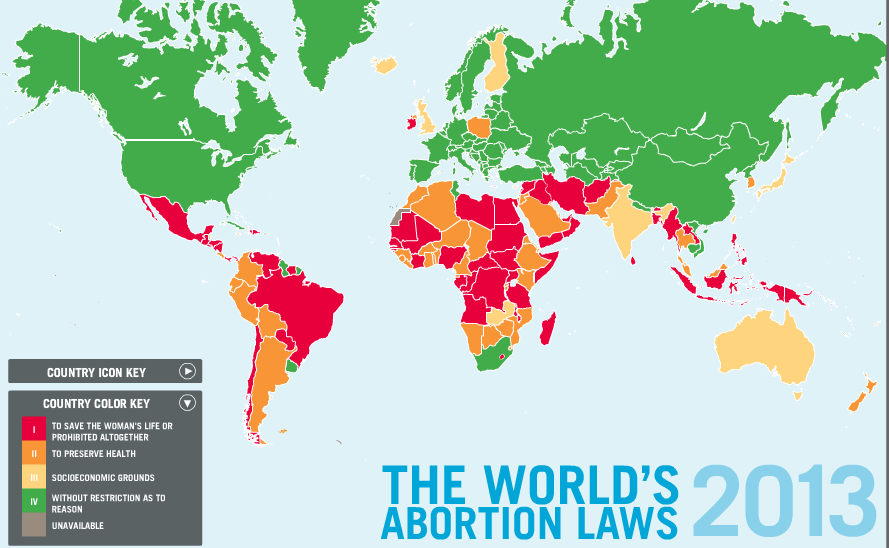
On this point, Christian ultra-conservativism agrees with the point of view of the Malik school of law among Muslims. In essence, Christian terrorists are attempting to move the United States on the below map away from a modern European norm, where abortion is elective up to a certain point in pregnancy, to an Afro-Asian and Maliki Muslim norm where it is often forbidden except to save the mother’s life (or not even then).

4541

…

The same Christian fundamentalists who fulminate most loudly against “sharia law” (medieval Muslim canon law) are perfectly happy to impose their own, Christian sharia on secular American society. Some of them are willing to deploy violence to that end, making them religious terrorists. But on this issue, there increasingly isn’t much difference between the American Republican Party and the Wahhabi clerics in their Riyadh madrasas. In both cases, religious, theological doctrines are being made the basis of public law, which is un-American and actually unconstitutional (the First Amendment refers to that as Establishment of religion, which it forbids).

Emphasis Mine

The Capitalists desire control and are willing to align themselves with those who are willing and able to exercise control on their behalf. Class warfare is brutal, and the Capitalists want brutal people to keep Capitalism going.

This is where Fascism keeps coming up. It is the iron fist ready to smash any in-roads into the profitability of big business. Although Fascism starts out as a protest against the ravages of Capitalism on the petite bourgeoise, it morphs into a rabid defender of Capitalism because it cannot conceive of an alternative economic system. It just wants to get the wrong people out of running Capitalism.

Thus, the media supports White Terrorism by treating it differently. This is because the White Terrorists are aligned to the political agenda of the Capitalists. As such they are not fighting the system, they are preventing the system from falling into the wrong hands.

Cole also lists Top Ten differences between White Terrorists and Others

5. White terrorists are part of a “fringe.” Other terrorists are apparently mainstream.

6. White terrorists are random events, like tornadoes. Other terrorists are long-running conspiracies.

7. White terrorists are never called “white.” But other terrorists are given ethnic affiliations.

8. Nobody thinks white terrorists are typical of white people. But other terrorists are considered paragons of their societies.

Emphasis Mine

And this is how the media continues to construct racism, and to convince people that the victims of terrorism are actually terrorists. This then reinforces the racism of the proto-Fascists and eventually turns abstract racism into concrete racism.


Read more!

2015/11/16

From Beirut to Paris - your wars are our dead: Socialist Alliance statement on terror attacks

From Beirut to Paris - your wars are our dead: Socialist Alliance statement on terror attacks.

These latest acts of terror must not be allowed to justify ongoing and new imperial wars, tougher anti-refugee and anti-immigrant laws and anti-democratic “security” laws and repression of democratic rights.

In response to the attacks in Paris, people opened their homes to the traumatised and wounded. Taxi drivers ferried people home for free. People queued to donate blood. There has been international condemnation, statements from Western leaders, including Prime Minister Malcolm Turnbull and a global outpouring of sympathy and symbolic acts of solidarity across the globe.

The same level of response from the West did not follow the immediate aftermath of the bombings in Beirut (often called the 'Paris of the middle east'). But people's lives matter as much in Paris as they do in Beirut or Syria or Iraq. Perhaps this latest attack in the heart of Europe has, at least, made the horror inflicted on the people of Beirut and the Middle East more difficult to ignore.

Terrorist forces such as ISIS and Al Qaeda are the products of decades of Western imperialist intervention and occupation in the Middle East. These same Western governments have been responsible for more bloodshed across the region than ISIS. In Iraq, for example, where more than half a million have been killed since the 2003 invasion and the society largely destroyed, the kind of extreme fundamentalist terror represented by ISIS was unknown prior to the invasion and occupation by the US and its allies.

At the time of the invasion of Iraq, both Western intelligence agencies and the millions of people who marched against war warned that this military intervention would only create more terror. They have been proven correct and it is the people of Paris, Beirut, Syria and Iraq who are paying the price.

Emphasis Mine

Elie Fares makes the same point in From Beirut, this is Paris: in a world that doesn’t care about Arab lives:

When my people died, no country bothered to light up its landmarks in the colors of our flag. Even Facebook didn’t bother with making sure my people were “marked safe”, trivial as it may be. So here’s your Facebook safety check: we’ve, as of now, survived all of Beirut’s terrorist attacks.

When my people died, the world was not in mourning. Their death was but an irrelevant fleck on the international news cycle, something that happens in those parts of the world.

And you know what, I’m fine with all of it. Over the past year or so, I’ve come to terms with being one of those whose lives don’t matter. I’ve come to accept it and live with it.

Emphasis Mine

The world forgets that its is the Arabs, Kurds, and Iranians who are fighting the ISIS, and who are being killed by them.

No wonder people in the Middle East have such a cynical attitude to the values espoused by the West. They think, as Gandhi did, that Western Civilization is a good idea — not a reality.


Read more!

2015/10/08

GLW: Terror raids fuel Islamophobia

Pip Hinman writes that Terror raids fuel Islamophobia .

This state harassment campaign will not deter those already worked up and thinking about reacting to police harassment: if anything, it will fuel it. The police know that.

Why, then, do they do it? Clearly, the police, with their media accomplices, want to scare young Muslims. But they are wrong if they think this will deter young people from “radicalising”. This “permanent war” on the streets of Sydney — or at least on some streets — finds its echo in Australia’s support for the permanent wars in the Middle East.

The harassment of young people — either of the Muslim faith or from a Middle Eastern background — serves the interests of the ruling class in deflecting attention away from their rotten policies that result in an array of problems young people have to deal with today: increasing isolation, alienation, mental health problems, entry into higher education and trying to find a job.

Emphasis Mine

Islamphobia distorts the public discourse. The role the US occupation of Iraq played in the rise of Daesh is not discussed. Also, ignorance is professed about the role of CIA in the creation of Al Qaeda and the Taliban. And the list goes on.

If the people are not frightened, they might start to question the Capitalist system, and that is expressly forbidden.


Read more!

Juan Cole: Nigeria's Boko Haram is about Vengeance, not Islam

Gregory Alonso Pirio writes that Nigeria's Boko Haram is about Vengeance, not Islam.

So many people are scratching their heads as they search for an explanation for the extreme acts of violence meted out by such groups as the Nigerian jihadist organization, Boko Haram, and its now allied Middle Eastern Islamic State or ISIS.

Often in normal conversation, people will pull out an explanation, seemingly out of the air, that Islam as a religion lends itself to violence. The facile reasoning does not synch with historic fact certainly for Violent Extremist Organizations (VEOs) that I am familiar with in sub-Saharan Africa. My research on Boko Haram, for instance, shows that the driver of jihadist violence is a narrative of vengeance that was adopted in response to state violence. Historically, this may be true of several other VEOs in sub-Saharan Africa whose radicalization followed a massacre committed by government security forces against peaceful reform-oriented Islamist movements. Such has been the case in Somalia, Uganda and Tanzania.

Emphasis Mine

Admitting the state role in creating these VEOs runs counter to the dominant discourse that the state is defending us against the existential threat of Radical Islam.

The existence of a state is for the protection of the interests of the ruling class. The state is the only legal organ of violence. The state will do whatever it takes to survive.

Because of this, there will be no peacefull transfer of power from the Capitalists to the Workers.


Read more!

2015/07/31

Israeli squatter-terrorists kill Palestinian toddler, injure 4 after setting their Home Ablaze

Juan Cole re-posts that Israeli squatter-terrorists kill Palestinian toddler, injure 4 after setting their Home Ablaze.

Israeli settlers killed a Palestinian toddler and injured four others early Friday morning after settling their home ablaze in the village of Doma near Nablus in the occupied West Bank, local sources said.

Ali Saad Dawabsha, one-and-a-half years old, died shortly after sustaining serious burns, said Ghassan Daghlas, an official who monitors settlement activity in the northern West Bank.

His mother and father, Riham and Saad, and their son Ahmad, 4, also sustained injuries and were evacuated to a nearby hospital, Daghlas said, adding that their home was left completely burned.

Emphasis Mine

ISIS burn a Jordanian pilot alive and are justly condemned throughout the world.

Israelis burn a Palestinian child alive and there is silence.

As John Pilger says, Palestinians are unworthy victims. Indeed, they are even blamed for all the violence done to them.


Read more!

2015/05/30

The great national security swindle

Tony Iltis debunks The great national security swindle.

The number of fatalities from terrorist attacks in Australia is tiny. Even taking into account Australians killed overseas, such as those killed in the 2002 Bali nightclub bombing, there are far greater threats to Australian lives.

Safe Work Australia reported: “As at 26 May 2015, 65 Australian workers have been killed while at work” this year, and 38 women have been killed in domestic violence attacks since the start of the year.

The same state and federal governments that find unlimited resources to fund draconian “anti-terror” policing and prosecutions are unable to fund accommodation for women fleeing partner and ex-partner violence. “In March, there were 33,933 people on the Victorian public housing waiting list, with 9556 eligible for 'early' urgent housing, which includes many who have suffered family violence,” the May 22 Age said.

The Abbott government has responded to this threat to Australians' lives by further cutting funding to women's services and housing.

The government's response to the threat to Australians' lives from workplace accidents has been to foreshadow a further round of criminalisation of trade unions, particularly construction workers' unions, for attempting to protect occupational health and safety.

The Abbott government's attempts to convince Australians that they are threatened by terrorists was helped by the opening of the inquest into the deaths of Man Haron Monis and two hostages when he hijacked a Sydney cafe in December.

However, so far the evidence presented to the inquest suggests that Monis was an attention-seeking psychopath with a shotgun rather than an ideologically motivated terrorist.

Emphasis Mine

The issues of violence against women and the sacrifice of safety for profits do rank on the Capitalist agenda. The perpetrators are among the supporters of Capitalism: violent men and ruthless business owners. One does not attack one's own supporters.

Yet, the ruling class wants an enemy that we are all frightened of so that we need them to protect us.

We need to discover who the real enemy is.


Read more!

2015/04/17

Syria, Yemen Conflicts only seem to be about Sunni-Shiite from 30,000 Feet

Juan Cole writes that Syria, Yemen Conflicts only seem to be about Sunni-Shiite from 30,000 Feet.

JUAN COLE: I see evidence of al-Qaeda thinkers, like Ayman al-Zawahiri, who was the number-two man for a long time, before bin Laden was killed, being influenced by Marxist thought, and radical Marxism. This is very clear in the technical terms that the Muslim far-right uses. They talk about a vanguard. This was a Leninist term. In some radical forms of Marxism, activists were impatient with the working class, which seemed not to want to fulfill its historical duty by rising up against the business classes, and so it engaged in sabotage—not everywhere all the time, but there were some groups that did that kind of thing in hopes of provoking a class war, because they knew the business classes would call upon their agents, the police, to crack down hard on sabotage and workers’ activism and so forth.

I think that al-Qaeda picked up this kind of thinking from the Marxist fringe in places like Egypt and so forth. I think that it is a deliberate strategy on their part, the sharpening of contradictions, or the heightening of contradictions, as it’s called. I think it explains everything that happened in Iraq.

I remember reading a New York Times piece in 2005 or so that al-Qaeda in Iraq had blown up a pet shop. There were pieces of rabbits and snakes wiggling on the ground. This author in The New York Times expressed himself with amazement. He said, “We should get out of Iraq now, because we can’t understand why you would do that. And if you don’t understand what your enemy is doing, then you should not be there.”

I understood exactly what they were doing. They were hitting soft targets. They were hitting businesses. It was a Shiite-owned pet shop. What they were trying to do was to get the Shiites’ goat in Iraq. They were trying to provoke a civil war, because they hoped that the Shiite clans who were being hit would go and attack Sunnis, and if they went and attacked the Sunnis, then al-Qaeda could go to the Sunnis and say, “Gee, you seem to be being attacked. We could protect you.”

So by provoking attacks on their own community, they actually could parlay that into power.

At the time, I was skeptical that they could succeed in this, but you come to last June, and they took over Mosul, the second-largest city in the country, in exactly this way—by continually provoking the Shia, getting reprisals going, and then going to the Sunnis against whom the reprisals were waged and saying, “You need protection.” By that time, the Mosulites said, “Yes, we do. Would you please come in,” even though Mosulites are cosmopolitan, secular-minded people. But they were willing to bring in this radical fundamentalist group just because they were tired of being targeted by the Shiite government.

Emphasis Mine

Marxists should always be sharpening the contradictions—but only through political means. We are offering an alternative political explanation for events. We want to show that there are Communist and Capitalist narratives at play in the world around us.

Marxists have rejected the terrorist mentality. Terrorism, as shown by events over the past twenty (20) years, has strengthen the Capitlist state through greater legal power, greater reliance on force, and the ready support of such measures by the population. Support for the government is almost reflexive once the terrorism aspect is highlighted.

The Capitalist is always willing to suppress the working class whenever it feels its interests are threatened. But it can, and has, retreat before determined resistance by a significant portion of the working class.

Marxists, at this stage of the struggle, are engaged in educating and radicalising the working class through mass actions, propaganda, and agitation. We join in the daily struggle to sharpen our political awareness of how the world works.


Read more!

2014/11/03

Take Kurdish freedom fighters off terrorist list

Sue bolton says “Take Kurdish freedom fighters off terrorist list”.

There are two reasons to support the Kurds of Kobane. One reason is humanitarian: to prevent a massacre. The other reason is to protect and defend the building of an alternative society which should be a beacon for all left and progressive people in the world.

Unfortunately for the Kurds, their unacknowledged homeland, Kurdistan, is occuppied by four other states:

  1. Iran
  2. Iraq
  3. Syria
  4. Turkey

Turkey has been waging genocide against the Kurds. This is largely unreported in the West unless there is a terrorist attack in Istanbul.

Because Turkey is an important NATO ally (US client), this is tolerated in the West. Genocide is only wrong if it is done by official enemies. And since before 9/11, the PKK has classified as a terrorist even as it tries to defend against the genocidal attacks of the Turkish state.

This level of oppression calls for a new and substainable society in which everyone participates. This leads to progressive measures in governance and social norms:

The Kurds in Syria are building a society that should be a model for the Middle East — a society where the rights of minority religions and minority ethnic groups are protected, and where there is a revolution in women's rights. The US doesn't want to support the Kurds in Rojava because it is using sectarianism to keep compliant governments in power in various countries in the Middle East.

Once again, we see Capitalism relying on divise means to maintain power.

Bolton lists the demands of the Socialist Alliance as:

  • Arms for the defenders of Kobane.
  • Opening the border with Turkey and an aid corridor for Kurds.
  • End Turkish support for IS.
  • Remove the PKK from Australian terrorist list: they are freedom fighters not terrorists


Read more!

2012/03/27

Colombia: The end for guerrilla warfare?

In Colombia: The end for guerrilla warfare?, the conclusion is:

An era of guerrilla warfare in Latin America is coming to an end. Exactly how the end game will be played out remains to be seen.

The primary reason for the failure of guerrilla warfare in Colombia is that the insurrection is against a domestic government that has maintained the veneer of legitimacy since the national war of liberation.

Instead, the origin of the guerrilla warfare was in the rural defense of the small farmers against the land grab of the large landlords. The decline in the insurregency appears to be the result of the migration of the small farmers to the urban centres.

What began as a civil war between the Liberal and Conservative parties became more and more clearly a war of the large landowners against the small landowners, especially those led by Liberal Party and communist self-defence forces in what came to be called the “independent republic”.

This urbanization led to the radicalisation of the urban poor. However, this radicalisation gave rise to recruits to the insurgency. This surge ran up against the material constraints of arms, food, and safety in the rural hinterland as the depopulation continues. So the insurgency cannot retrest to the countryside to be a Maoist one.

This is further complicated by the cocaine production which fueled both the insurgency and the repression as the land became valuable for production of cocoa leaves. Control of land and refining is valuable enough to kill for.

And the insurgency lost the political battle as:

…the FARC was more politically isolated than it had ever been before, and the ruling class of the country was more united than ever before in its determination to defeat the FARC. The Pastrana government had won the political victory it sought at the beginning of the negotiations.

And the military counter-insurgency succeeded because of technological developments as well as:

The offensive against the FARC also included an international component with three major goals: reducing sympathy for the FARC among the broad left in other countries, eliminating safe havens for FARC operations outside of Colombia and reducing FARC income from cocaine trading.

The end game is seen as:

Although the FARC still leads thousands of armed fighters and has the financial resources to continue fighting, the decimation of its leadership combined with its political isolation has brought it to the point of no return. It may enter into a new peace process with the government of Juan Manuel Santos, although it has little to bargain with. On the other hand, if it does not, the continued offensive against it by the Colombian military could result in its complete disintegration as an organised force.


Read more!

2011/03/13

Posts Noted 2011 March 13

Blog posts noted on 13 March 2011

  • Mark Thoma reposts on The End of the 'Washington Consensus' part of The end of the 'Washington consensus', by Kevin Gallagher. A premature celebration, perhaps, as the iron fist of the US military is not alluded to at all. These things are not mentioned in polite company.
  • The bigger point here is that, even if Colombia gets the sorry trade deal it wants and doesn't get a canal, the United States is literally and figuratively bankrupt in its competition with Chinese finance. Literally, because the US has the largest deficit on the planet and owes a big chunk of that to the Chinese. Figuratively, because the economic model that the US has exported to Latin America hasn't worked. China is funding infrastructure, exploration, science and technology, and all the other things that President Obama says we should be spending on here at home.

  • Cassandra's legacy: Joseph Tainter: talking about collapse. The complexity overwhelms the ruling class' ability to manage society. The more efficient a society becomes, the smaller the ruling class becomes. This relative smallness reduces the pool of talent able to meet crises.
  • Tainter's point is that there is a strong relationship between resources and complexity. It is clear that complexity cannot exist without resources - not for a long time, at least. But the relationship is far from being linear: with resources diminishing, complexity does not decrease – on the contrary it keeps increasing. It is the result of the benefits that complexity gives: resource depletion can be counteracted by increasing complexity, but only up to a certain point and with ever-reducing returns. At some moment, returns become negative, society cannot support any longer its complex infrastructures and the result is collapse.


Read more!

2009/02/23

Global Counter-Insurgency

Anonymous posted two references to the shift in rhetoric about the long war.

Sen. John Kerry says Pakistan aid bill to be passed shortly , and that:

He opposed the use of term war on terror.

"What we are doing is conducting global counterinsurgency. And a counterinsurgency by definition needs to win hearts and minds of people it has to bring people on your side not push them away. So , I think we have to do a better job of implementing [o]ur strategy."

Once again, a member of the US government does question the US strategy at all. The only problem he sees is that the strategy has not been implemented correctly.

In Obama and the counter-insurgency era, Anthony Fenton concludes that

Since the Obama administration campaigned on the continuity of counter-insurgency and irregular war as key elements of US power projection under his administration, it is likely that these policies will attain a level of popular support not experienced by the Bush administration, and will see little critical scrutiny by the media. The challenge will be to shed light on and critically examine these policies as they manifest in any number of settings around the world in the days to come.

I think that Fenton forgets that the War on Terror was very popular in 2001 and 2002 both in the USA and here in Australia. I would say that the general population was thirsty for revenge over the attacks on 11 September 2001.

Pres. Bush could have called it the War on XYZZY and the people would have understood it to be a war on Islam. Such was the racism that underlay the response at the time.

The War on Terror has the effect of casting the US government as the good guys and the defenders of that is good and pure. It was a term for the time. Now that the war is dragging on and the timetable for the conquest of the Middle East is falling behind every day, a change in semantics is needed to maintain support.

It is interesting to note that both of these articles stress the continuity with the Bush administration. This is a way of saying that the strategy is correct and the US government is resolute in this matter. Only a few adjustments need to be made: "Smart Power" instead of "Hard Power" or "Soft Power".

But even the term, "Global Counter-Insurgency", is a mistake. The only thing that unites all of these resistence groups is the hatred of US military and economic incursions. The danger is that the US strategy make create the monster that it seeks to destroy.


Read more!

2009/02/22

Global Counterinsurgency: Strategic Clarity for the Long War

Roper (2009:106) concludes that a change in the lexicon is an important weapon in the War on Terror:

The United States needs to refocus its efforts and resources to more effectively deal with the current global threat. Clear thinking supported by clear language will assist in this endeavor. American policy should focus more on denying support for those organizations with political goals inimical to US interests, rather than emphasizing the apprehension of individual terrorists. Removing the “war on terrorism” from the official lexicon and replacing it with more precise and descriptive terms such as “war on global hirabahist insurgency” or “global counterinsurgency” would be an important step in identifying the real nature of the enemy, the security challenges posed, and the array of techniques the enemy may employ. More importantly, the change in descriptor will help focus the intellectual framework required to develop a successful US strategy for dealing with this complex and lethal problem.

Emphasis Mine

Roper's main points are that terrorism is a tactic, and that insurgency and terrorism may overlap but are not the same thing. "Understanding terrorism as an activity subsumed under a wide variety of activities employed by an insurgent movement provides the intellectual clarity required to identify the real enemy and formulate effective countermeasures. It is, therefore, inaccurate to semantically equate terrorism and insurgency." (Roper:2009,97)

Roper (2009:94-95) gives several definitions of terrorism but they all have the same assumption: violence by governments is legitimate while violence by non-government forces is not. Indeed, government terrorism is often described as an "... overreaction ... from target governments" (Roper:2009,p.97).

Roper (2009:98) contend that counter-insurgency strategies designed to suppress Communists is inappropiate for this new type of insurgency.

Classic counterinsurgency theory tends to assume a binary struggle between insurgent and counterinsurgent, yet insurgencies today may incorporate many diffuse, competing insurgent movements. In contrast to revolutionary war theory, these conflicts often lack a “united front.” Likewise, classic insurgency theory typically regards insurgency as between an internal nonstate actor and a single government. Today, however, there is real-time informal cooperation and cross-pollination between insurgents in many countries, often accomplished without a central controlling authority. The National Security Strategy of the United States describes terrorist networks as being more decentralized than traditional terrorist organizations; less dependent upon a central command structure; and more reliant upon inspiration from a common ideology. Although parallels—such as the need for contextually specific solutions—exist with the ideologically motivated Communist insurgencies of the mid- to late twentieth century, the franchise-like character of modern transnational insurgencies fueled by religious fanaticism is new.

Emphasis Mine

In this, Roper is wrong. A counter-example is the Irish resistance to the English occupation. The resistance was world-wide from support in the USA, Australia, Argentina, Canada, France, etc. A notable action against English tyranny took place at Vinegar Hill in 1804. A driving force of the international resistance was religion, and this has been going for 500 years.

Roper (2009:101-102) posits that the correct strategy is to:

The US strategic goal in the Long War is to preserve and promote the way of life of free and open societies based on the rule of law, defeat terrorist extremism, and create a global environment inhospitable to extremists. American strategy to achieve this goal is based on an international effort to deny terrorists resources. This strategy is comprised of three elements: protect the homeland; disrupt and attack terrorist networks; and counter ideological support for terrorism. Protecting the homeland is the defensive aspect of the strategy, but defense in and of itself is not enough. A successful strategy requires attacking the terrorists and their ability to operate, to include their leadership, funding, and communications. The most important component of the strategy is countering ideological support for terrorism—the “decisive effort.” It should be self-evident that countering ideological support for those who commit terrorist acts is as much a social, societal, and psychological issue as it is a physical one.

Emphasis Mine

The fundamental problem is that the American Government is a terrorist organisation itself. Everything it does is in furtherence of grabbing resources of the third world for its own benefit. Even its vaunted "Shock and Awe" campaign of 2003 was a classic case of terrorism - sheer brutality to achieve political acquiesence. It supports a terrorist government: Israel.

The gulf between the words of the US government and its actions are an abyss into which the US Army has cast itself. Every action by the US Military in Iraq and Afghanistan is terrorism against the local people. The US Military has become the biggest recruiter for the resistence. How can the US Army defeat itself?

Another underlying assumption of the article is that legimate governments are those who serve the interests of the USA. There is no self-determination in the US's view of the world. Everyone exists to serve the USA.

The very success of the USA economy means that the USA must be an empire that rules through terror. And this terror begets terror. In order to win the long war, the USA must destroy itself. Therein lies the danger for the rest of us.

References

Roper, Daniel S. (2009), "Global Counterinsurgency: Strategic Clarity for the Long War", Parameters, Autumn 2008, pp. 92-108 (Viewed 22 February 2009)


Read more!

2006/12/31

Knowing the Enemy

In the Dec 18 2006 edition of The New Yorker, George Packer (pp.60-69) wonders about Knowing the Enemy and Can social scientists redefine the "war on terror"? The article is really managing the discontent among the wretched of the earth instead of alleviating the discontent.

Diagnosis and Cure

David Kilcullen, a Lt. Colonel in the Royal Australian Army, is quoted as saying

“I saw extremely similar behavior and extremely similar problems in an Islamic insurgency in West Java and a Christian-separatist insurgency in East Timor,” he said. “After 9/11, when a lot of people were saying, ‘The problem is Islam,’ I was thinking, It’s something deeper than that. It’s about human social networks and the way that they operate.” In West Java, elements of the failed Darul Islam insurgency—a local separatist movement with mystical leanings—had resumed fighting as Jemaah Islamiya, whose outlook was Salafist and global. Kilcullen said, “What that told me about Jemaah Islamiya is that it’s not about theology.” He went on, “There are elements in human psychological and social makeup that drive what’s happening. The Islamic bit is secondary. This is human behavior in an Islamic setting. This is not ‘Islamic behavior.’ ” Paraphrasing the American political scientist Roger D. Petersen, he said, “People don’t get pushed into rebellion by their ideology. They get pulled in by their social networks.” He noted that all fifteen Saudi hijackers in the September 11th plot had trouble with their fathers. Although radical ideas prepare the way for disaffected young men to become violent jihadists, the reasons they convert, Kilcullen said, are more mundane and familiar: family, friends, associates.

Emphasis Mine

The immediate problem with this analysis is there is no cause. Rebellion is presented as something that exists. Here only the explanation is of how rebellion maintains itself.

This shallow analysis leads to an equally shallow prescription:

Steve Fondacaro, a retired Army colonel who for a year commanded the Joint Improvised Explosive Device Defeat Task Force in Iraq, is in charge of the Human Terrain project. Fondacaro sees the war in the same terms as Kilcullen. “The new element of power that has emerged in the last thirty to forty years and has subsumed the rest is information,” he said. “A revolution happened without us knowing or paying attention. Perception truly now is reality, and our enemies know it. We have to fight on the information battlefield.” I asked him what the government should have done, say, in the case of revelations of abuse at the Abu Ghraib prison. “You’re talking to a radical here,” Fondacaro said. “Immediately be the first one to tell the story. Don’t let anyone else do it. That carries so much strategic weight.” He added, “Iraqis are not shocked by torture. It would have impressed them if we had exposed it, punished it, rectified it.” But senior military leadership, he said, remains closed to this kind of thinking. He is turning for help to academics—to “social scientists who want to educate me,” he said. So far, though, Fondacaro has hired just one anthropologist. When I spoke to her by telephone, she admitted that the assignment comes with huge ethical risks. “I do not want to get anybody killed,” she said. Some of her colleagues are curious, she said; others are critical. “I end up getting shunned at cocktail parties,” she said. “I see there could be misuse. But I just can’t stand to sit back and watch these mistakes happen over and over as people get killed, and do nothing.”

Emphasis Mine

So the message is spin early and spin often. This is truly totally fucked. Have these people no idea what is going on in the rest of the world? Did they really think that by just changing the channel, everything will be made better and have a happy ending?

There is a myopia here that looks at the world through a television set. Control the programming and you control the world. The reason that other sources of information is because of the demand for information that better explains the reality people are seeing and feeling.

For a Western culture, it is now hard for us to realise that people talk to each other in the rest of the world. They move about. They see the devastation. They remember life before the West came.

There are no isolated incidents to be explained away. What is happening to them is happening to others as well.

This information is not to keep the natives happy - it is keep Westeners comfortable in their ignorance. As long as we have our creature comforts, we can ignore the cries of pain coming from the outside. Ignorance can then be truly bliss.

The Cold War and the GWOT

The Global War on Terror (GWOT) is now to seen as the replacement for the Cold War:

Kilcullen’s thinking is informed by some of the key texts of Cold War social science, such as Eric Hoffer’s “The True Believer,” which analyzed the conversion of frustrated individuals into members of fanatical mass movements, and Philip Selznick’s “The Organizational Weapon: A Study of Bolshevik Strategy and Tactics,” which described how Communists subverted existing social groups and institutions like trade unions. To these older theoretical guides he adds two recent studies of radical Islam: “Globalized Islam,” by the French scholar Olivier Roy, and “Understanding Terror Networks,” by Marc Sageman, an American forensic psychiatrist and former covert operator with the mujahideen in Afghanistan. After September 11th, Sageman traced the paths of a hundred and seventy-two alienated young Muslims who joined the jihad, and found that the common ground lay not in personal pathology, poverty, or religious belief but in social bonds. Roy sees the rise of “neo-fundamentalism” among Western Muslims as a new identity movement shaped by its response to globalization. In the margin of a section of Roy’s book called “Is Jihad Closer to Marx Than to the Koran?” Kilcullen noted, “If Islamism is the new leftism, then the strategies and techniques used to counter Marxist subversion during the Cold War may have direct or indirect relevance to combating Al Qaeda-sponsored subversion.”

Emphasis Mine

This is the closest the article comes to recognising that there might a common cause for both Communist Revolution and Islamic Jihad. The article then goes on to examine whether such approaches are relevant and makes some suggestiosn that Janet Albrechtsen, while saying that There is no substitute for knowing your enemy, interprets as:

But that depends on two things. Muslim communities must recognise and own the problem that exists in their communities. And non-Muslims must work with them to build up trusted networks, providing better alternatives to radicalism. It's here, at the grassroots, that the battle of ideas needs to be fought and won.

Emphasis Mine

And she misses the whole point which was to divert the discontented away from joining organisations that confront the new world order into those that work within the system.

Complex Warfighting

In the New Yorker article, the cause of this discontent is never mentioned or examined. It just exists as if it were part of human nature.

However, Lt Col Kilcullen is more forward in Complex Warfighting which he wrote for the Royal Australian Army. He says that [t]he key driver is Globalisation (pp.2-3):

5. The key influence on contemporary conflict is Globalisation. A widely accepted definition of Globalisation is ‘a process of increasing connectivity, where ideas, capital, goods, services, information and people are transferred in near-real time across national borders’.2

6. Globalisation, during the last decades of the twentieth century, has created winners and losers. A global economy and an embryonic global culture are developing, but this has not been universally beneficial. Poverty, disease and inequality remain major problems for much of the world, and the global economy has been seen as favouring the West while failing developing nations. The developing global culture is perceived as a form of Anglo-Saxon cultural imperialism: corroding religious beliefs, eroding the fabric of traditional societies, and leading to social, spiritual and cultural dislocation. This has created a class of actors – often non-state actors – who oppose Globalisation, its beneficiaries (the developed nations of the ‘West’) and, particularly, the US.

7. Globalisation has created enemies of the West, and given them unprecedented tools to further their cause. Globalised media, satellite communications, international travel and commerce, and the Internet facilitate the coordination of diffuse movements that oppose Western dominance. The free flow of capital, people and ideas allows the spread of movements inimical to Globalisation, and provides them the means to further develop.

8. Moreover, Globalisation is not fully controllable by governments. Multi-national corporations, trans-national organisations, and non-government actors are key players in Globalisation. Indeed, this is one reason why inequalities and problems have developed: in many cases, forces other than conscious national policy drive the process of Globalisation. This hampers an effective response to the opposition provoked by Globalisation.

9. Finally, national security, like almost all of national life, has become globalised. Under Globalisation, a nation’s security interests no longer equate to its territory. Indeed, the Government’s 2003 foreign policy White Paper emphasised this, stating that ‘Australia’s interests are global in scope and not solely defined by geography’3. National security concepts based on geographical theories such as the ‘sea-air gap’ or the concentric circles of the 1980s ‘defence in depth’ concept are hence not applicable to Australia’s circumstances. Such geographical determinism assumes Australia will automatically be secure if we keep an adversary out of our physical space. However today, Australia’s economic, political, technological, and industrial interdependence with the rest of the world means that our interests and sovereignty can be seriously threatened without an attack upon our territory.

In other words, global capitalism is rapidly expropriating wealth at a rate that is causing widespread discontent. And there is nothing governments can do about it. The areas of exploitation are now required to be defended by the Australian Armed Forces in order to keep the exploitation running smoothly.

An all we Westeners have to do is believe that poverty and despair is the problem of the poor. It is their fault for being poor. not ours. We just stole their wealth - so can we be held responsible. Next time you know, you would say Capitalism is a crime against humanity and join a Communist Party.

Read more!

2006/12/04

United 93

During the showing of United 93, I had a strong desire to go and kill Muslims. I was frightened by this. What had fired up my blood? It was the sight of innocent people being set up to be murdered.

No reason was given for this slaughter. There was no soul-searching by the murderers. They were just going to kill Americans.

The only indication of a motive is the picture of a Mosque the new pilot clips to the plane's rudder controls.

The armed rebellion is interesting in that the ordinary people sit passively under the violence that is inflicted on them. This is how people are conditioned in the West. We are trained to await our leaders to guide us and help us.

In a way, this movie reveals how an American revolution would unflod. The people would continue to absorb more and more alien information until they realise that the situation is completely hopeless unless they act.

The response of the hijackers, in this movie, is also instructive: they respond with increasing threats of violence to ever increasing acts of defiance. This response eventually fails.

In the real world, the ruling class relies on violence, propaganda, and bribery to maintain control. Thus the task of revolutionaries is much more difficult. Why should people risk their comfort for the unknown?

It is a bit difficult to change pilots once the plane crashes into the building


Read more!

2006/04/18

Big Brother Is Listening

As you should be aware, Big Brother Is Listening (Web Link May Require Paid Subscription) according to Mr. James Bamford in Atlantic Monthly (04/06) Vol. 297, No. 3, P. 65.

Technological advancements have widened the scope of National Security Agency (NSA) surveillance, while the legal barriers to such eavesdropping have been lowered with a White House mandate that permits the NSA to place Americans on watch lists and monitor their communications without first obtaining permission from the Foreign Intelligence Surveillance (FISA) court. Previously a court order was required, and could only be secured if the NSA showed that it had probable cause to eavesdrop on people suspected of involvement with terrorist organizations. Now people can be placed on watch lists by NSA shift supervisors who have a "reasonable belief" of involvement, and the number of Americans targeted by the NSA has consequently ballooned from perhaps 12 annually to 5,000 over the last four years, according to sources. If innocent people are marked because they fulfill these highly subjective criteria, they may be denied visas, federal jobs, or other services and privileges without ever knowing why. The NSA's surveillance methodology is signal intelligence, in which electronic communications containing vast quantities of emails and phone calls are intercepted and run through computers that flag specific words, phrases, names, phone numbers, and Internet addresses, and forward these communications to analysts. Also clearing the way for greater NSA surveillance is the FCC's extension of the 1994 Communications Assistance for Law Enforcement Act (CALEA) to cover "any type of broadband Internet access service" and new Internet phone services, while the two congressional intelligence committees tasked with protecting the public from privacy abuses have abnegated their responsibilities. The NSA likes to hire people away from providers of critical telecommunications system components, offering them the opportunity to work with state-of-the-art equipment and contribute to national security. Furthermore, a great deal of the telecommunications industry secretly cooperates with the NSA in its eavesdropping efforts.

Emphasis Mine

What mealy-mouth liberalism! The White House has NOT lowered ...the legal barriers.... It has broken the law! You know, the law! That fundamental principle of any civilised society.

And of course, no crime is without those abet it by carrying it out and those who ignore it. Your silence makes you an accomplice after the fact.


Read more!

2006/02/25

Deep Shit Situation

The week after the third annnivsery of the huge mobilization against the start of the current Iraq War (15 February 2003) has left the world in a deep-shit situation:

  • Suicide Bombing of Saudi Oil Complex Foiled leaves the oil markets nervous. Al-Qaeda may succeed next time. Hello $2-$3 a litre. (My wild guess!)
  • Shiite protests Roil Iraq after the bombing by guerriillas of the domed Askariyah shrine in Samarra. Hello civil war! Get the troops out of there! Now!
  • State of emergency in Phillipines. Another front-line state in the War on Terror in trouble.
  • The Cartoon protests continue! Hello clash of civilizations!
  • The Iranian Nuclear standoff continues
  • So does the North Korean Nuclear standoff.
  • The controversy over the take-over of some US ports by a Dubai company has the US press in hysteria over the smuggling of nuclear weapons into the USA. Whereas the truth is that there was little security before. The NBC demonstrated that the smuggling of radioactive material was possible. Only 7% of cargo is inspected. And the vaunted radioactive detection failed!
  • The USA moved one step closer to a totalarian state with George W. Bush saying is above the law while the USA is at war!
  • The housing market teeters along. The bubble may be slowly deflating.

Historians (if a future exists) may wonder how all of this came to pass. One clue may be in the authoritarian cult discussed by Glenn Greenwald when he asks Do Bush followers have a political ideology? Another clue could be that The Educational System Was Designed to Keep Us Uneducated and Docile.


Read more!

2005/10/24

Standing up to the War on Terror

FORUM: Standing up to the War on Terror

Wednesday October 26 6pm

Carslaw Building Room 175 Sydney University

Organised by Sydney Uni Peace Group

  • Professor Ahmad Shboul - Arab and Islamic Studies Sydney University
  • Micheal Thompson - National Tertiary Education Union (NTEU)
  • Speakers from National Association of Community Legal Centres and Students Against War

Proposed 'anti-terrorism' legislation is being widely condemned as a further step towards a police state. ASIO would be given coercive powers and the ability to secretly detain people for two weeks without charge; supporting the right to resist military occupation would become and offence punishable by seven years imprisonment; a 'shoot to kill' policy would be introduced for people 'fleeing' police questioning, even if not suspected of a terrorist offence.

At this forum, Ahmad Shboul will discuss the real impact that the 'war on terror' is having on the people of the middle east and on the muslim community in Australia. A speaker from the National Association of Community Legal Centres will outline the extent of the laws and the effect they will have on civil liberties. The National Tertiary Education Union (NTEU) have come out against the laws and will speak at this forum about their stand.

If passed, the new anti-terror laws are set to give police more rights to keep anti-war protesters off the streets and intimidate the movement. On campuses the crack down on dissent is being acutely felt - Voluntary Student Unionism is aimed at removing our ability to organise against government policy and police have arrested many activists campaigning against VSU.

Come along and discuss how we can defend our civil liberties, stop the racist scapegoating and re-build a challenge to the ongoing War, which has already killed over 100,000 people in Iraq, starting with the national rally on November 5.


Read more!

2005/10/09

Who'd be a suicide bomber?

Kim Bullimore concludes her review of Paradise Now by asking Who’d be a suicide bomber?:

With the "war on terror" in full swing, Paradise Now brings into context a historical and material understanding of why suicide bombings happen. The mainstream corporate media, which rarely mentions the word "occupation" in relation to Palestine, Iraq or Afghanistan, all too often presents suicide bombings in a vacuum and as the irrational act of a deranged Islamic fundamentalist. However, as University of Chicago academic Robert Pape notes, what 95% of suicide bombers have in common is not religion but their opposition to imperialism and occupation.

According to Pape’s study Dying to Win: The Strategic Logic of Suicide Terrorism, of the 462 suicide bombings carried out since 1980, half were by secular bombers and there is little evidence that they "hate Western values or hate being immersed in Western society". Instead, what they have in common, says Pape, is that "they are deeply angered by military policies, especially combat troops on territory they prize and that they believe they have no other means to change those policies".

It is this anger and resignation that Abu-Assad brings to the screen through Kahled and Said, but he also brings hope for justice and a way to change the dynamics of resistance and occupation through the character of Suha. Paradise Now is a film that should not be missed by anyone interested in understanding the realities of the Palestinian-Israeli conflict.

Italics in original; bold emphasis mine

In other words, suicide bombings are seen by their supporters as patriotic acts of resistence. Communists see them as futile acts because they misunderstand the nature of power in a capitalist society. These acts of terror drive the proletariat into the hands of the capitalists seeking safety. The correct course is to appeal to the solidarity of the international proletariat against their common oppressors.


Read more!

2005/10/08

The Bali bombings: How can such acts be stopped?

Max Lane asks after The Bali bombings: How can such acts be stopped? He gives the main driving force for the bombings as being caused by despair and humiliation:

When Indonesia won its independence in 1945, the country was propelled forward by a sense of hope, a sense that once freed from colonial rule, from the dictatorship of Dutch and other Western commercial interests, the economy could be developed and society would prosper.

Sixty years later, this hope is gone. In 1945, Western colonialism left Indonesia with no education system of any worth, no industry, no scientific or technological capacity. While Europe, North America, Japan and Australia industrialised and modernised during the 19th century and continued to prosper through most of the 20th, Indonesia, like all the Western colonies, was used as a source of cheap raw materials and of coolie labour.

Sixty years later little has changed. The policies of the developed capitalist nations, backed by the International Monetary Fund (IMF) and the World Bank, have kept Indonesia non-industrialised, poverty stricken and technologically dependent.

Emphasis Mine

His solution is:

Such actions should be condemned as murderous, cruel and wanton and also as ineffective in achieving any change to the lives of Third World peoples. But they will continue as long as the huge gulf of power and wealth between the imperialist West and the underdeveloped, exploited Third World continues.

How to end these attacks? In the end, they will only stop when the movements to end this gulf grow, both in Indonesia and in the developed countries, and become forces that lead people to throw off the humiliation, national oppression and exploitation that the underdeveloped world now suffers.

Here in Australia, the movement against the US-led occupation of Iraq and Afghanistan must grow and force the US, Australia, Britain and other foreign armies out of Iraq and Afghanistan. The movement to "make poverty history" must go beyond an advertising campaign by celebrities and return to the streets, demanding the complete cancellation of the Third World's debt. That is what we can do to stop the continuation of terrorist attacks like those that took place in Bali.

Emphasis Mine

In other words, people with hope are less likely to kill. People with nothing to lose may want to kill as many of their tormentors as possible.

It is very hard to accept that one's lifestyle is based on the brutal exploitation of others. We are all guilty of the oppression of the Indonesians because we have not found a way to stop the exploitation. The guilt for the killings lies with the bombers and their associates. The guilt for their despair and anger lies with us.


Read more!

2005/04/02

Crude Futures Rise to New High Above USD57

Goldman Sachs report causes Crude Futures Rise to New High Above [US]$57 by predicting that a "super-spike" of USD105 may be reached soon. Although,

Oil prices are now 67 percent higher than a year ago, but still well below the inflation-adjusted high above $90 a barrel set in 1980.

There are dissenters to this view because it creates an ...unreasonable fear in the market:

Oil analyst Marshall Steeves of Refco Group Inc. in New York said the rally in fuel prices is "overdone."

"I don't think the sky's the limit," Steeves said. "At some point, there'll be some impact on demand. But where that price is, is hard to determine."

In other words, no one has any idea what is going on. But you should not panic even though they are acting like headless chooks.

The reasons for the report were:

... The report said that oil prices could go as high as $105 a barrel _ the price Goldman Sachs said may be necessary to significantly curb energy consumption.

Goldman Sachs analyst Arjun Murti said factors contributing to the run-up in prices include geopolitical turmoil in oil-producing countries.

"Oil markets may have entered the early stages of what we have referred to as a 'super spike' period _ a multiyear trading band of oil prices high enough to meaningfully reduce energy consumption and recreate a spare capacity cushion only after which will lower energy prices return," the report said.

The political instability referred to but not mentioned is:

  • Illegal occupation of Iraq
  • Pending war in Iran
  • Socialist revolution in Venezuela
  • Impending death of King Fahd in Saudi Arabia possibly unleashing a civil war between claimants to the throne
  • Ongoing civil war in Colombia
  • The Yukos crisis in the Russian Federation

As the US imperialists struggle to maintain control over the world's capitalist economy, their efforts are adding to the instability of the markets. For them not to try means that a sooner demise of the US hegemony. We are living in the dangerous times of a collapsing power.


Read more!