2018/01/12

Anna Patty; 'Class cluelessness' in Australia is not a white working class issue

Anna Patty writes that 'Class cluelessness' in Australia is not a white working class issue.

Dr David Burchell, who lectures on History and Political Thought at the University of Western Sydney, says traditional working-class people in Australia valued the respect they earned in their local community because they held down stable jobs and worked with their hands with some skill.

Dignity was found in hard work and in holding down a steady job and being able to support a family. But those values are not shared by the professional managerial class that live in city centres.

However, the gulf between the traditional working class and professional managerial class has widened and the Australian Labor movement has drifted further away from socially conservative views held by the traditional working class, while embracing many of the more progressive social values held by the professional managerial class.

The bread winner model family also remains robust among blue-collar workers. The traditional working-class vision for a stable job and nostalgia for the nuclear family continues to be the ideal for many working parents who barely see each other. They often tag team their child care, which can mean meeting in a car park to hand over the baby as one parent starts work and the other finishes.

In Australia, class divisions are not simple. Watson says there is a divide between wage earners and the self-employed. That means tradies vote Liberal alongside other self-employed business people, fee-charging lawyers and other members of the upper managerial class.

In Australia, the post-war professional managerial class had an interest in nation building including large infrastructure projects, including social housing during the Whitlam era. During the Hawke/Keating period that social infrastructure investment started to become dismantled.

Watson argues that when the professional managerial class developed its own strong economic interests aligned with the owners of capital, an antagonism with the traditional working class developed.

Emphasis Mine

There has always been a split between the ordinary proletariat and the worker aristocracy. The latter have always aligned themselves with the petite-bourgeoisie.


Read more!

2018/01/11

Chris Dillow: Conservatives & austerity

Chris Dillow ponders the strange relationship between Conservatives & austerity.

There’s a second way. Once we acknowledge that people’s incomes depend upon fiscal policy it follows that poverty is a failure of government rather than of individuals. Conservatives can then no longer regard it as a moral failing.

Fiscal austerity, therefore, is needed in order to maintain the “natural” hierarchy in which the rich are entitled to power because they are virtuous heroes whilst the poor must be stigmatized as lazy and feckless.

Secondly, American rightists have no problem with the prospect of rising government debt if it means tax cuts for the rich. They value inequality and hierarchy over fiscal prudence.

Yes, support for austerity is an intellectual error. But it might be one founded in a peculiarity of the Conservative psyche. Keynesians, I fear, under-rate this point.

Emphasis Mine

George Orwell expressed the same sentiments in his book, 1984.

It was possible, no doubt, to imagine a society in which wealth, in the sense of personal possessions and luxuries, should be evenly distributed, while power remained in the hands of a small privileged caste. But in practice such a society could not long remain stable. For if leisure and security were enjoyed by all alike, the great mass of human beings who are normally stupefied by poverty would become literate and would learn to think for themselves; and when once they had done this, they would sooner or later realise that the privileged minority had no function, and they would sweep it away. In the long run, a hierarchical society was only possible on a basis of poverty and ignorance.

Emphasis Mine

And I cannot resist including Adam Suttler's rant about why the people need the rulers:

People need hierarchy to protect them from all of those threats that the hierarchy created.


Read more!

Steve Roth: The Evolution of Ownership...get off my lawn

Steve Roth writes about The Evolution of Ownership…get off my lawn.

It’s not hard to see the crucial fact in this little fable: property rights are ultimately based, purely, on coercion and violence. If the controlling tribe can’t enforce its claim through violence, their “ownership” is meaningless. And those claimed rights are not just inclusionary (the one tribe can use the water). Property rights are primarily or even purely exclusionary. Owners can prevent others from doing anything with the owners’ property. Get off my lawn!

In the modern world we’ve largely outsourced the execution of that violence, the monopoly on violence, to government. If a family sets up a picnic on “your” lawn, you can call the police and they’ll remove that family — by force if necessary. And we’ve multiplied the institutional and legal mechanics and machinery of ownership a zillionfold. The whole world’s financial machinery — the immensely complex web of claims, claims on claims, and claims on claims on claims, endlessly and densely iterated and interwoven — all comes down to (the threat of) physical force.

Balance sheets, accounting, and their associated concepts (assets, liabilities, net worth, equity and equity shares) are the technology humans have developed to manage, control, and allocate our (violence-enforced) ownership claims, a crucial portion of our social relationships. At first the balance sheets were only implicit — when the tribe first laid claim to the spring. But humans started writing them down and formalizing them, tallying those ownership and obligation relationships, thousands or tens of thousands of years ago. (Coins weren’t invented till about 800 BC.)

Emphasis Mine

Roth gives a succinct history of property. The importance of the state in enforcing those rights are critical.

Different property rights are the basis of social classes. Slavery treats slaves as property. Feudalism treats a tract of land along with its people as property. Capitalism treats the products of labour as property.

In a Capitalist society, the government is not neutral, nor are the police, the justice system, or the army. They all exist to enforce and protect Capitalist property rights.

Socialist control of a Capitalist government is untenable because of the inherent contradiction between what the government protects and promotes, and what the mass of the people want.

A Socialist revolution means the sweeping away of the Capitalist instruments of power, and replacing them with Socialist ones.


Read more!

Paul Mason: Churchill's genius was understanding how to keep working-class radicalism in check

Paul Mason writes that Churchill’s genius was understanding how to keep working-class radicalism in check.

Churchill’s choice to fight — even though, as the writer of the Oldman movie claims, he veered dangerously close to the idea of a compromise with Hitler — was the result of a patriotic calculation. If you don’t fight, you lose the empire, was one line of argument. The other, implicit, but understood above all by the Labour moderates around the Cabinet table of the all-party coalition — Clement Attlee and Arthur Greenwood — was about domestic politics.

Boris Johnson, in his recent biography of Churchill, constructs a convincing alt-history around the question: what would have happened to the world in a “non-Churchill universe”? Nazi tyranny across Europe is the answer — but Johnson can’t quite bring himself to complete the picture by asking what it might have done to British politics. The answer is, they would have exploded. In a non-Churchill universe, the Labour leaders, under pressure from their mass base, might never have joined the National Government. They would certainly have broken with it if, under cover of a semi-press blackout, the British government had handed Malta, Gibraltar and some African colonies to Germany and then sued for a separate peace. To sell that peace to the public, the entire supercilious apparatus of the media, monarchy and civil service would have been deployed.

Churchill’s genius in 1940 was not just that he understood the military situation, but that he understood the dynamics of the British class system and what kept working-class radicalism in check better than any Conservative member of the cabinet.

Both the current Churchill biopics portray him as a flawed elitist, past his prime, drawing on emotion and willpower to make an otherwise inexplicable break with his blundering past. Meanwhile the Dunkirk movie portrays Britain as a kind of sepia postcard, in which people manning the flotilla boats stand like model figurines against fragments of Nimrod from Elgar’s Enigma Variations. Though all three films are eminently watchable, it is important to understand that a false reality is being constructed, in which class conflict, ignorance and the deep pro-fascist sympathies of the large sections of the British elite are edited out. Once you factor them back in, the redemptive character of Churchill’s actions become all the more impressive.

Emphasis Mine

Fascism is what the Capitalists want when the petite-bourgeoisie and proletariat want change. Fascism allows the Capitalists to pit the petite-bourgeoisie against the proletariat.

Fascism always starts as a petite-bourgeoisie revolutionary movement as has been happening in the US. This movement manifested itself as the TEA Party, White Rights, Mens Rights, etc.. The latter are all based on groups that have lost power under social changes. These groups want to return to a mythical past.

This is the danger with Donald Trump. His political base is within the petite-bourgeoisie. He has to align with fascist tendencies if he wants to keep their support. He had to do this at the recent Charlottesville protests.

Even if Trump does not have Fascism as his destination, his reliance on those who do, drives him in that direction. This tendency will be deepened as Trump comes into conflict with other factions within the Capitalist class. He needs the support of the Fascists to survive any political fight.


Read more!

Will Steffen: Penrith swelters while Florida freezes: climate disruption is to blame

Will Steffen writes that Penrith swelters while Florida freezes: climate disruption is to blame.

Terms like "global warming" and the mental images they trigger can be misleading when people attempt to understand what is happening to the climate. A far better term is "climate disruption", which captures the real nature of the vast array of changes, many of them abrupt and unexpected, that are occurring.

"Climate disruption" was often used by Professor John Holdren, science adviser to former US president Barack Obama, to emphasise that a 1 or 2 degree increase in global average temperature does not simply translate into modest, uniform warming but rather triggers surprisingly sharp changes in extreme weather and disrupts longer-term weather and climate patterns.

The world's ecosystems and critical human systems, such as agriculture, are adapted to the relatively stable climatic conditions of the past 12,000 years. These include not only temperature, but also the circulation patterns of the atmosphere and the oceans that move heat and moisture around the planet and deliver the seasonal and geographical patterns of rainfall, heat and storms that we consider normal. These normal patterns are increasingly being disrupted by what is often termed "climate change".

Emphasis Mine

If people think migration is bad now, wait until whole populations start moving in reaction to permanent changes in climate. In history, people have always moved away from areas that became drier to those that became wetter. Rainfall dictates where people live. This should be obvious to Australians.

Syria is probably the best current example of how a state is failing because of climate disruption. The prolonged drought caused an internal migration which the government failed to address adequately. This caused a social crisis that escalated in a brutal civil war.

Australia should not be worried about a few hundred migrants in boats. Australians should be worried about 120 million Indonesians who face the choice between dying in the soon-to-be-too-hot islands, or moving south to cooler climes.

By the time it is obvious that action should be taken, it would be too late to restore normalcy quickly. The cost of reversing the emission grows daily. The future cost of doing nothing is high; the future cost of fixing the problem will be even higher.


Read more!

2018/01/10

Andrew Bacevich: A Country Addicted to War

Andrew Bacevich writes about A Country Addicted to War.

The fact is that the individuals entrusted by President Trump to direct U.S. policy believe with iron certainty that difficult political problems will yield to armed might properly employed.  That proposition is one to which generals like Mattis and Nicholson have devoted a considerable part of their lives, not just in Afghanistan but across much of the Islamic world. They are no more likely to question the validity of that proposition than the Pope is to entertain second thoughts about the divinity of Jesus Christ.

In Afghanistan, their entire worldview — not to mention the status and clout of the officer corps they represent — is at stake.  No matter how long the war there lasts, no matter how many “generations” it takes, no matter how much blood is shed to no purpose, and no matter how much money is wasted, they will never admit to failure — nor will any of the militarists-in-mufti cheering them on from the sidelines in Washington, Donald Trump not the least among them.

Meanwhile, the great majority of the American people, their attention directed elsewhere — it’s the season for holiday shopping, after all — remain studiously indifferent to the charade being played out before their eyes.

It took a succession of high-profile scandals before Americans truly woke up to the plague of sexual harassment and assault.  How long will it take before the public concludes that they have had enough of wars that don’t work?  Here’s hoping it’s before our president, in a moment of ill temper, unleashes “fire and fury” on the world.

Emphasis Mine

As Upton Sinclair once wrote:

It is difficult to get a man to understand something, when his salary depends on his not understanding it.

The objective reality of failure in Afghanistan has its roots in the subjective reality of American morality superiority. The Americans cannot succeed without challenging their subjective reality.


Read more!

David Von Drehle: The Trump Recession is coming

David Von Drehle writes that The Trump Recession is coming.

The stock market races endlessly upward. Help-wanted signs paper shop windows. Economies around the world are in a rare period of simultaneous growth, and tax cuts have brightened corporate boardrooms around the US.

But a downward turn lies somewhere ahead, be it a recession, slump or, God forbid, crash. A necessary part of the energy of economic cycles comes from the ebbing of each wave.

History suggests that the next recession is not far off. The current expansion, though relatively weak, has been steady since June 2009, making this the third-longest upward climb on record.

Emphasis Mine

This analysis relies solely on historical comparisons which is a good first-order approximation. But it explains nothing, and predicts nothing.

However, each boom and bust cycle is different. But the underlying cause remains the same: over-production.

In this boom cycle, there is no obvious commodity that is driving the boom. This makes it difficult to estimate when over-production will occur and the bust starts.

That there will be over-production is one of the fundamental laws of motion for Capitalism. It has nothing to do with Donald Trump.

The Wikipedia article (List of recessions in the United States) points out:

The National Bureau of Economic Research dates recessions on a monthly basis back to 1854; according to their chronology, from 1854 to 1919, there were 16 cycles. The average recession lasted 22 months, and the average expansion 27. From 1919 to 1945, there were six cycles; recessions lasted an average 18 months and expansions for 35. From 1945 to 2001, and 10 cycles, recessions lasted an average 10 months and expansions an average of 57 months. This has prompted some economists to declare that the business cycle has become less severe. Factors that may have contributed to this moderation include the creation of a central bank and lender of last resort, like the Federal Reserve System in 1913, the establishment of deposit insurance in the form of the Federal Deposit Insurance Corporation in 1933, increased regulation of the banking sector, the adoption of interventionist Keynesian economics, and the increase in automatic stabilizers in the form of government programs (unemployment insurance, social security, and later Medicare and Medicaid). See Post-World War II economic expansion for further discussion.

Emphasis Mine

These economic stabilizers are under attack by Conservatives. Removing the stabilizers will make live for the workers miserable when a crash happens. But, the rich do not give a fuck for the poor.


Read more!

Steve Roth: The winners have us all playing a loser's game

Steve Roth writes that The winners have us all playing a loser’s game.

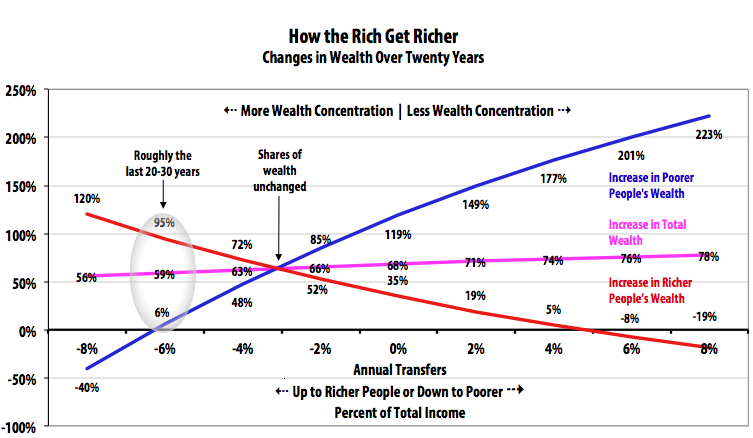
Perfect markets concentrate wealth. It’s their nature. But at some point, market-generated wealth concentration strangles those very markets (compared to markets with broader distributions of wealth). If a handful of people have all the wealth, how many iPhones will Apple sell? If only a few have the wealth to buy cars, automakers will produce a handful of million-dollar Bugattis, instead of forty handfuls of $25,000 Toyotas. Sounding familiar?

Why, then, aren’t we spending our lives on the right side of this chart? It’s a total win-win, right? The answer is not far to find. Nassim Taleb shows with some impressive math (PDF) what’s also easy to see with some arithmetic on the back of an envelope: if a few richer people (who dominate our government, financial system, and economy) have the choice between making our collective pie bigger or just grabbing a bigger slice, grabbing the bigger slice is the hands-down winner.

To summarize: perfect markets, left to their own devices, concentrate wealth. Concentrated wealth results in less wealth, and far less collective well-being. (You’ll notice that I haven’t even mentioned fairness. It matters. But I’ll leave that to my gentle readers.)

This all leads one to wonder: how could we move ourselves into that happy world of rapidly increasing wealth and well-being on the right side of the graph? Hmmmm…

Emphasis Mine

Roth agrees that Marx was right about the dynamics of Capitalism. However, Roth wants to save Capitalism through the expansion of the Welfare State.

Yet, Roth points out the main impediment to the expansion of the Welfare Stete: the capture of the state by the wealthy. The plutotracy cares not whether it grows fast or slow, as long it stays in control.

Roth fails also to mention the importance of the USSR in the creation of the Welfare State in the West. The Welfare State was a political instrument to counteract Communist propaganda about a workers' paradise. Without the USSR, there is no longer a need for the Welfare State because there is now no alternative.

Or it could be as George Orwell wrote in 1984?

It was possible, no doubt, to imagine a society in which wealth, in the sense of personal possessions and luxuries, should be evenly distributed, while power remained in the hands of a small privileged caste. But in practice such a society could not long remain stable. For if leisure and security were enjoyed by all alike, the great mass of human beings who are normally stupefied by poverty would become literate and would learn to think for themselves; and when once they had done this, they would sooner or later realise that the privileged minority had no function, and they would sweep it away. In the long run, a hierarchical society was only possible on a basis of poverty and ignorance.

Emphasis Mine

A free society is a Communist one.


Read more!

Daniel Little: Is history probabilistic?

Daniel Little asks Is history probabilistic?

However, there are several crucial flaws in this analysis. First, the picture is flawed by the fact that history is made by purposive agents, not algorithms or mechanical devices. These actors are not characterized by fixed objective probabilities. Historical actors have preferences and take actions to influence outcomes at crucial points. Second, agents are not fixed over time, but rather develop through learning. They are complex adaptive agents. They achieve innovations in their practices just as the engineers and bureaucrats do. They develop and refine repertoires of resistance (Tilly). So each play of the game of political history is novel in important respects. History is itself influenced by previous history.

Finally, there is the familiar shortcoming of simulations everywhere: a model along these lines unavoidably requires making simplifying assumptions about the causal factors in play. And these simplifications can be shown to have important consequences for the sensitivity of the model.

So it is important to understand that social causation is generally probabilistic; but this fact does not permit us to assign objective probabilities to the emergence of central states, dictatorships, or democracies.

Emphasis Mine

This is a very important part of Lennist Party theory. A revolutionary party must attract and develop cadre who are able to intervene at critical points in the development of the consciousness of the proletariat. And, in doing so, the cadre develop themselves and othe party members by reflecting upon their collective experience.

This is also why the revolutionary party is always the subject of intense survellience and intervention by state security appartuses. The prime example is COINTELPRO that was run by the FBI.

The development of the proletarian consciousness has to consider the history of the society in which they operate. Consciousness is not made in a vacuum. Consciousness is built through experience, reflection, and action.


Read more!

2018/01/09

Chris Dillow: The politics of death

Chris Dillow investigates The politics of death.

Neither response, though, is what we get. Instead, when Aditya Chakrabortty said on Question Time last week that the government is “send[ing] disabled people to their deaths” the reaction was as if he’d spat in the church’s collection plate (9 mins in).

Which in a sense he had. Aditya had the bad manners to point out that politics is a matter of life and death — at least for the poor — thereby puncturing his audience’s illusion that it is just a cosy little debating game in which the only costs are that a few MPs move down the career ladder. I had hoped that the Grenfell disaster would destroy this illusion, but it seems the imbecilities of posh folk don’t die as quickly as do the poor.

Emphasis Mine

We live in a political and economic system (Capitalism) in which winners are celebrated and the losers are forgotten. Every day Capitalism exists, we are compilicit in mass murder.

Indeed, the obliviousness of the death of poor leads the celebration of death under Fascism. As Miguel de Unamuno said:

Just now I heard a necrophilous and senseless cry: 'Long live death'. And I, who have spent my life shaping paradoxes must tell you as an expert authority, that this outlandish paradox is repellent to me. Let it be said without any slighting undetone. He is a war invalid. So was Cervantes. Unfortunately there are too many cripples in Spain now. And soon there will be even more of them if God does not come to our aid. It pains me to think that General Millan Astray should dictate the pattern of mass psychology. A cripple who lacks the greatness of Cervantes is wont to seek ominous relief in causing mutilation around him. General Millan Astray would like to create Spain anew, a negative creation in his own image and likeness; for that reason he wishes to see Spain crippled as he unwittingly made clear.

Emphasis Mine


Read more!

Seth Godin: Where would we be without failure?

Seth Godin asks Where would we be without failure?

Failure (and the fear of failure) gives you a chance to have a voice…

Because failure frightens people who care less than you do.

Emphasis Mine

People are continually advising me to give up because Communism and Socialism has failed. They point to historical examples (of which there are many). My response is that we are learning from failure.

The real question is whether Communism is a worthwhile goal? Would the struggle towards Communism make us better people? Or are we content to wallow in the mire of selfish self-interest?


Read more!

Mike Kimel: The Upcoming Liberation of Mexico (and Parts of Africa)

Mike Kimel writes about The Upcoming Liberation of Mexico (and Parts of Africa).

All of this, taken together, suggests that Mexico is an awful place for Mexican and non-Mexican people alike. And yet, the land has so much promise. Plus great weather. The humane and socially aware solution is obvious: the government of Mexico must be overthrown. Ideally, it would be replaced by indigenous, peaceful, inclusive, tolerant, non-racist, intersectional, organic and home-grown Mexicanx policies and traditions. Obviously, in Mexico, that would be a social structure derived from Aztec culture. That would be the ideal outcome. However, given the conditions people in Mexico are willing to tolerate to get to and live in the US, the bar is very, very low. That means the odds of making things worse are infinitesimally small.

So for this operation, the likelihood of success is large, the probability of failure is tiny, and the benefits are huge. What’s not to like about regime change in Mexico? Furthermore, the benefits of this regime change wouldn’t accrue just to Mexicans and African refugees who are currently trapped in Mexico. Even white supremacists — who because they are in the majority in the US would bear the bulk of the cost in blood and treasure — would have a benefit: penance. The karmic load they carry would diminish slightly, and they might even develop some empathy. Some white supremacists might stop and think about how the world could have turned out but for their accident of birth. With a different history, America’s white supremacists would have all ended up in Mexico. Conversely, the Mexican population (together with America’s minority population and the few white Americans who are racially aware) might have ended up living in the US, perhaps even a US operating along pre-Columbian Mexican norms.

Now, this opportunity for racist white people to achieve some small measure of redemption doesn’t have to stop with Mexico. In fact, it shouldn’t stop with Mexico. From the LA Times article, it is clear there are people in countries in Africa who could be spared having to flee their homeland if the white supremacists in the US would develop a small measure of humanity and overthrow their governments too. Now I know what you’re thinking… we heard a similar “we will be greeted as liberators” line about a decade and a half ago. But it was different then. The motives were selfish. Our leaders thought they were acting to make Americans safer, and to make matters worse, they didn’t even bother to differentiate between the safety of the racist majority who should just die already and those who are worthy of such safety.

Emphasis Mine

Kimel is being sarcastic here. The US government currently loves the Mexican and African governments. If the US government did not, the CIA would be busy trying to overthrow these foreign governments.

The litany of US interventions to overthrow unfriendly governments can be found here.

The US government does not give a fuck about ordinary people whether they are white, black, brown, yellow, red, etc.. All Capitalist governments want to divide us by race, gender, sexual preferences, culture, history, language, nationality, etc..

It is up to we workers to develop our own consciousness about how the current world is constructed to benefit the rich and screw over the poor.


Read more!

Steve Roth: Democracy. Capitalism. Socialism. Choose Any Three of the Above

Steve Roth writes about Democracy. Capitalism. Socialism. Choose Any Three of the Above.

None of this is to suggest that there is a political parity or symmetry among these anti-ists — at least in the United States. Anti-democrats are essentially invisible and voiceless, their message a fatal political non-starter. As for anti-capitalism, try naming one successful politician this side of the Seattle city council (one member) who even makes noises about “eradicating capitalism.” Certainly on a national stage, doing so would be political suicide. (The Bernie movement is, rather, all about the ubiquitous social institutions detailed above, and about pushbacks to corporate power within our heavily capitalistic system.) Anti-socialists, on the other hand, stand at the very pinnacles of power; their voices are manifold, loud, and widely broadcast.

But regardless of their relative political power, all of these these ill-considered, utopian, faith-based, tribalistic anti-isms are a bane on the body politic. At this point in our evolution, capitalism, socialism, and democracy are necessary for any country’s prosperity, economic freedom, and economic well-being. And they all need improvement — just as we’ve been fitfully improving things for hundreds, even thousands of years.

Emphasis Mine

Socialism has to develop out of Capitalism. This has to be a conscious development — Socialism is not inevitable. Socialism has to be chosen daily.

Democracy is vital for the functioning of Socialism and the eventual evolution to Communism.

There well may be residual pockets of Capitalism in a Socialist society as is now happening in Cuba. But the majority of the productive forces will be owned and managed by the people.


Read more!

2018/01/08

Ted Rall: How Society Makes Victimhood a No-Win Proposition

Ted Rall examines How Society Makes Victimhood a No-Win Proposition.

Society doesn’t like victims. Victims make us uncomfortable. It’s probably a vestige of our Darwinian instinct for survival: the monkey clan prospers when its members are healthy and lucky, but finds life perilous around those who are sick and unfortunate. We turn away from the unlucky: the homeless man, the woman whose face bears burn scars, the black guy getting choked to death by cops. Not our business, not our problem, these are troubles to be avoided. I do it too.

This instinct goes double for those who refuse to soft-pedal their victimhood. Not even the most active social justice warriors have Rose McGowan’s back in her Twitter crusade against Harvey Weinstein — she’s a bit too angry for comfort. (Her recent drug arrest doesn’t help.)

Emphasis Mine

This is especially so in a society that is built on Darwinian survival: Capitalism. The apex predator is worshipped and emulated. Victims are trophies to be displayed and mocked.

Donald Trump is an unabashed Capitalist and enough Americans wanted him to be a symbol of their country that he became POTUS.


Read more!

Daniel Little: Organizational dysfunction

Daniel Little writes about Organizational dysfunction.

One intriguing hypothesis is that correction of dysfunctions requires observation, diagnosis, and incentive alignment. It is necessary that some influential actor or group should be able to observe the failure; it should be possible to trace the connection between the failure and the organizational features that lead to it; and there should be some way of aligning the incentives of the powerful actors within and around the organization so that their best interests are served by their taking the steps necessary to correct the dysfunction. If any of these steps is blocked, then a dysfunctional organization can persist indefinitely.

The failures of Soviet agriculture were observable and the links between organization and farm inefficiency were palpable; but the Soviet public had not real leverage with respect to the ministries and officials who ran the agricultural system. Therefore Soviet officials had no urgent incentive to reform agriculture. So the dysfunctions of collective farming were not corrected until the collapse of the USSR. A dysfunction in a corporation within a market economy that significantly impacts its revenues and profits will be noticed by shareholders, and pressure will be exerted to correct the dysfunction. The public has a strong interest in nuclear reactor safety; but its interests are weak and diffused when compared to the interests of the industry and its lobbyists; so Congressional opposition to reform of the agency remains strong. The same could be said with respect to the current crisis at the Consumer Financial Protection Bureau; the influence of the financial industry and its lobbyists can be concentrated in a way that the interests of the public cannot.

Emphasis Mine

For an organization to function correctly, it must be under democratic control. A wide democratic base ensures that an organization functions for the benefit of the wider society.

The width of a democratic base determines spread of benefits from that organization. An organization exists to benefit its owners. If a narrow clique control an organization, then a narrow group reaps the benefits, while the majority bear the costs. This is the case under Capitalism.

Socialism means that there is social control of important organizations. This would mean that the benefits from these organizations would flow to the wider community.


Read more!

2018/01/07

Ten truths about Cuba's general elections

Ten truths about Cuba's general elections.

Although the media spends a lot of time portraying Cuba as a “dictatorship”, it has barely covered the fact that Cubans have once again begun a process of electing officials, starting from the local and going all the way up to the national parliament.

Already, 78% of the population has participated in the process of selecting candidates for local government elections scheduled for November 26. A second round is scheduled for December 5 [2017] in cases where no candidate reaches 50%.

More than 27,000 candidates (from an initial list of 60,800 nominees) will contest for more than 12,000 seats spread out across 168 municipal assemblies. Sixty-five per cent of candidates are not sitting incumbents and 35% are women.

The second round of the process, to elect representatives to regional parliaments and the National Assembly, is scheduled for early next year [2018]. President Raul Castro has already announced he will step down as the head of state following the election of the next National Assembly.

Emphasis Mine

A dictatorship is any political entity in which the Western elites do not get their own way:

  • Iran is a dictatorship because the Iranian people think for themselves.
  • Chine is currently not a dictatorship because Western companies are making lots of money.
  • Russia is a dictatorship because the Russian elite have their own agenda.
  • Venezuela is a dictatorship because the people are putting their needs first.
  • Saudi Arabia is not a dictatorship because they sell cheap oil and buy expensive arms from the West.

When the Western media talk about democracy, they mean the multi-billion dollar political campaigns in which very rich people run for office. Democracy is perverted into a scam in which the rich get richer, and the poor get ripped off.

This was why the Bernie Sanders campaign so frightened the elite:


Read more!

2018/01/06

Paul Le Blanc: The Russian Revolutions of 1917

Paul Le Blanc writes about The Russian Revolutions of 1917.

Lenin proved utterly unsuccessful in his efforts, during the last years of his life, to push back bureaucratic developments and to end the influence of Joseph Stalin, the most authoritarian of the Communist leaders. Similar efforts by other Communist leaders throughout the 1920s, most notably by Leon Trotsky and his Left Opposition, were defeated. Stalin became the USSR’s unquestioned dictator. Even his onetime ally, Nikolay Bukharin, proved unable to curb the tyrant’s increasingly brutal excesses. Millions, including many Communists, suffered and died after Stalin and his supporters consolidated their dictatorship in the early 1930s.

As the USSR was experiencing significant economic development and becoming a major world power, the bureaucratic and authoritarian nature of the Stalin regime gave Communism the profoundly undemocratic connotation that it has for many people today. For many, socialism came to mean not economic democracy but merely state ownership and control of the economy. Even the word soviet became associated simply with the USSR’s dictatorial regime. Stalin’s successors in subsequent Communist governments of that country later denounced his crimes, but they were never successful in overcoming the dictatorial legacy. That legacy ultimately undermined the country’s future development, contributing in significant ways to the collapse of the USSR in 1991.

Many analysts argue that such a dictatorship was inherent in the nature of Lenin’s ideas, Marxism, socialism, and even revolution as such. Others explain its development by pointing to different factors: deep-rooted aspects of Russian culture from tsarist times, the failure of working-class revolutions in more industrialized countries, and the impact of hostile foreign pressures. Some continue to see the Russian revolutions of 1917 as a positive example for workers and oppressed groups.

Emphasis Mine

I think the immature development of the Russian proletariat is the main cause of the trajectory of Soviet Communism. The Russian proletariat were a minority in 1917 and concentrated in two (2) cities: Moscow and Petrograd. Russian industrialisation was still in the early stages of development, and was driven through the nobility using foreign capital (mainly French). This meant the working class was very isolated in a sea of peasantry.

The concentration of workers in the two (2) capitals of the Russian Empire, Moscow and Petrograd, meant that they were easier to organise and had easier access to power. These cities were more open to the rest of the world thereby allowing ideas and news to reach people more readily. And as these cities were the main ones, they had universities which incubated radicalism. The closeness of radicalism and workers proved to be a potent mix for the development of socialism in the Russian empire.

This concentration of workers came about because the nobility wanted to modernise the Russian economy. The lack of indigenous capital meant that foreign investment was critical for industrialisation. The French became major investors because Russia could prevent the eastward expansion of German Capital and influence. Foreign investment prefers large projects and this concentrates the workers. Because the investment was foreign, Capitalists were unable to hide behind nationalism in defending their interests. This made the distinction between the Bourgeiose and the Proletariat easier to see.

However, the concentration of workers and the lack of indigenous capital isolated the workers from the peasants. But the newness of industrialisation had not completely severed the family ties of the workers to the peasants. The experiences of the workers and the peasants were different: a peasant can survive in isolation; a worker needs a functioning economy to survive. This difference made political alliances difficult. The peasant had the option of withdrawing from society. The worker does not.

The immaturity of the Russian proletariat came about from its isolation and concentration. The development of Socialism needed to force peasants to become workers. This external conversion inhibited the growth of workers' consciousness that was needed for a successful implementation of Socialism.


Read more!

2018/01/05

Dan Little: Europe after World War II

Daniel Little writes about Europe after World War II.

Perhaps more than in most histories, Judt's narrative makes it clear that there are large moral realities interwoven with the facts and events he conveys. Individuals commit actions that are deplorable or admirable. But more profoundly, whole nations were confronted with choices and actions in these decades that were formative for generations to come. This is nowhere more apparent than in the ways different European countries dealt with their own responsibility for the extermination of the Jews during the Holocaust. Judt deals with this issue in the epilogue to the book, and it is an important piece of historical writing all by itself. (A version was published in the New York Review of Books (link).) He demonstrates that almost none of the involved nations — especially the Netherlands, Poland, Italy, France — lived up to the duty of confronting honestly the behavior of its citizens and officials during the Shoah. France's mendacity in particular on the subject of its willing deportation of 65,000 Jews created a permanent stain on French culture — and it laid the basis for the continuation of denial of French responsibility by the FN up to the present day.

Emphasis Mine

Here we encounter the interplay between subjective and objective realities. An individual's subjective reality of denying the Holocaust is bolstered by the objective reality of no offical acknowledgement of the State's historical role in the Holocaust. And the objective reality cannot be changed without overcoming the fierce resistance of these individuals.


Read more!

2018/01/04

Ted Rall: Laptop Fundraiser

Ted Rall is having a Laptop Fundraiser.

Back in 2011, you were generous enough to come through when I needed a new laptop computer. It was an amazing machine, but six and a half years is a long time for any portable computer to last — especially when you travel as much as I do. I’ve scanned and colored thousands of cartoons, written hundreds of columns, worked on my blog and done endless research.

Emphasis Mine

Rall needs our support. Please donate.


Read more!

2018/01/03

Juan Cole: Wind powered all of Scotland in October & other Renewable Success Stories

Juan Cole writes that Wind powered all of Scotland in October & other Renewable Success Stories.

Wind turbines in Scotland during the month of October , driven by unusually strong gales, generated enough electricity to supply 99% of the country’s power needs, taking into account residential, industrial and business sectors! And if we just looked at the residential market, the wind turbines could have powered 4.5 million homes! One catch: Scotland only has about 2.45 million households!

99%!

Still, the average Swede emits over 4 tons of carbon dioxide a year. That is better than Europe’s average 6 tons and ‘way better than the US average of 16 tons per year per person (!!!). But 4 tons a person is still huge, given that CO2 is like setting off atomic bombs in the atmosphere. The new Markbygden ETT wind farm will be an important step toward carbon-free Swedish electricity. Of course, that has to be combined with switching to electric vehicles and adopting low-carbon agricultural and building techniques if we are to move to a net carbon zero civilization.

Emphasis Mine

Energy storage reliability is the next hurdle we have to overcome. The pumped-water storage system cannot be deployed everywhere. Future water shortages will make existing ones vulnerable as water is diverted to more critical uses.


Read more!

2018/01/02

Peter Robson: Capitalism's last wild ride - Noys' book dissects accelerationism

Peter Robson reviews Capitalism's last wild ride - Noys' book dissects accelerationism.

Accelerationism — although now largely a right-wing movement — has some origins in leftist thought about capitalism. The idea that the processes of capitalism and its productive forces would themselves drive it to its next stage — or whatever lies beyond — led some to conclude the best thing to do is push capitalism as hard as it can to go as fast as it can.

This, in a nutshell, describes accelerationism. Whether it is the forcing of labour processes to be more efficient, the combination of humanity and machines, or the destruction of borders and identities — it is all viewed as ways to create the higher velocity society of the future.

Against these visions, Noys explores the counterpoint that revolution would not be a liberation of productive forces, unleashing a higher velocity existence. Rather, it could be a handbrake on a runaway train, slowing us before destruction.

But he rejects this in favour of more nuanced approach, an approach that is more fundamentally political. And this, ultimately, is the real problem with accelerationism — it surrenders politics to the realm of technological progress and thereby to those who control that progress.

This explains why so many of its supporters are the “not remotely human rich” (to paraphrase sci-fi writer William Gibson), but also why it attracts some who are demoralised with political struggle.

Surrendering to blind material progress absolves one from having to build movements or relate to social forces. Building powerful movements of ordinary people requires the all-too-human quality of empathy — an anathema to the prophets of accelerationism.

Emphasis Mine

In order to build Socialism, we need to rediscover our humanity through connecting to the humanity of others.


Read more!

2018/01/01

Movie Review: Star Wars: The Last Jedi

I review Star Wars: The Last Jedi movie.

I was intrigued by Keith Knight's theory about how the First Order was able to track the Resistance through hyperspace. But this was a risky strategy given that the Resistance fighter pilots have a high attrition rate (close to 100% by the end of the movie).

The main tension in the movie is between direct action (Poe Dameron and Finn) and survival (Leia Organa and Vice Admiral Holdo). This is the quandary that affects all guerrilla groups. Direct action attracts new members and supporters while harming the oppressors. This entails retaliation which threatens the survival of the group. The movie closes on the importance of political action over military action.

Direct military action had been successful for the Resistance and Rebel Alliance in the past. Then they were strong enough to tackle the enemy in open battle to either prevail, or to retreat in good order. Now, the losses in personnel and materiel has become critical and harder to replace. The First Order can easily win any battle of attrition. This is demonstrated in the movie as the First Order is able to recover from the losses of two (2) of the largest ships and several Star Destroyers, and force the resistance to escape on a single ship.

This materiel and personnel advantage of the First Order discourages forces in the Outer Rim from coming to the aid of Leia's group on Crait. There is the known cruelty of the reprisals by the First Order. People would make the rational decision to keep their heads down, and bend with the prevailing wind. DJ exemplifies this by striking a deal with the First Order and escaping to live another day.

Yet the movie closes on a very important point: political education. Three (3) children are re-enacting the heroic stand by Luke Skywalker on Crait. It is through their mythologising that the Resistance grows. Trotsky once wrote that the success of the October Revolution came about through the dedication of single Party workers scattered throughout the Russian Army, factories, villages, etc. They did not attack the State, but rather they patiently educated their fellows on Socialism and Capitalism.

The Resistance will not grow until it grasps the necessity of political action over military action. And it must grow if it is defeat the First Order in open combat.


Read more!

2017/12/31

Barry Healy: 80 years on, Steinbeck's classic still packs a punch

Barry Healy writes that 80 years on, Steinbeck's classic still packs a punch.

Healey says Of Mice and Men,

Thus all the oppressed keep themselves divided, one against the other, trying to gain some scrap of self-worth by putting each other down. Yet George and Lennie have a secret that cuts through this fog of alienation and with just a few words inspire the spirit of the workers.

Their dream is to buy their own farm and, through sharing the labour, create a decent life for themselves. As Lennie naively blurts it out, the individual workers' initial scepticism falls away as they dare to imagine themselves as part of it.

George and Lenny's dream is a synonym for socialism and its power is subversive in the farm.

Emphasis Mine

Our primary identity is that of workers. To fully realise that identity, we need to have the vision of Socialism.


Read more!

2017/12/30

Daniel Little: How to think about social identities

Daniel Little muses on How to think about social identities.

Finally, it is also clear — as the theorists of intersectionality have demonstrated (for example, Patricia Hill Collins; link) — that most of us possess multiple identities at the same time. We are Irish, European, lesbian, working class, anti-fascist, and Green, all at the same time. And the imperatives of the several identities we wear are often different in the political actions that they call for. Here again the question of consistency arises: how are we to reconcile these different calls to action? Is there an underlying consistency of values, or are the orienting values of one's anti-fascism largely independent from one's commitments to a pro-environmentalist agenda?

It is clear that various kinds of identities are highly relevant to politics and collective action. Appeals to identity solidarities have powerful effects on mobilization and political activization. But given that identities are not primeval, it is also clear that identities are themselves the subject of political struggle. Leaders, activists, and organizations have powerful interests in shaping the content and focus of the identities that are realized in the groups and individuals around them.

Emphasis Mine

The only identities that matters are those of worker and capitalist. One has to choose one over the other. There is no grounds for compromise between the two (2).


Read more!

2017/12/29

Chirs Dillow: Why I'm not a lefty

Chris Dillow reveals Why I'm not a lefty.

There is, in fact, a common theme to all these differences. It’s about attitudes to knowledge. I’m much more wary of how much we can know for sure and so am sceptical of policies which presume such knowledge. This might reflect a class difference: as someone of working class origin, I’ve had humility beaten into me in a way that posher lefties might have.

Unlike Nick, however, I’m not going to disown the left. The differences I’ve described are perhaps those between Marxists and non-Marxists. The non-Marxist left believes, with Orwell, that England is “a family with the wrong members in control”. My problem is that in a class-divided society the wrong members will always be in control.

Emphasis Mine

I agree with Dillow that the Right conflates the Marxists and non-Marxist Liberals into the Left. The structure of society has to change.


Read more!

2017/12/28

Andrew Bacevich: How We Learned Not To Care About America's Wars

Andrew Bacevich reveals How We Learned Not To Care About America's Wars.

Bacevich lists the following reasons for why Americans generally care the ongoing wars waged by the USA around the world:

  1. U.S. casualty rates are low.
  2. The true costs of Washington’s wars go untabulated.
  3. On matters related to war, American citizens have opted out.
  4. Terrorism gets hyped and hyped and hyped some more.
  5. Blather crowds out substance.
  6. Besides, we’re too busy.
  7. Anyway, the next president will save us.
  8. Our culturally progressive military has largely immunized itself from criticism.

In other words, the general American population has no skin in the game. War has become an abstraction. There is an immaturity imposed on the American people by the media: adults are doing their thing, and the children should be quiet.


Read more!

2017/12/27

Dan Little: Social consciousness and critical realism

Daniel Little argues that Social consciousness and critical realism are interrelated. The material basis of social structures exposed through Critical Realism can explain the subjective reality constructed by agents in their Social Consciousness. Little omits the reproduction of the objective reality by agents reproducing their subjective reality.

Little argues that the subjective view of one's social identity is constructed …through interaction with other individuals, and many of those interactions are determined by enduring social structures and institutional arrangements. We do not have a sense of who and what we are in isolation. My concept of being male is built as distinct from what I perceive femaleness to be, and what others perceive femaleness to be.

So ideas and identities are objective in at least two senses, and are therefore amenable to treatment from a realist perspective. They have objective social determinants that can be rigorously investigated; and they have a particular grammar and semiotics that need to be rigorously investigated as well. Both kinds of inquiry are amenable to realist interpretation: we can be realist about the mechanisms through which a given body of social beliefs and values are promulgated through a population, and we can be realist about the particular content of those belief systems themselves.

Emphasis Mine

In a patriarchal society, the idea of gender is expressed as either male or female. How this gender is expressed is through a particular set of signs, and an acceptable set of language and actions. An example would be wearing pants for males, and wearing dresses for females. One would say that a male wearing a dress to be taboo.

Ironically, this position seems to converge in an unexpected way with two streams of classical social theory. This approach to social consciousness resonates with some of the holistic ideas that Durkheim brought to his interpretation of religion and morality. But likewise it brings to mind Marx's views of the determinants of social consciousness through objective material circumstances. We don't generally think of Marx and Durkheim as having much in common. But on the topic of the material reality of ideas and their origins in material features of social life, they seem to agree.

Emphasis Mine

In Marx's case, this is usually expressed as the Objective creating the Subjective. Reality creates our ideas about reality. If one sees two (2) genders, then one has the idea that there are only two (2) genders. This is reinforced when others report that there are only two (2) genders.

These considerations seem to lead to a strong conclusion: critical realism can be as insightful in its treatment of objective social structures as it is in study of “subjective” features of social consciousness and identities.

Emphasis Mine

What Little omits is that Marx also said that the Subjective creates the Objective. What we see as reality is not the true reality: it is only an approximation. Our ideas inform what we see. In this case, the existence of other genders is considered to be an impossiblity. This idea of impossibility precludes any discussion of other genders.


Read more!

2017/12/11

SCIAM: How Captives Changed the World

Catherine M. Cameron describes How Captives Changed the World.

Although captives formed the lowest social stratum of the groups they entered, they nonetheless influenced these societies in profound ways. They introduced their captors to new ideas and beliefs from their natal group, fostering the spread of technologies and ideologies. And they played key roles in the creation of status, inequality and wealth in the groups that abducted them. These factors may well have laid the groundwork for the emergence of a much more sophisticated social structure: the state-level society, in which one person or small group of people hold significant power and authority over a population numbering more than 20,000 and in which group membership is built not on kinship ties but on social class or residence within the boundaries of a nation-state. For all the misery they endured, captives changed the world.

Emphasis Mine

Cameron disputes …the idealized image of small communities of people who treated one another as equals. In other words, primitive Communism may never have existed. And the earliest societies were slave-owning with slaves being obtained through raiding. This would appear to be more in line with some right-wing thinking in that all societies were based on war and acquisition.

Also, this view would also contradict the notion that slavery originated from insolvent debtors. It would appear that slavery could pre-date the origins of money and debt. Cameron cites some cases in which slaves functioned as a …unit of value and was used as a method of payment.

Perhaps the most surprising finding from my study is that captives were a potent source of social and political power for their captors. In small-scale societies, social power stemmed from the number of followers a leader controlled, most of whom were relatives. However, unwillingly, captives added significant numbers of nonkin followers and thus increased the status of their captors. Captors, especially women of reproductive age, allowed leaders or status-seeking men to increase the size of their family or number of followers without incurring a bride price to the bride's family. And by definition, captives created instant inequality in the societies they joined. As the most marginal and despised members of the group, they raised everyone else's standing.

Emphasis Mine

Cameron argues that this surplus production from slaves freed a leader from the constraints of kinship. One of which was to restrain growth of inequality within a kin. This surplus production allowed the generation of reciprocity from nonkin through gifts and feasts. This would have allowed a leader to assemble a greater war-band which would allowed for the acquisition of more captives. A positive feedback would then increase further the power and reach of such a leader.

Given the impacts of captives on the cultures they entered, I suspect that they played an important role in one of the fundamental social transitions in human history: the formation of complex, state-level societies. University of Michigan archaeologist Norman Yoffee has argued that state-level societies did not emerge until socioeconomic and governmental positions were no longer linked to kinship. And most archaeologists and other social scientists agree that states were at least in part the result of a few people creating and controlling surplus goods. Captive taking helped early human groups meet both these conditions for the evolution of statehood. Captives were not the only factor in the formation of states, of course. They existed in many small-scale societies around the world without effecting this dramatic social change. But captives were (and still are) taken to bolster the social status of ambitious men and, in my view, gave some of these men the opportunity to accrue the quantities of wealth and power that must have been the foundation of early states.

Emphasis Mine

This still adheres to the Marxist idea that surplus production gave rise to the class society. In the conventional view, it was specialization, such as pottery-making, etc., that lead to inequality in wealth distribution. Or a priesthood had emerged to compel the generation of surplus goods.

It would be interesting to discover what other factors led to formation of states.


Read more!

2017/11/15

Dan Little: Capitalism's bad incentives

Chris Dillow writes about Capitalism's bad incentives.

Now, I’m not saying that these bad incentives will bring down capitalism or that they are all eliminable: there is a great deal of ruin in a nation. They do, however, raise an important possibility — that there is abundant room for a leftist government to consider alternative governance structures that reduce agency problems and produce better incentives. As John McDonnell notes, such structures might (pdf) well include more cooperatives, as these give control to workers who have both skin in the game and local knowledge of particular working practices.

Unfortunately, the Capitalists will see the development of worker cooperatives as a threat to their power as these cooperatives are a contending centre of power in the political and economic system. And their existence undermines the Capitalists' contention that there is no alternative.


Read more!

2017/11/14

Noam Chomsky: A World in Peril

Noam Chomsky and David Barsamian discuss A World in Peril.

Functioning democracy erodes as a natural effect of the concentration of economic power, which translates at once to political power by familiar means, but also for deeper and more principled reasons. The doctrinal pretense is that the transfer of decision-making from the public sector to the “market” contributes to individual freedom, but the reality is different. The transfer is from public institutions, in which voters have some say, insofar as democracy is functioning, to private tyrannies — the corporations that dominate the economy — in which voters have no say at all. In Europe, there is an even more direct method of undermining the threat of democracy: placing crucial decisions in the hands of the unelected troika — the International Monetary Fund, the European Central Bank, and the European Commission — which heeds the northern banks and the creditor community, not the voting population.

Emphasis Mine

Capitalism destroys Democracy.


Read more!

2017/11/13

Dan Little: Community resilience

Dan Little writes about Community resilience.

So the question here is this: what features of community life can be developed and cultivated that can serve as "shock absorbers" working to damp down the slide towards antagonism? What social features can make a multi-group community more resilient in face of provocations towards separation and mistrust?

Without pretending to offer a full theory of inter-group community stability, there are a few measures that seem to be conducive to stability.

First, the existence of cross-group organizations and partnerships among organizations originating in the separate groups, seems to be a strongly stabilizing feature of a multi-group society. The presence of a group of leaders who are committed to enhancing trust and cooperation across group lines provides an important "fire break" when conflicts arise, because these leaders and organizations already have a basis of trust with each other, and a willingness to work together to reduce tensions and suspicions across groups.

Second, person-to-person relationships across groups (through neighborhoods, places of work, or family relations) provide a basis for resisting the slide towards suspicion and fear across groups. If Chandar and Ismael are friends at work, they are perhaps less likely to be swayed by Hindu nationalist rhetoric or Islamic separatist rhetoric, and less likely to join in a violent mob attacking the other's home and community. Neighborhood and workplace integration ought to be retardants to the spread of inter-group hostility.

Third, policing and law enforcement can be an important buffer against the escalation of ethnic or religious tensions. If a Muslim shop is burned and the police act swiftly to find and arrest the arsonist, there will be a greater level of trust in the Muslim community that their security interests are being protected by the system of law.

Intergroup violence is the extreme case. But the separation of communities into mutually fearful and mistrustful groups defined by religion, race, or ethnicity is inherently bad, and it has the prospect of facilitating intergroup violence in the future. So discovering practical mechanisms of resilience is an enormously important task in these times of division and antagonism presented by our national political leaders.

Emphasis Mine

Shouldn't we consider class solidarity instead? Little's analysis seems to be blind to class. He alludes to the ruling class formenting community antagonism, but is unable to elucidate a theory for such a policy.

The explicit generation of community unrest by the political class means that law enforcement is unlikely to intervene. In fact, the police are more likely to protect the agitators (such as Fascists) than their victims.


Read more!

2017/11/10

Dan Little: Worker-owned enterprises as a social solution

Dan Little writes that Worker-owned enterprises as a social solution.

The central insight of Marx's diagnosis of capitalism is couched in terms of property and power. There is a logic to private ownership of the means of production that predictably leads to certain kinds of outcomes, dynamics that Marx outlined in Capital in fine detail: impersonalization of work relations, squeezing of wages and benefits, replacement of labor with machines, and — Marx's ultimate accusation — the creation of periodic crises. Marx anticipated crises of over-production and under-consumption; financial crises; and, if we layer in subsequent thinkers like Lenin, crises of war and imperialism.

The shorthand for this is alienation.

The logic is pretty clear. When an enterprise is owned by private individuals, their interest is in organizing the enterprise in such a way as to maximize private profits. This means choosing products that will find a large market at a favorable price, organizing the process efficiently, and reducing costs in inputs and labor. Further, the private owner has full authority to organize the labor process in ways that disempower workers. (Think Fordism versus the Volvo team-based production system.) This implies a downward pressure on wages and a preference for labor-saving technology, and it implies a more authoritarian workplace. So capitalist management implies stagnant wages, stagnant demand for labor, rising inequalities, and disagreeable conditions of work. 

When workers own the enterprise the incentives work differently. Workers have an interest in efficiency because their incomes are determined by the overall efficiency of the enterprise. Further, they have a wealth of practical and technical knowledge about production that promises to enhance effectiveness of the production process. Workers will deploy their resources and knowledge intelligently to bring products to the market. And they will organize the labor process in such a way that conforms to the ideal of humanly satisfying work.

Emphasis Mine

Who owns the means of production greatly affects how workers are treated.

Worker management has implications for automation in a different way as well. Private owners will select forms of automation based solely on their overall effect on private profits; whereas worker-owned firms will select a form of automation taking the value of a satisfying workplace into account. So we can expect that the pathway of technical change and automation would be different in worker-owned firms than in privately owned firms.

In short, the economic and institutional realities of worker-owned enterprises are not entirely clear. But the concept is promising enough, and there are enough successful real-world examples, to encourage progressive thinkers to reconsider this form of economic organization.

Emphasis Mine

Getting workers to voluntarially increase their productivity was a big problem user USSR Socialism. We need to understand this problem in greater detail.


Read more!

2017/11/09

Chris Dillow: The Wykehamist fallacy

Chris Dillow examines The Wykehamist fallacy.

I suspect it’s partly because of a longstanding assumption among much of the Establishment, of which the BBC is part. This assumption is a form of the Wykehamist fallacy, the belief that members of that Establishment are jolly good chaps, usually because they went to the right schools and universities.

In truth, of course, the Wykehamist fallacy is an ancient one. Adam Smith was describing something like it when he wrote:

We frequently see the respectful attentions of the world more strongly directed towards the rich and the great, than towards the wise and the virtuous. We see frequently the vices and follies of the powerful much less despised than the poverty and weakness of the innocent. (Theory of Moral Sentiments, I.III.29)

I think Dillow misses the class basis for the Wykehamist Fallacy — it is the objective of the ideological superstructure to convince us everything is fine with Capitalism. Theire relentless message is that Capitalism is Good, and Socialism is Bad.


Read more!

2017/11/08

Steve O'Brien: Russian Revolution's legacy worth celebrating

Steve O’Brien writes that Russian Revolution’s legacy worth celebrating.

In the contemporary context, however, it is capitalism, more than socialism, which is falling short. Voters are feeling disenfranchised by a political system which sees the 1% get richer, as rents, house prices, student debts and utility prices soar.

The powerful minority that dominates capitalism says it is not the system which is to blame for low wages and longer working hours, but rather refugees, single mothers, climate activists, trade unionists and the unemployed.

Their neoliberal answer to social and economic problems is to offer more of the same: more privatisation, tollways, coal mines and budgetary restraint.

Emphasis Mine

Rather than excuse the failure of Socialism in the USSR, we should examine the trajectory of Socialism there and seek out lessons for Australia.


Read more!

2017/11/07

Paul Le Blanc: The Russian Revolutions of 1917

Paul Le Blanc writes about The Russian Revolutions of 1917.

The collapse of the tsarist regime thus left in its wake two centers of political authority: (1) the traditional politicians of the Provisional Government, who had little control over the people, and (2) the democratically elected soviets, which exercised more political power owing to support from the great majority of workers and soldiers. This system of dual power proved to be unstable. The instability grew as the moderate politicians proved increasingly unable to meet the rising expectations of the laboring masses.

With armed workers and revolutionary troops controlling the streets of the capital, political realities now tilted in a much more revolutionary direction. The Russian workers and peasants saw clearly that the landowners and capitalists and their leading political representatives had actively supported Kornilov. Kerensky was badly compromised because of his earlier overtures to Kornilov. The moderate SR and Menshevik leaders were discredited for supporting Kerensky. The Bolsheviks—who had built an effective political organization and put forward the popular demands of “Peace, Bread, Land” and “All Power to the Soviets”—had greater mass support than ever before.

Trotsky’s failure at the peace talks led to another crisis that undermined soviet democracy. After a fierce debate, Lenin persuaded a Communist Party majority in the government to accept the harsh peace terms. The Left SRs strongly opposed any agreement to the German demands, which included Russia’s giving up the Baltic states, Finland, Poland, and Ukraine. The Treaty of Brest-Litovsk was signed on March 3, 1918, and the Left SRs angrily walked out of the government and began organizing against both the peace settlement and the Communists. The Left SRs had a far better understanding of realities among the peasants than did the Communists. Their departure from the government opened the way for serious (sometimes even criminal) misjudgments by the government in dealing with the rural population. In particular, efforts to secure grain from the countryside in order to relieve bread shortages in the cities resulted in violent conflicts that undermined support for the Communist regime.

In this same period the Communists carried out a shift in economic policy that was to cause lasting problems. Threats of economic sabotage by capitalist factory owners who were hostile to the regime led the government to take over more and more of the economy—much more rapidly than originally intended. Ordinary workers were put in charge of factories, and their inexperience as managers resulted in economic difficulties. The government’s expansion into the economy also generated the growth of bureaucracy. A bureaucracy involves a hierarchy of administrators, managers, clerks, and others who are supposed to coordinate and control complex political, social, or economic activities. Often, a bureaucracy becomes an extremely impersonal and relatively inefficient structure, notorious for its arbitrary power and unnecessarily complicated procedures. Some historians believe that as the Soviet bureaucracy grew larger and more cumbersome, what was left of political democracy and economic efficiency degenerated. This bureaucratic degeneration added to the severe strains of the civil war and the foreign economic blockade. These added strains, in turn, resulted in a devastating breakdown of much of Russia’s industry.

As the USSR was experiencing significant economic development and becoming a major world power, the bureaucratic and authoritarian nature of the Stalin regime gave Communism the profoundly undemocratic connotation that it has for many people today. For many, socialism came to mean not economic democracy but merely state ownership and control of the economy. Even the word soviet became associated simply with the USSR’s dictatorial regime. Stalin’s successors in subsequent Communist governments of that country later denounced his crimes, but they were never successful in overcoming the dictatorial legacy. That legacy ultimately undermined the country’s future development, contributing in significant ways to the collapse of the USSR in 1991.

Emphasis Mine

Workers should learn from this history.


Read more!

2017/11/06

GLW: Ireland's Che stamp sells out amid unprecedented public demand

Ireland's Che stamp sells out amid unprecedented public demand.

The Che Guevara stamp produced by the Irish republic’s postal service (An Post) has sold out its initial 120,000 print run. The stamp was released to mark the 50th anniversary of the Latin American freedom fighter’s murder on October 9, 1967 by CIA-backed Bolivian state.

The announcement confounds right-wing critics, who opposed the stamp. An Post has described the demand for the €1 stamp — using Irish artist Jim Fitzpatrick’s image of the revolutionary icon — as “unprecedented”.

Emphasis Mine

Right-wingers cannot understand the appeal of Che. They always to submerge the resistance of the past:

For right-wingers, Che is a callous murderer. For the oppressed, Che is a liberator.


Read more!

2017/10/07

Seth Godin: If you can't see it, how can you make it better?

Seth Godin writes that If you can't see it, how can you make it better?.

The problem is becoming more and more clear: once we begin to doubt the messenger, we stop having a clear way to see reality. The conspiracy theories begin to multiply. If everyone is entitled to their own facts and their own narrative, then what exists other than direct emotional experience?

And if all we've got is direct emotional experience, our particular statement of reality, how can we possibly make things better?

If we don't know what's happened, if we don't know what's happening, and worst of all, if we can't figure out what's likely to happen next, how do take action?

Emphasis Mine

This is why party reports focus on:

  • Number of people who turned up to an event. This is a measure of the outreach potential. These are the ones who are willing to be seen to be supporting a cause.
  • Number of people joined to an organisation at an event. These are the people who take the step of going beyond agreement.
  • Number of speakers at an event. This is a measure of the diversity of opinions and the willingness of organisers to tolerate them.
  • Number of party papers sold. This is a measure of how acceptable the party's views are to the attendees at an event.

The first one is most suspect because it can fluctuate greatly throughout an event. But the other three (3) are more concrete as it is money in the bank.

What party reports do not focus on (because I imagined it is too depressing) are:

  • Number of inactive members (meeting financial commitments but not turning up to anything)
  • Number of members who no longer meet any financial commitments
  • Number of members who leave to join other organisations

I think these numbers are more important as they represent opportunities for improvement. The party can grow in two (2) ways:

  1. Recruiting new members through public outreach at events and through the party newspaper.
  2. Retention and activation of existing members.

If we do not reduce the second, we end up with a two-tier party: veterans; and the fly-by-nighters. We need to have a party with a clear graduation in experience. This means more mixing of experience.

Although numbers are good, too many numbers can obscure things. Numbers have to be collected with a goal in mind. We have to continually challenge the collection and the validity of the measurement.


Read more!

2017/08/30

Ted Rall: Progressive, Heal Thyself

Ted Rall writes that Progressive, Heal Thyself.

Many progressives are stupid. Unless they get smart soon, “The Resistance” to Donald Trump will fail, just like everything else the Left has tried to do for the last 40 years.

Stupid progressive thing #1: letting yourself be shocked by Trump.

Stupid progressive thing #2: viewing Trump‘s politics as significantly more dangerous or extreme than, say, Obama‘s.

Stupid progressive thing #3: always reacting, never acting.

Stupid progressive thing #4: never learning from past mistakes.

Emphasis Mine

The stupidity arises out of:

  • Lack of political theory
  • Lack of political experience
  • Lack of political memory

The best antidote is to join a revolutionary Communist party. In the party, there are classes about political theory (Marxism), discussions about past experiences, and meetings to plan actions to implement the political theory in light of past experiences.


Read more!