2023/10/15

Mike Shedlock: If You Don’t Openly Condemn Hamas, Then Don’t Complain What Happens Next

Mike Shedlock writes If You Don’t Openly Condemn Hamas, Then Don’t Complain What Happens Next

However, it is certain Hamas had swarmed through crowds, killing at least 260 people and taking an unknown number hostage at a music festival.

New Rule: If you cannot openly and honestly blast Hamas for these actions, then do not bother complaining about any response by Israel.

Emphasis in Original

This is a common tactic of all those who support the settler-colonial states—history only starts with something bad happening to the settler-colonial state. This tactic is used to deprive the event of any context and history. It is used to frame the discussion as something bad has happened to 'the good people', and you must condemn 'the bad people'. It is used, as here, as gate keeping—you cannot participate in the discussion unless you accept this statement.

Without understanding the context and the history, you are left with the impression is that these acts occur in a vacuum, and therefore the colonised are simply mindless brutes who must be exterminated because there is no reasoning with them.

This tactic has the negative effect of reinforcing this terrorist behaviour—if the only time you in the issues confronting the colonised is when atrocities occur, then the terrorists have the incentives to commit more horrific atrocities.

Flag of Palestine


Read more!

2023/10/14

Sue Bull: Stop Israel’s genocidal attack on Gaza

Sue Bull says Stop Israel’s genocidal attack on Gaza

For there to be a just political settlement, we need to help build a powerful global solidarity movement with the Palestinian people and against Israeli apartheid.

Effective solidarity means building alliances with those who support justice for Palestine such as the union movement, churches, community groups and Palestinian refugees.

The Anthony Albanese Labor government should call on Israel to stop its genocidal war on Gaza and lift the blockade. It should impose and support a comprehensive arms embargo on Israel. It should oppose ongoing Israeli land grabbing and ethnic cleansing support. And, it should support the right of Palestinian refugees to resettle in their traditional homelands with full rights.

Most Palestinians no longer believe that a “two-state solution” is viable. Palestine must become an integrated non-racialised, democratic state, where every citizen has equal rights.

Emphasis Mine

Israel needs to be subsumed into a secular Palestine. The religious apartheid needs to end. No religion has primacy in the new Palestine. The dual citizenship of Israel needs to end: residents need to choose whether they are Palestinians or not.

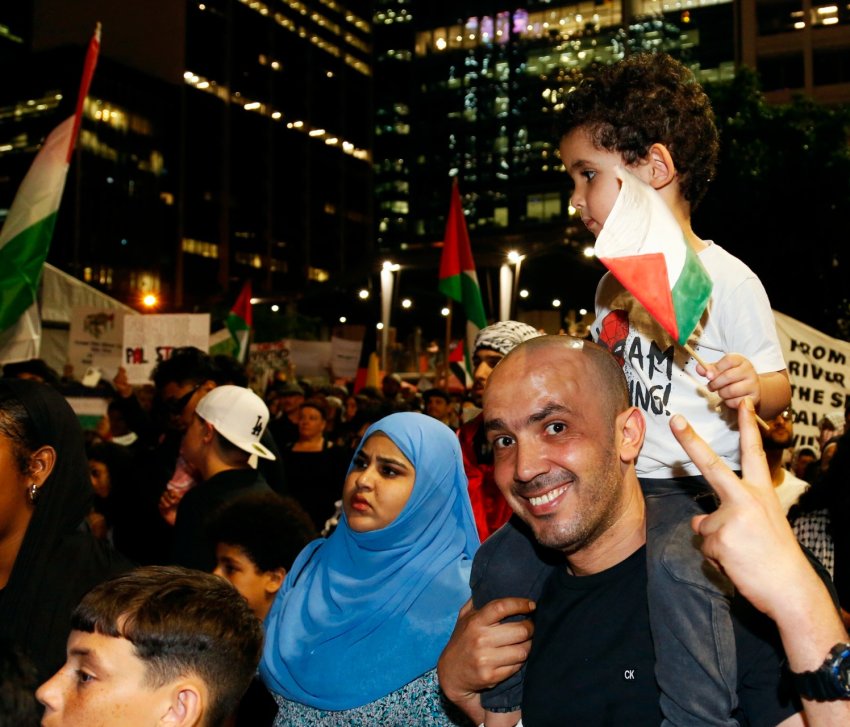
Protesting Israel's genocidal bombardment of Gaza in Meanjin/Brisbane. Photo: Alex Bainbridge


Read more!

Juan Cole: Israel’s Colonial Revenge Genocide in Gaza is only the latest in a Long History of such Massacres

Juan Cole discusses Israel’s Colonial Revenge Genocide in Gaza is only the latest in a Long History of such Massacres

Such vendettas against civilian populations have been routinely pursued by colonial militaries in the wake of a forceful challenge to their control. We must be clear-eyed and recognize that such revolts have sometimes been characterized by the deployment of the most horrific terrorism against the settler population by the indigenous resistance. The main characteristic of the phenomenon, however, is the disproportionate response by the settlers and their colonial military, so that the number of indigenous people killed is orders of magnitude higher than the casualties among the settlers. Another frequent trope is the patriarchal justification of subsequent massacres by pointing to settler women and children killed. This rhetoric drove London’s repression of the first Indian Great Rebellion against British rule in 1857-1858.

Emphasis Mine

As Cole points out, this disproportionate response is a feature of a settler-colonial society. One example from List of massacres of Indigenous Australians is:

March 1797. After Aboriginal Australians killed two British settlers, a large punitive expedition was organised which surprised and dispersed a native camp of about 100 people, killing an unknown number. The armed group then returned to Parramatta to rest. Pemulwuy, a noted Aboriginal resistance leader of the early frontier, followed them into the town, demanding vengeance for the dispersal. A skirmish (known as the Battle of Parramatta) then occurred between Pemulwuy's group and a collection of British soldiers and settlers. One of the settlers was injured, but at least five Aboriginal Australians were shot dead with many more wounded, including Pemulwuy.

Emphasis in Original

This example does not explain why the two (2) settlers were killed as part of Battle of Parramatta. This is the standard history of a settler-colonial society in which all atrocities start with the actions of the colonised, never in the context in which the actions occurred. One is left with the impression that the colonised are just blood-thirsty barbarism who act without reason. Consequently, the settlers believe that they are left with no other option than genocide. For to admit a rational basis for the actions of the colonised is to undermine the settler-colonial project.

In his book, "The Battle of Parramatta: 21 to 22 March 1797", Jonathan Lim argues the settlers killed were a soldier and his common-law wife (pp.20-21). These murders occurred during raids by Aboriginals to destroy the economic basis for settler encroachment on Aboriginal lands by destroying the grains just before harvest (p.17). These raids have been going for a couple of years. The increasing levels of reprisals by settlers, and the presence of a military garrison on the frontier points to the success of economic warfare.

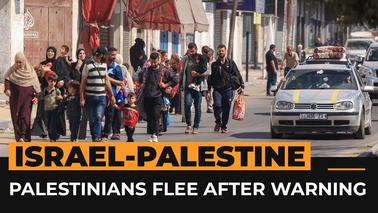
Street view of Palestinian families walking and in cars mving towards the viewer overlaid with the caption, Israel-Palestine: Palestinians flee after warning


Read more!

2023/10/10

Farooq Sulehria and Harris Qadeer: Kashmir: Anti-neoliberal intifada convulses the Himalayas

Farooq Sulehria and Harris Qadeer discusses "Kashmir: Anti-neoliberal intifada convulses the Himalayas".

By October, the boycott extended, with more and more consumers joining in. In response, more than 50 key activists were arrested, while the authorities threatened to register anti-terrorism charges against electricity consumers not paying their bills.

These heavy-handed state measures were responded to, on the one hand, by observing a general strike on October 5, and on the other, by extending the agitation. In the next phase, the Peoples Action Committees have announced a mobilization of women on October 10 and students on October 17.

Unsurprisingly, at the time of writing, the government spokespersons have promised talks, while police continue chasing Peoples Action Committee leaders, who have gone underground. Co-author Harris Qadeer is also in hiding to evade arrest. The police, simultaneously, are hesitant to detain activists because police stations where activists are detained are besieged by unarmed agitators. Besides being sympathetic to the demands, the cops don’t want “picket lines” outside their stations. In one case, police were forced to release arrested activists just hours after they were detained.

Meanwhile, the mainstream Pakistani media are avoiding any coverage of the movement. Despite this, Pakistan has also been infected. In certain towns, Peoples Action Committees have been set up, while traders associations in Karachi, the metropolitan hub of the country’s trade, have threatened not to pay their electricity bills. The situation in Pakistan is already explosive. An intifada against years of neoliberal “reforms” is the only option left to roll back the International Monetary Fund-dictated agenda that has pushed millions of lives into misery.

Emphasis Mine

Here we have non-violent protests going on for over five (5) months with very little media coverage. Even these protests are threatened as being treated as terrorism—this term has lost all substational meaning as states use it to denote anyone who opposes them. The importance of expanding grassroot networks, like the Peoples Action Committees, is essential for the non-violent protests to continue.

PaJK dharna protest


Read more!

Yves Smith: Is Israel Weaker Than Widely Seen in Hamas/Palestine “War”?

Yves Smith discusses Is Israel Weaker Than Widely Seen in Hamas/Palestine “War”?

Let us also remember the elephants in the room. Israel, even more so as it has become more right wing and ultra-Orthodox continue to increase as a percentage of its citizenry, has no end game for the Palestinians other than continued oppression and the hope that the current resident population leaves and/or otherwise shrinks. They have relied on policing and when the Palestinians have attacked Israel, the use of the IDF to contain the eruptions.

On the other side, there are militant forces in the Middle East that want Israelis expelled from Muslim holy areas, and potentially all of Israel. These desires have not gotten much of anywhere due to Israel having nukes and being perceived to be too formidable, particularly with US backing, for a hot conflict to have had good odds of success. However, Israel’s opponents have noted that Israel did not fare very well when it attacked Lebanon in 2006 to try to root out Hezbollah and instead failed abjectly. However, an offensive operation is also much more demanding and risky than defense.

In other words, the Israeli government has maximalist aims but has been implementing them slowly, and a meaningful contingent in the neighborhood also has maximalist aims.

Also keep in mind, given the need for Israel to project that it is undefeatable, both to deter attack and to maintain confidence at home, that just as in the Yom Kippur War, a battlefield win can still be a strategic loss. …

Emphasis Mine

Israel is implementing ethnic cleansing of Palestinians under the influence of the right-wingers. The illusion of Israeli invincibility is meant to deter any Western interference in that aim.

Marwan Bishara argues in "An Israeli civil war?" that:

From then on, American complicity in the form of economic and military support has provided the radical Israeli Right with much-needed momentum. And lately, Arab and Palestinian appeasement of fanatical Israel further hardened its racism. The Palestinian Authority has been repressing its own people in order to provide protection to Israel’s entrenching apartheid, rendering its survival an Israeli necessity.

Likewise, the willingness of autocratic Arab regimes to ditch the “land for peace” formula, and to sign up for unconditional peace and normalisation with colonial Israel, has provided Netanyahu and his fanatical allies with the legitimacy and the rationale to double down on their fanatical expansionist policies.

Emphasis Mine

This article was published before the current crisis. But Israel could collapse from within as the IDF refuses to fight in Gaza. The main problem for the Israeli religious fanatis is that they are exempt from military service, and so no voice within the IDF.

IDF-Merkava-Mk-4M-2016-Zachi-Evenor


Read more!

2023/10/09

Ted Rall: Clueless on Gaza

Ted Rall discusses how Americans are Clueless on Gaza

Gazans faced a choice.

They could obey Israel and its supporters. They could suffer, chafe under occupation, dodge bombs and bullets, starve, watch their friends and neighbors die, with no end in sight as the world keeps ignoring them.

They could stage protest marches that no important media outlet would cover, write firm-but-polite letters to the editor no one would publish and post to social media accounts no one would read. As they engaged in peaceful protest, they would keep starving and dying.

Or they could confront the Israelis with violence.

You can argue that violence is never the answer. You can claim that you’d be docile, that you’d live under blockade and occupation, never taking up arms or cheering those who do.

Go on, judge the Gazans. We both know you’d do the same exact thing if you were them.

Emphasis Mine

Back in 1943, there was the Warsaw Ghetto Uprising:

The uprising started on 19 April when the ghetto refused to surrender to the police commander SS-Brigadeführer Jürgen Stroop, who ordered the destruction of the ghetto, block by block, ending on 16 May. A total of 13,000 Jews were killed, about half of them burnt alive or suffocated.

Stroop reported 110 German casualties, including 17 killed.

The uprising was the largest single revolt by Jews during World War II. The Jews knew that victory was impossible and survival unlikely. Marek Edelman, the only surviving ŻOB commander, said their inspiration to fight was "not to allow the Germans alone to pick the time and place of our deaths". According to the United States Holocaust Memorial Museum, the uprising was "one of the most significant occurrences in the history of the Jewish people".

Emphasis Mine

One ghetto uprising is celebrated, while the other ongoing one is condemned.

Warsaw Ghetto Uprising (Poland) - Photo from Jürgen Stroop Report to Heinrich Himmler from May 1943. One of the most iconic pictures of World War II.


Read more!

2023/10/06

Dave Holmes: Ukraine: US proxy war in crisis

Dave Holmes discusses Ukraine: US proxy war in crisis

Much of the Western left is blinded by the deeply mistaken idea that Ukraine is fighting for self-determination against an attempted Russian takeover. I have taken up this question in a previous article (see Key issues of the war in Ukraine).

Russia is not seeking to take over Ukraine; it wants to secure its neutrality and demilitarisation. After eight fruitless years trying to achieve the implementation of the Minsk accords giving autonomy to the Donbass, Russia intervened in the already existing civil war between Kyiv and the Russia-oriented provinces in the south.

Emphasis Mine

He argues that Ukraine is in a far worse negotiating position than they were in April 2022. Now, Russia is against a freeze or cease-fire given the Russian view that they were deceived over the Minsk accords.

The Russian negotiating position now appears to be capitulation or extinction of the Ukrainian state. Some Russian voices are advocating control of Odesa, Mykilaiv, Dnipro, and Kharkiv oblasts in addition to the five (5) already annexed.

The de-industrialization of the West has weaken its ability to supply the Ukrainian Armed Forces. There is the incredible claim that Russia's military production is currently seven (7) times that of NATO.

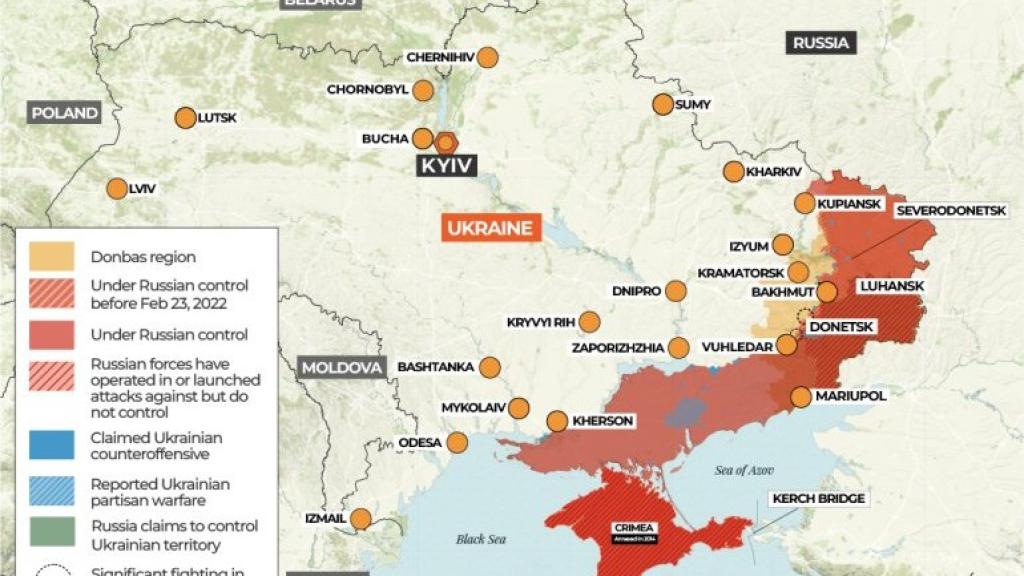
Ukraine map


Read more!

2023/10/05

Eric Lee: Ukraine and the world’s unions — the view from Kyiv

Eric Lee discusses Ukraine and the world’s unions — the view from Kyiv

Ukrainian trade unionists cannot understand why some of their brothers and sisters — for example, those in COSATU — who helped bring down a fascist regime in their own country would today be supporting a fascist regime somewhere else. They cannot understand why people in former colonies are not supporting Ukraine in what is clearly an anti-colonial struggle against a brutal, imperialist enemy.

Ukrainian workers and their unions remain defiant. They want and expect their fellow workers and unions around the world to stand with them, in solidarity. It is the very least that we can do.

Emphasis Mine

Lee has forgotten the history leading up to World War 1 in which the international worker solidarity was smashed by nationalism. Megan Trudell writes in Prelude to Revolution: Class Consciousness and the First World War:

Such a cataclysm was bound to create social shock waves that would rock the world’s ruling classes. But it certainly did not appear at the start that revolutions would be a result of the conflict. The strength of nationalist feeling in the first year of the war is an aspect of the war that perplexes many – why was the patriotic frenzy so great and why did so many workers volunteer to fight so enthusiastically? The notion that nationalism is all powerful is often used to bolster the argument that all the ruling class has to do is wave the flag and workers will flock behind it. It is an argument not restricted to the First World War but one encountered during every subsequent war – right up to the modern examples of the Falklands, the Gulf and Bosnia. The question of whether or not nationalism is a more powerful impulse than class identification is therefore utterly bound up with any account of the war.

The same period also saw the growth of the national idea in the more established capitalist states, where, for example, a ‘new celebration of British nationalism, with the establishment, for the first time, of a state run educational system that indoctrinated children in the glories of “national” history, the writing of nationalist popular novels, plays, poetry and songs by literary admirers of the empire and the conscious invention of traditions aimed at encouraging popular identification with the monarchy’.

In part this enthusiasm was a response to ruling class propaganda about the nature of the war. Every ruling class involved argued the war was one of national defence. Germany was defending itself from Russian aggression, France from German militarism. Britain was defending ‘poor little Belgium’. Each ruling class pushed the idea that there was an outside threat to the democratic rights enjoyed by the nation’s citizens, and in part the response of each country’s working class was an identification with one’s nation and a desire to protect one’s way of life.

But it wasn’t a straightforward calculation on the part of the ruling classes involved. Such had been the scale of domestic crisis in most of the countries involved that it was not at all obvious that workers would respond to the call to arms. In Britain, against a background of social upheaval and a potentially explosive situation in Ireland where the pressure for Home Rule was mounting, the Liberal minister John Morley considered that ‘the atmosphere of war cannot be friendly to order in a democratic system that is verging on the humour of [18]48’. Ruling classes across the globe were in fact astonished by the scale of patriotic zeal. This should not be surprising: nationalism is not simply imposed from above, but has to in some way correspond to existing national sentiments among a section at least of the population – often the middle class – and grips the minds of the masses when other social change seems remote.

It is not simply the case that workers who had fought so hard for social change in the pre-war years suddenly turned their backs on their own struggles and were brainwashed by their respective governments. Much of their motivation can be traced precisely to the holding back, or even defeat, of such social struggles. The vision of war came to seem as if it were an alternative way of dramatically transforming society. Magnus Hirschfeld described the response to the declaration of war as ‘a discharge of tensions that had built up for years’. Ferro argues that the ‘worker of 1914, going off to war, had found a substitute for revolutionary hopes.’ Many workers went to fight with ‘an image of war as the antithesis of the boredom, materiality and mechanisation of every day life’. …

Emphasis Mine

We are seeing the same patterns now. There has been fifty years of retreat of workers' solidarity within countries with the advance of neo-liberalism. And the retreat of international solidarity with the advance of offshoring through globalism, and the refugee crises. Workers are being pitted against each other within countries and between countries.

Eric Lee Ukraine


Read more!

Setri and Setiawan: Matriarchal Society in The Secret Life of Bees by Sue Monk Kidd

I discuss a paper by Setri & Setiawan (Matriarchal Society in The Secret Life of Bees by Sue Monk Kidd)

Summary

This paper is the first result returned by Google Scholar when I searched by matriarchal society. The lead author has only published one (1) article which is cited mainly by other articles in the same journal. The definition of matriarchal society is based on power distribution.

Abstract

The abstract of the paper says, in part:

…At political level, August character shows as the matriarch or the leader in community with important role for overcoming conflict and decision making process. At economical level, it shows that matriarchal society common practice has right and same position in economic affair and giving gift each other to make the economic condition balance. Last, at spiritual and cultural level, it is described that women characters in The Secret Life of Bees believe in feminine divine which is the Black Mary and doing worship for her. In conclusion, The Secret Life of Bees novel clearly depicts matriarchal society based on the theory of Matriarchy by Heide Göettner-Abendrot.

p. 28
Emphasis Mine

Definition of Matriarchy

The authors use the following definition of matriarchy:

At some points, values in a cultural context define the right and the wrong (Lina & Setiawan, 2017). Further, modern matriarchy is not merely social structure based on maternal lineage; however, it is rather a maternal value as Göettner-Abendroth (2009) stated:

“Matriarchy is mother centered society as the most important function to insure its future. This social system is based on maternal values includes care-taking, nurturing, motherliness, peace-building, in which these hold for everybody for mothers and those who are not mothers, for women and men alike.”

p. 28

In Marxist terms, the authors see a matriarchy centred on the elevation of reproductive labour. From that centering, political power flows to women. The authors (p. 29) see this political power as facilitating consensus-building. The authors (pp. 29-30) see the matriarchical economic system as communism. They clarify this as follows:

Matriarchy social system emphasizes the role of mothers within society who take over all responsible for others include economic needs, social needs, or cultural and politics. It is not just a reversal form of patriarchy in which women ruling over men, however, it is more likely complementary equality between the genders and generations and it is not necessarily need mothers’ biological relation.

p. 30

The authors used behavioural analysis to determine the structure of the society, rather than the flow of surplus value:

In conclusion, in order to know that certain society is categorized as matriarchal society, it is important to observe their behaviors and activity within their community, and then use precise theory as a guidance to find the result.

p. 32

Teta Irama Setri

Google Scholar has Setri at Universitas Teknokrat Indonesia. This author has only published one (1) article of note (the first two (2) entries in the following table from Google Scholar are duplicates):

TitleCited byYear
Matriarchal Society in The Secret Life of Bees by Sue Monk Kidd
TI Setri, DB Setiawan
Linguistics and Literature Journal 1 (1), 28-33
4942020
Matriarchal Society in The Secret Life of Bees by Sue Monk Kidd. Linguistics and Literature Journal, 1 (1), 28–33
TI Setri, DB Setiawan
3232020
SYSTEMATIC FUNCTIONAL LINGUISTICS: TRANSITIVITY ANALYSIS ON ONLINE NEWSPAPER
TI Setri, DT Erlangga
 2023
Presupposition in The Jakarta Post News Article
TI Setri, DT Erlangga
 2022

Linguistics and Literature Journal

The Linguistics and Literature Journal is not among the top 100 journals according to Google Scholar, nor among the top twenty (20) when searched by the journal name. This journal is published by the same university where the lead author is employed.

Citations

The top thirteen (13) citations are all from the same journal. This paper seems to be a niche article.

References

  • Göettner-Abendroth, H. (2009). International Academy HAGIA [Online]. Retrieved from https://www.hagia.de/en/matriarchy/
  • Lina, Desma & Setiawan, Dwi Budi. (2017). An analysis of culture shock from west to east as seen in Rielly’s The Tournament. Teknosastik: Jurnal Bahasa dan Sastra, 15(1), 14-20.
  • Setri, T. I., & Setiawan, D. B. (2020). Matriarchal Society in The Secret Life of Bees by Sue Monk Kidd. Linguistics and Literature Journal, 1(1), 28-33.
Nampeyo and Family, 1901, Adam Clark Vroman


Read more!

2023/09/12

Comments on "Cultural hitchhiking and competition between patrilineal kin groups explain the post-Neolithic Y-chromosome bottleneck"

I compare "Cultural hitchhiking and competition between patrilineal kin groups explain the post-Neolithic Y-chromosome bottleneck" with "Patriarchy and the origins of women’s oppression" by Sue Bull.p>

Bull (2023) write:

But the clan system started to break down under the pressure of a family system propelled by husband headed family units based on the individual labour of men in ploughing and herding. Boyle goes on to say: “Private property first developed through a gradual privatisation of communal property by an elite that used religion and war as cover and justification. In the process, women, like slaves, land and livestock, become their private property.”

It is in this context that inheritance became critical. Now, men wanted to prove that their children were their own, so monogamy intensified for women and their confinement became a growing requirement. Brewer notes: “inheritance led to accumulation of wealth over generations, developing the social hierarchies of class, status and power… It is ironic that while the discovery of farming by women at the beginning of the Neolithic period was such a positive leap forward, by the end of the Neolithic it had changed into a negative outcome for women… their subordination and powerlessness in the developing class society and all class formations from that time onwards.” In other words once women lost their direct role in agricultural production, they lost their status, power and equality as well.

It is likely that all of this was developing before and during the first fully formed class society of ancient Sumer, about 5000 BC, and patriarchy was developing too.

Emphasis Mine

Bull (2023) contends that the emergence of the patriarchy was a consequnce of the change of gender roles during the transition to agriculture from hunter-gatherer. Bull quotes Boyle saying that private property was the primary driver for the establishment of the patriarchy.

Zeng et.al. (2018) notes that:

In human populations, changes in genetic variation are driven not only by genetic processes, but can also arise from cultural or social changes. An abrupt population bottleneck specific to human males has been inferred across several Old World (Africa, Europe, Asia) populations 5000–7000 BP. Here, bringing together anthropological theory, recent population genomic studies and mathematical models, we propose a sociocultural hypothesis, involving the formation of patrilineal kin groups and intergroup competition among these groups. Our analysis shows that this sociocultural hypothesis can explain the inference of a population bottleneck. We also show that our hypothesis is consistent with current findings from the archaeogenetics of Old World Eurasia, and is important for conceptions of cultural and social evolution in prehistory.

Emphasis Mine

It would appear that the emergence of the patriarchy had a devasting impact on males as only about 6% were able to pass on their genes across the Y-chromosome bottleneck. What is more interesting that cultural changes were able to emerge after about a 1,000 years to remove that bottleneck. That cultural change was able to preserve elements of patriarchy while expanding the percentage of males able to pass on their genes.

This improved model of the patriarchy has been able to survive for about 6,000 years. This longevity means that patriarchy solves cultural problems. In order to overthrow the patriarchy, one must devise alternate solutions to the cultural problems that the patriarchy currently solves. And these alternate solutions need to be acceptable to enough males that the cultural changes gain traction.

The question is what cultural problems patriarchy solves. This needs further investigation.

Каменный век (1)

References

Bull, S. Patriarchy and the origins of women’s oppression, 16 July, 2023, https://links.org.au/patriarchy-and-origins-womens-oppression

Zeng, T.C., Aw, A.J. & Feldman, M.W. Cultural hitchhiking and competition between patrilineal kin groups explain the post-Neolithic Y-chromosome bottleneck. Nat Commun 9, 2077 (2018). https://doi.org/10.1038/s41467-018-04375-6


Read more!

2023/09/11

Alex Bainbridge: Socialist Alliance reaffirms ‘critical Yes’ position on Voice to Parliament referendum

Alex Bainbridge discusses Socialist Alliance reaffirms ‘critical Yes’ position on Voice to Parliament referendum

Socialist Alliance recognises the concerns of many militant First Nations activists that the Voice will be another powerless advisory body which may actually block change, and that the referendum partly serves as a distraction to absolve the government of its continued crimes against First Nations peoples. The level of grass-roots struggle that happens now and after the referendum will determine if First Nations people’s quest for justice can overcome either constraint by a bureaucratic Voice or demoralisation by a majority No vote.

Socialist Alliance commits to solidarity with that struggle. It will continue to give voice to First Nations militant activists’ demands for real changes to advance First Nations justice and sovereignty, regardless of their position on the Voice.

Emphasis Mine

Even though a successful YES vote could give a toothless First Nations advisory body, it is critical that this referendum succeed to deny some racists a victory. The other racists will be overjoyed at a successful YES vote because they think the support for First Nations will dissolve away with self-congratulations about 'progress'.

The First Nations have been fighting for thirty (30) years for implementation of recommendations of the Black Deaths in Custody Royal Commission, and for twenty (20) years for that from from the Bringing Them Home Royal Commission.


Read more!

2023/09/09

Rob Urie: Will It Be Socialism or Barbarism for the Twenty-First Century?

Yves Smith reposts Will It Be Socialism or Barbarism for the Twenty-First Century? by Rob Urie, author of Zen Economics, artist, and musician who publishes The Journal of Belligerent Pontification on Substack

Illuminating the depravity of late-stage capitalism is a fools errand without alternatives. The US— Left, Right, and Center, is beholden to the logic of capitalism. The ‘Left’ response to the failure of Covid-19 mitigation policies has been libertarian, not ‘Left.’ Lest this come as a surprise, libertarianism is the ethos of capital that claims that corporate executives and oligarchs should be ‘free’ to exploit labor, pollute with impunity, and cheat on their income taxes. It is the ethos of unaccountable power. It is approximately as compatible with Left politics as European fascism of the twentieth century was. The point: the US desperately needs Socialist and Communist political alternatives. Deference to libertarianism will leave fascism as the only ‘logical’ alternative.

Emphasis Mine

Capitalism desperately tries to maintain the myth that there is no alternative to itslef. This is why every supporter of Capitalism repeats the mantra that "Socialism has failed everywhere it has been tried."

With the maintenance of Capitalism, the political spectrum becomes Libertaianism to Fascism. Both ends fails because they rely on Capitalism. The difference is the amount of state involvement.

This also explains why some supporters of Capitalism conflate Fascism and Socialism as they believe that government control is identical to Socialism without considering the underlying economic relations. Those economic relations are about who controls the means of production: Capitalists or workers. One could characterise Anarchism as Libertarian Communism (no state, only a confederation of worker and resident collectives).

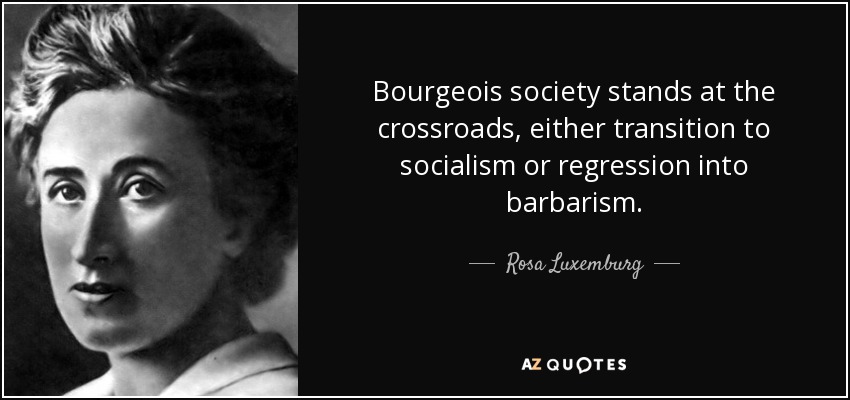
Quote from Rosa Luxemburg: Bourgeois society stands at the crossroads, either transition or regression to barbarism.


Read more!

2023/09/08

Seth Godin: The Paradox of Insular Language

Seth Godin discusses The paradox of insular language

Language only works when other people know what you’re saying, but once they know, it’s likely that the others can figure it out.

So why bother?

It turns out that vernacular elevates those that are using it as much as it isolates the ones who don’t understand it.

When we speak as insiders, we become insiders.

A practical way to create tribal affiliation is to amplify insular language.

Emphasis Mine

We Communists are especially guilty of this. We have a specialist technical language based on what Marx wrote. But we need to communicate with other workers in order to build the workers' movement.

Front page of the 1867 edition of Das Kapital by Karl Marx


Read more!

2023/09/07

Seth Godin: The Big-O conundrum

Seth Godin discusses The Big-O conundrum

There are Big-O problems in marketing, in sales, in customer service, in finance, in production and in compliance. There’s nothing wrong with winging it–until there is.

Emphasis Mine

The main difference between Anarchists and Leninists is the amount of centralism that is needed for a Communist society to operate. The problem is that a Communist society needs an advanced industrial base to suceed. That base was built by Capitalism.

A Capitalist system operates as an aristocracy of managers for large organisations, and as a monarchy for smaller organisations. As organisations grow, they have to migrate from a monarchy into an aristocracy. The primary driver for this transition is the span of control that a person is capable of managing effectively. One could view an aristocracy as a confederation of local lords—in other words, feudalism.

The Capitalist state oversees the Capitalist organisations through a bureaucracy. The state has the necessary force to ensure compliance. In reality, the state is a battleground among Capitalists to advance their own interests. The state is not a neutral actor in a Capitalist society.

Anarchists believe that a loose confederation of communities can function for an advanced industrial civilisation. Maybe the samller organisations could transition to direct worker democracy without much problems as the workers are all known to each other, and have been exposed to the overall operation of the business. This model will fail for larger organisations as specialist functions need to be coordinated.

The Leninist model of Democratic Centralism is the best model for a post-Capitalist society in managing the large organisations. Instead of decomposing the large organisations into a confederation of direct worker democracies, the structure and efficiencies of the large organisations need to be preserved but brought under worker control through an executive committee that answers to the workers on a regular basis.


Read more!

2023/09/06

Jerry Harris: Marxism and Ukraine’s struggle for independence and self-determination

Jerry Harris discusses Marxism and Ukraine’s struggle for independence and self-determination

Determining the principal contradiction has important practical results that reveal splits in the left. If the principal contradiction is between Ukraine and Russia, then Ukraine has a right to self-defense and the right to obtain arms. Just as Vietnam had the right to obtain Chinese and Soviet arms to defend itself against the US invasion. In fact, an international boycott of arms to Ukraine would only result in their defeat and a successful annexation by Russian forces. On the issue of ending the war, Ukraine must be the primary negotiator over its own fate, and the leading voice in the determination of its own future.…

Understanding US/Russian tensions as a secondary contradiction does not mean ignoring the reality of great power competition. It still means that the US needs to be part of the negotiations, that the US did meddle in the Maidan uprising, and that NATO was aggressive in its push eastward. But it does not obscure the Russian invasion as the principal problem, nor relegate Ukraine to a secondary role and its full independence to a secondary question, to be determined by an agreement between great powers. Lastly, when left realists accept Russian security concerns as the motivation for the invasion, it weakens our ability to convince people to take an anti-war stance when the US declares the exact same security reason for its next invasion. Reaffirming the long-standing principle of independence and self-determination must be maintained as the clear dividing line between socialist and imperialist worldviews.

Emphasis Mine

What Harris misses in his analysis is whether the people of the Crimea, Donetsk, Kherson, Luhansk, Lviv, and Zaporizhia, have the same rights as Ukrainians in general for self-determination. Harris fails to mention that a pretext for the invasion by the Russian Federation was given by President Putin at the Security Council meeting on 22 February 2022:

Those people declared that they were establishing two independent republics, the Donetsk People’s Republic and the Lugansk People’s Republic. This was the point when the confrontation started between the Kiev officials and the people living on that territory.

In this context, I would like to point out that Russia initially did everything it could to make sure these disagreements could be resolved by peaceful means. However, the Kiev officials have conducted two punitive operations on those territories and, apparently, we are witnessing a third escalation.

All these years – I want to stress this – all these years, the people living on those territories have been literally tortured by constant shelling and blockades. As you know, the people living on those territories, close to the front line, so to speak, were in fact forced to seek shelter in their basements – where they now live with their children.

A peace plan was drafted during the negotiating process called the Minsk Package of Measures because, as you recall, we met in the city of Minsk. But subsequent developments show that the Kiev authorities are not planning to implement it, and they have publicly said so many times at the top state level and at the level of Foreign Minister and Security Council Secretary. Overall, everyone understands that they are not planning to do anything with regard to this Minsk Package of Measures.

Nevertheless, Russia has exerted efforts and still continues to make efforts to resolve all the complicated aspects and tragic developments by peaceful means, but we have what we have.

Our goal, the goal of today’s meeting is to listen to our colleagues and to outline future steps in this direction, considering the appeals by the leaders of the Donetsk People’s Republic and the Lugansk People’s Republic on recognising their sovereignty, as well as a resolution by the State Duma of the Russian Federation on the same subject. The latter document urges the President to recognise the independence and sovereignty of the Donetsk People’s Republic and the Lugansk People’s Republic.

Emphasis Mine

Various other authors have dismissed the legitimancy of those oblasts' claims to sovereignty as merely Russian machinations.

The sovereignity of Ukraine is counterpoised against that of Donetsk and Lugansk.


Read more!

2023/09/05

Daniel Little: A horrendous massacre in Tamil Nadu, 1968

Daniel Little discusses A horrendous massacre in Tamil Nadu, 1968

This event illustrates the workings of oppression involving both caste and class. The landless workers were predominantly dalit — the lowest caste. And they were the poorest of the poor, with very little power to assert a fair share of the harvest. Land owners were in a position to resist increases in wages (the primary demand of the workers in this dispute), both through their structural advantage within the property system (land ownership) and their coercive power (through their ability to call upon armed thugs to carry out their violence against the dalit protests). A solution for the property disadvantage for the dalit workers is land reform, and during the years following the Keezhvenmani massacre there was a reasonably strong organization dedicated to land reform and dalit land ownership, the Land for Tillers Freedom (LAFTI). However, land reform based on NGO activism is likely to remain small-scale, in comparison to state-wide land reform programs.

Kanagasabai quotes V Geetha and Kalpana Karunakaran in the introduction to Mythily Sivaraman's Haunted by Fire (2013):

That episode and visit brought home to Mythily the starkness of life in this grain rich part of Tamil Nadu… She realised that the price for dignity, for daring to declare oneself a communist was very high in these parts – many had paid with their lives… Unsurprisingly, in her subsequent reflections, she refused to concede that the monstrous incident at Kilvenmani was only a wage dispute gone wrong, and argued passionately for it to be recognised for what it was: class struggle in the countryside. (Geetha & Karunakaran, 2013)

Class struggle in the countryside, indeed — landlords exercising horrendous violence against landless workers.

Emphasis Mine

Without the control of the means of production (in this case, land), workers are unable to defend themselves against the violence of others. The state only defends the interests of the ruling class (in this case, landlords). Little cites examples of the courts and police siding with the landlords against the farm workers.

Little acknowleges that this is an example of class war with the resolution lying in the control of the means of production by the workers.

Photograph of Indian Express front page reporting on 42 burnt alive in Thanjavur village. To the left is a movie poster for the movie, 'Ausaran'.


Read more!

2023/09/04

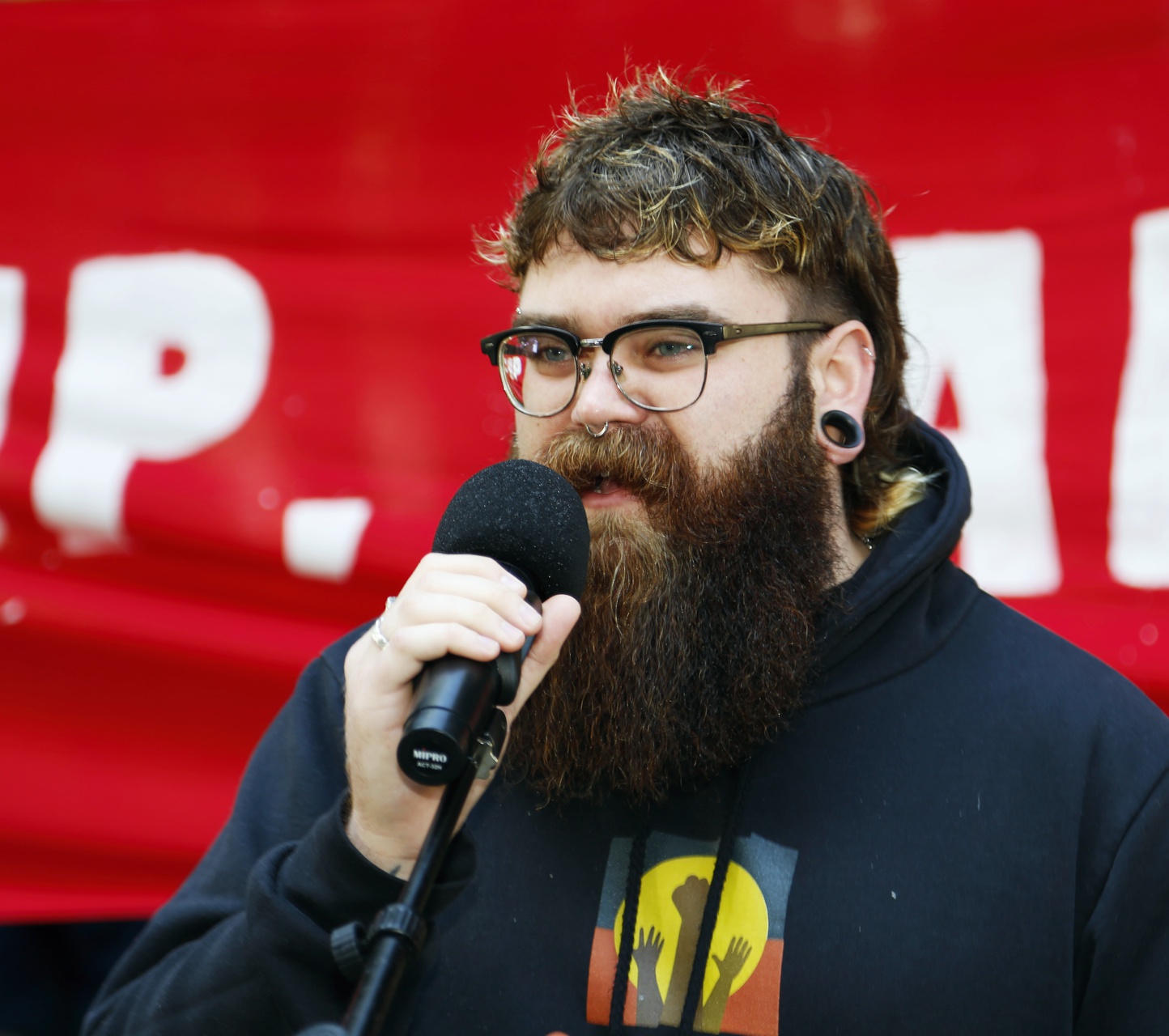
Alex Bainbridge's interview of Sam Woripa Watson: ‘Sovereignty is about controlling what happens on your land’

Alex Bainbridge interviews Sam Woripa Watson: ‘Sovereignty is about controlling what happens on your land’

Watson is part of a large cohort of progressive, militant activists who oppose the Voice in favour of measures to support the genuine sovereignty of First Nations peoples.

“We don’t support a powerless body of bureaucrats (whether they’re Black or not) giving their opinion to parliament and then parliament doesn’t have to do anything,” Watson said.

By contrast “we support Aboriginal rights and we support sovereignty and self determination, but that doesn’t mean voting ‘yes’ for this Voice.

“What it actually means is land rights and community-controlled organisations and reparations.”

Emphasis Mine

Watson believes that a successful YES vote for the Voice referendum will hobble the progress to recognisation of Aboriginal sovereignty. Watson defines that as:

Sovereignty is the ability to control what happens to your people on your land.

That sovereignty had never been ceded. We settlers need to recognise this fact in order to really move towards reconciliation.

Picture of Sam Woripa Watson


Read more!

2023/09/03

Luke Pearson: The Voice to Parliament: Beyond yes or no…

Luke Pearson discusses The Voice to Parliament: Beyond yes or no…

Sadly, I know that there is like a common enemy to put aside our differences and band back together, and whether or not the referendum is successful you can be sure we will have many days ahead where there will be much less room for debate or division about who that enemy is or what we need to do in response to their attacks. There will be many more days when we start a conversation but end up becoming the object of debate, sacrificed on the altar of white people asking yet again ‘How do we solve the Aboriginal problem?’ not realising that it is not us who are the problem but them.

Emphasis Mine

Pearson correctly argues that the Voice Referendum is about white people, not Aborigines. His worry is that the debate about the discussions about the 2023 referendum will harm the cause of Aborigines by making Aborigines an object of white concern.

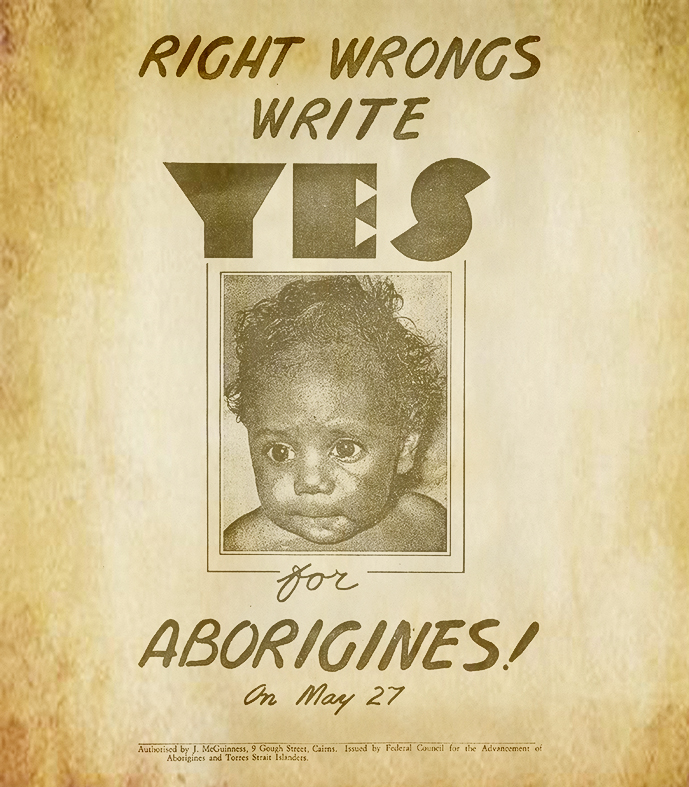
The Autralian Constitution was originally written to exclude Aborigines. The results of the 1967 referendum partially corrected that. Aborigines are still struggling to assert themselves into a foreign legal document, instead of the legal document struggling to adapt to an Aboriginal way of thinking.

Without a clear direction from the diverse Aboriginal communities about this referendum, I would find it hard to choose the proper vote to cast. The Aboriginal communities has far more serious issues to deal with rather than allowing white people to feel better about themselves with a cosmetic change to the Australian constitution.

Poster for 1967 referendum urging a YES vote. The poster has a picture of an Aboriginal baby, and the poster says: Right wrongs. Vote YES for Aborigines on May 27.


Read more!

2023/08/30

Yves Smith: Zelensky’s Latest TV Interview Shows How Much the Ukraine Conflict’s Dynamics Have Shifted

Yves Smith discusses Zelensky’s Latest TV Interview Shows How Much the Ukraine Conflict’s Dynamics Have Shifted/

First, Russia has deemed four formerly Ukraine oblasts as Russian territory. It has not secured full control of them and that step would be the bare minimum that Russia would accept, which means more territorial acquisition. Second and even more important, a stated aim of the Special Military Operation was the “demilitarization” of Ukraine, which the Istanbul negotiations showed could be met by the exit of NATO forces (little green men) and weapons from Ukraine and a commitment that Ukraine would never enter NATO. Note this negotiation took place before Porshenko, and later Merkel and Hollande admitted to entering into the Minsk Accords in bad faith and using it to buy time to arm Ukraine. The US and NATO officials have repeatedly said that who joins NATO is NATO’s business and they will never agree to restrict membership. So that requires Russia to continue to prosecute the war until NATO members are so drained that they are not capable of mounting a threat for a long time.

Third and most important, the Russian public would not accept a ceasefire. Putin is one of the least belligerent individuals in Russian public life.

Emphasis Mine

Between Zelensky's maximalist position of restoration of Ukrainian 1991 boundaries and Russian legal theory that five (5) oblasts are now formerly part of the Russian Federation, there is currently no basis for any peace talks to start, nor, even, a cease-fire. Given the Russian perception that the West has negotiated in bad faith previously, and any cease-fire would be used to rearm Ukraine in order to continue teh conflict. Without the prospect of a cease-fire leading to peace, the war will continue until the Ukranian armed forces are destroyed. Even then there is the danger that NATO troops would be covertly introduced to prolong the conflict thereby confirming Russian suspicion that it has been fighting NATO all along.


Read more!

2023/08/21

Mohammed Samaana: Washington for First Time terms violent Israeli Squatter-Settlers “Terrorists,” but US Needs to Let UNSC Impose Sanctions

Mohammed Samaana writes that Washington for First Time terms violent Israeli Squatter-Settlers “Terrorists,” but US Needs to Let UNSC Impose Sanctions

In response to the recent killing, the US State Department said, “We strongly condemn yesterday’s terror attack by Israeli extremist settlers that killed a 19-year-old Palestinian.” It’s highly unlikely that the statement is a turning point in America’s foreign policy, but this announcement differs from the traditional State Department boilerplate expressing the cliche of “Israel has the right to defend itself” or at best equating between the Palestinian victims and their Israeli oppressors. The Jewish Power party was dismissive of the State Department’s remarks.

This dismissal reflects the confidence Israelis in general feel that no action will be taken against them by any Western power no matter what. Historically, any action against Israeli crimes against the Palestinians didn’t go beyond criticism, and the US has for the most part ensured this impunity by using its veto in the UN in order to block any practical punishment of Israel.

Emphasis Mine

The US government has been moved to issue a statement condemning the actions of the military wing of the Jewish Power party which is now part of the ruling Israeli government coalition. But this condemnation will not lead to any reduction in US financial support for the Israeli military. Nor would the US allow the UNSC to take any action against Israel.

Samaana contrasts this response to Israeli aggression against the Palestinians with that to Russian aggression against Ukraine:

The double standard foreign policy which involves turning a blind eye when it comes to Israel is evident in the way western countries dealt with Russia invasion of Ukraine. Sanctions were imposed on Russia immediately and military aid to Ukraine to defend itself hasn’t stopped. In fact what Israel is doing to the Palestinians is worse than Russia’s invasion of Ukraine. Israel has been carrying out ethnic cleansing of the Palestinians before its official establishment on Palestinian land in 1948 with a number of western countries supporting the ethnic cleansing by different means including arming and financing Israel.

Speaking of Russia, it hasn’t taken any action to help the Palestinians either. Putin’s Russia has allowed Israel to bomb Syria with stunning silence from those who are duped with Putin assuming that he is anti-imperialist. At the same time, despite Israel being heavily reliant on American military and financial aid, it has been reluctant to help Ukraine, desiring to keep its good relations with Russia, which decided recently to open a new consulate in Jerusalem.

Emphasis Mine

Both the USA and Russia are guilty of supporting and enabling aggression. Both should be condemned and opposed.


Read more!