2016/04/24

Chris Dillow: Why not full employment?

Chris Dillow asks Why not full employment?.

And, they say — channeling Kalecki:

Guaranteed employment does not conform to the dominant ideology of capitalist societies which is generally internalized by practically everyone in the society, including workers.

This ideology, they say, manifests itself in several ways hostile to full employment policies. For example, the unemployed are blamed for their plight; governments are deemed to incompetent to implement proper macro policies or a jobs guarantee; and there’s a fear that union militancy will price workers out of jobs. In this sense, the lack of demand for full employment policies is another manifestation of the political dominance of the 1%. As Steven Lukes wrote:

Is it not the supreme and most insidious use of power to prevent people, to whatever degree, from having grievances by shaping their perceptions, cognitions and preferences in such a way that they accept their role in the existing order of things, either because they can see or imagine no alternative to it, or because they see it as natural and unchangeable? (Power: a radical view)

All this raises a thought. Could it be that the main obstacle to full employment policies is not so much one of technical economics so much as ideology and politics?

Emphasis Mine

I agree that the consciousness of the working class is utterly dominated by the Capitalists. This has impeded the development of SYRIZA, the Occupy Movement, and unions as they try to reform the system. There comes a point when their demands threaten the system. At that point, most people want to preserve the system rather than overthrow because they reasonably see chaos in the collapse. They have no faith in any alternatives.

The examination and publicity of alternatives, such as Cuba, Venezuela, and Rojava (Kurdistan), are important. When people see alternatives existing and surviving against enormous odds, they can see options for themselves.


Read more!

2016/04/23

Ruken Isik: Women struggle for a new society in Rojava

Ruken Isik writes about Women struggle for a new society in Rojava.

The idea of democratic autonomy is directly opposed to the ideology of the nation-state, which in the Middle East is tightly bound to ideas of cultural and ethnic homogeneity. The new system in Rojava is more of a multicultural, multilingual, and multireligious system that is designed to “allow the legal participation of individuals who will be able to mobilise and organise along the lines of ethnicity, religion, gender, class.”

It is a system of self-governance that rejects the model of centralised administration. This is also the model of self-rule advocated by the Kurdish movement across the border in Turkey. Women in Rojava believe that this system can and does enable them to organise, and to participate in all decision-making processes.

…

The West always presents itself as deeply invested in bringing change and democracy to the Middle East. Yet the Kurds, together with the other ethnic groups now administering themselves for a better future, have been historically and continue to be ignored by the international community, which has turned a blind eye to the Kurds in general and to Kurdish women in particular.

As they work to build a society grounded in a systemic commitment to gender equity, the women in Rojava want to be in dialogue with international women's organisations and share their experiences.

Emphasis Mine

It is in the obscure parts of the world that the real social revolution is occurring.


Read more!

Opinion on Bernie Sanders after New York

After Bernie Sanders' defeat in the New York Democratic primary, I think it is necessary for the Sanders campaign to continue even though the pundits see it as a waste of time.

Peter Boyle interviews Australians supporting Bernie Sanders:

Dührsen was was a bit down about Clinton's unfair victory in the NY state primaries on the day we met up but he was determined to keep campaigning hard, especially to mobilise people who wouldn't otherwise even vote in the US presidential campaign.

If Sanders' campaign is defeated by the powerful establishment in the US, Dührsen is certain that this will not be the end of it: "Walls have been broken. Firstly, substantial numbers of Americans have voted for a man who is an open socialist. Second, the campaign has been able to self-fund through crowdfunding by ordinary people. At the very least he will be an inspiration to people all around the world because he has shown that this can be done."

Emphasis Mine

James Schneider describes How Bernie Sanders can harness the kind of momentum transforming British politics.

Whatever happens, build on the thing that reduces the structural power gap between you and the real enemy, which isn’t the Clintonite, plutocratic wing of the Democrats. For Sanders, that’s the ability to have half-a-million people who are doing some kind of activism weekly, a highly decentralized ability to raise money, etc. Whether he wins the nomination or not, the campaign needs to clearly articulate the political strategy of this movement. And then, of course, figure out how people in the movement can then engage with the strategy and try to change it.

Another thing is that you’ve got to decide what the relationship is to the Democratic Party, in a variety of ways. If you’ve got half a million people you are the biggest movement of people being active. But how do you engage with all the other movements that are transforming the country? How does the Sanders movement relate to Black Lives Matter? Who does it relate to in the Fight for $15?

Emphasis Mine

Juan Cole reposts Bernie Sanders’ Path Forward: The Disappointed Generation.

With all of these factors in mind, there is still a path for Bernie Sanders to win the nomination, but beyond that, the candidate is helping to shift the political spectrum in the United States. The Sanders campaign is still confident that moving forward they will be able to obtain the nomination. In a press release statement, Senator Sanders congratulated Hillary Clinton on her victories, but highlighted that he intends to continue all the way to the Democratic Convention in Philadelphia. “With more than half the delegates yet to be chosen and a calendar that favors us in the weeks and months to come, we remain confident that our campaign is on a path to win the nomination,” Sanders said.

Emphasis Mine

Ali R. Abootalebi asks What is Political Revolution and Can Bernie Sanders Deliver?.

The structural changes needed in the American body politics demand reconnecting the governed and the governors after years of political underperformance. This task calls for the creation of an alternative SDP to address the needs of the American electorate on the political left–and possibly the creation of a conservative party on the political right as well. Bernie Sanders’ political revolution requires not only popular input in electing a progressive candidate like him, it demands continuous popular engagement in politics through disciplined and well-organized party politics participation. Progressive candidates in the Congress can help the cause of progressive politics in the executive office, further mobilizing popular opinion to demand structural changes in the body politics and the better distribution of national resources though more effective governance. In that case, the American courts also will be more responsive in considering the popular will in their overall balancing calculation of legal and political rights. The inaction alternative will only see the continuing political decay. Then, no amount of political rhetoric and false promises through short term economic ‘bandaging’ and irresponsible fiscal borrowing will resolve the country’s deep-rooted political problems, nor will it rescue it from its international decline.

Emphasis Mine

What is most likely to happen is that Clinton wins the Democratic nomination and loses the presidental election to Trump. This will cause a split in the left between the Democratic Party and the rest. In that case, the best way forward would be the creation of broad Socialist Party (something along the lines of the Socialist Alliance in Australia) and an United Front with the various other movements.

The party is needed for theoretical and practical education and maturation of cadre from the various movements. Enthusiasm without knowledge of how the system works quickly leads to depression and despair.

Unfortunately, a Trump presidency would be the best hope of continuing and growing the widening political activism of the past year or so. The election of Obama was a set-back for progressive politics as it lulled people into apathy, and Clinton promises more of the same.

Let us not forget that Sanders' campaign is just one of many other campaigns in other countries. As noted above, we have much to learn from each other's experiences.


Read more!

2016/04/20

Dan Little: Origins of feudalism in the West

Dan Little examines the Origins of feudalism in the West.

These observations make clear the central thrust of the book: there was substantial continuity between the institutions and economy of the late Roman Empire in the West and the political and economic institutions of European feudalism which followed it for a thousand years. This continuity is unwelcome to the "modes of production" train of thought, which postulates a sharp break between classical and feudal systems.…

Emphasis Mine

I disagree that the presented evidence argues against the "modes of production" train of thought. For example, Capitalism did not start on 14 July 1789—it had been developing for the previous 400 years within the confines of Feudalism. That social revolution eventually gave political power to the Capitalists, and greatly diminished the political power of the landed aristocracy. Society was then aligned to the mode of production which was Capitalism.

This new interpretation of the origin of Feudalism within the confines of the classical Roman slave society does not detract from the idea of historical materialism based on the mode of production. It would just mean that Roman society collapsed faster than feudalism was able to take up the slack. Indeed, the final collapse of ancient Roman society in Constantinople overlapped the genesis of Capitalism in Northern Italy.

The French Revolution unleashed the power of Capitalism. Whereas the greatest feudal king of France, Louis XIV, was able to attain and preserve the current borders of France, Napoleon Bonaparte was able to smash French rivals such as Austria and Prussia, disband the Holy Roman Empire, invade Egypt, invade Russia, invade Spain. All of this within a century of each other.

The transition from Feudalism to Capitalism within France unleashed a storm across Europe. The only power able to withstand France was the older Capitalist country: Britain. Feudal powers melted in the face of Capitalist military power with the exception of Russia.

Based on this historical experience of social transition from Feudalism to Capitalism, I am leery of a smooth transition from Roman slave society to Feudalism. There was an economic, political, military, and social collapse in Western Europe in the fifth century CE. The main viable system was Barbarism from which Feudalism developed.


Read more!

Denis Godard: France: Reflections on 'Nuit Debout'

Denis Godard examines what is happeninig in France: Reflections on 'Nuit Debout'.

While the movement advances and raises these questions, the dominant trajectories of power continue to operate in the direction of reinforcing the police state, in the direction of racism and nationalism, in the direction of social attacks. The monsters are not figments of our imagination, they are really there. One of their forms is the far right. This is also why the trajectory of the movement places it necessarily in radical confrontation with the politics of the ruling class and with the State.

Once more, this confrontation will not progress in a linear manner. The movement will no doubt experience partial defeats and apparent setbacks. Without doubt it will change form more than once. It will sometimes be necessary to know how to change direction in massive and spontaneous flows, to cease beating its head against a wall so as to learn how to demolish or jump over the wall. Sometimes it will depend on initiatives taken by a minority, but which will give a lead to greater numbers.

What is certain is that after years of apparent apathy and advance of all the reactionary tendencies in French society, something has changed which renews hope. The precious stones buried under the hardened lava of previous movements have been brought to the surface by fresh-flowing lava, shining even more brightly.

The times which are coming will be no less hard. But now we are not condemned to take them lying down.

Emphasis Mine

I am living through a very radical period in history:

  • Liberation of East Timor
  • Campaign against mandatory sentencing
  • Refugee rights
  • Land rights
  • Anti-One Nation protests
  • Anti-globalisation protests
  • May Day protests
  • Anti-war demonstations
  • Anti-GST protests
  • Free Palestine Rallies
  • Canadian student strikes
  • The Occupy Movement
  • SYRIZA
  • Podemos
  • Bernie Sanders
  • Jeremy Corbyn
  • Scottish Independence Movement
  • Nuit Bebout
  • T.J. Hickey memorial
  • Free David Hicks
  • Anti-HECS and University fees protests
  • Gay Marriage movement

Just looking over this brief list, I have seen large and small movements come and go, expand and contract. I have seen movements tear themselves apart. I have seen victories and defeats. I expect to see more of the same.

This does not mean that I should give up. As the old boxing maxim goes, victory is about getting up more times than getting knocked down.


Read more!

2016/04/16

Tom Anderson, Eliza Egret: Turkey wages war on its Kurdish population

Tom Anderson & Eliza Egret writes that Turkey wages war on its Kurdish population.

The state and the right-wing in Turkey are maintaining a deafening media silence about the police and military massacres in the south-east through intimidating anyone who dares report it.

Due to this intimidation, coupled with its own racism and bias, Turkey's mainstream media has distorted the killings in Kurdish cities, branding those killed as terrorists and blaming the violence on the PKK and not the state.

On February 7, Today's Zaman reported the impossible figure of 733 'PKK members' killed in Cizre and Sur, while not mentioning any killings of civilians. A columnist in Daily Sabah claimed that the PKK had opened fire on ambulances — in reality it is the police and army preventing medical care reaching wounded civilians.

Similarly, the international press has remained overwhelmingly silent over Turkey's massacres in Bakur. There are two main reasons for this.

First, the Turkish state has imprisoned and deported foreign correspondents reporting from Bakur over the past year, and the mainstream media is unwilling to trust Kurdish media sources, buying into the state's attempts to discredit them.

Second, Turkey is an important ally of NATO and the US, and it is not in the interest of US-aligned governments to criticise it. In London, there have been demonstrations at the BBC, with British-based Kurds and their allies protesting the corporation's silence on Turkey's massacre of its Kurdish population.

“There is a reality in Kurdistan that if you don't have a weapon or gun then you can't live, as you are surrounded by brutal forces who don't let you live in normal conditions,” Baran said. “So the Kurds think that armed struggle is very crucial for them. This armed struggle guarantees their lives. If these people didn't have any weapons then worse things could happen. Kurds know that the armed struggle is very important for their existence.”

Emphasis Mine

The Kurds have been screwed over by the British, French, Syrians, Turks, Iraqis, Syrians, Iranians, USA, etc.


Read more!

Lucinda Donovan: University of Queensland bake sale backlash

Lucinda Donovan writes about the University of Queensland bake sale backlash.

Shortly after the event was announced, its Facebook page was flooded with threats of death and rape, both at the event organisers specifically and at women in general. Comments such as “kill all women” were popular, as well as a meme that depicted a victim of domestic violence and her abuser with the words “women deserve equal rights, and lefts”. Other comments and threats received both on the page, and in the personal inboxes of the organisers, are too foul to reproduce here.

Once again the attempts by misogynists to devalue and disprove the relevance and use of feminism has proved exactly why it is so desperately needed. Lewis's Law — that the comments on any article about feminism justify feminism — seems to be right yet again. When something as inoffensive as a bake sale is enough to provoke such hatred, what does that say about how we view women?

The hatred received for this bake sale was not just limited to a few trolls, but many commenters, some still in high school. When such vile opinions are still so readily spewed by so many, and those so young, it becomes apparent that not only do we still desperately need a powerful feminist movement, but that we also have a massive way to go.

Emphasis Mine

Oppression is not just by the ruling class. A significant proportion of the general population must also be actively involved.

A pervasive oppression means that young people readily engage in it without critical thought. This oppression flows through the education system and mass media, and encourages teenage boys to act in horrific ways.

Heterosexuality is seen as only being expressed through violent oppression of women. Thus, rape and threats thereof are seen as normal.

This rape mentality then spreads out to all outsiders: homosexuals, prisoners, protesters. Rape signifies the power relationships within any oppressive system.


Read more!

2016/04/15

Chris Dillow: Marxists & Libertarians

Chris Dillow writes that Marxists & Libertarians have much in common.

I don’t say this to embarrass him. Quite the opposite. I do so to point out that Marxists and libertarians have much in common. We both believe that freedom is a — the? — great good; Marxists, though, more than right-libertarians, are also troubled by non-state coercion. We are both sceptical about whether state power can be used benignly. And for both of us, the ideal is a withering away of the state. In these regards, Marxists probably have more in common with right-libertarians than with social democrats; Unlearning Economics has charged right libertarians with being “lazy Marxists.”

Of course, there are obvious differences between us — not least about the causes of poverty and historical nature (and definition!) of capitalism. My point is simply that we have some things in common. However, whereas Marxists have engaged intelligently with right-libertarianism, the opposite has, AFAIK, not been the case — as Robin and Bryan’s ignorance of the intellectual history of Robin’s theory of schooling demonstrates. This is perhaps regrettable.

Emphasis Mine

Another difference is that the Libertarians want to liberate Capitalism from State interference and control. Marxists want to replace Capitalism with Communism.

Although there is theoretical overlap, there is no point in political alliances because of this difference.


Read more!

Ted Rall: Inside the Media Bubble, No One Can Hear Us Scream

Tell Rall writes that Inside the Media Bubble, No One Can Hear Us Scream.

Talk about blaming the victim! Sure, Trump could have hired teams of professional politicos to navigate the peculiarities of each state’s primaries. As a billionaire, he certainly could have afforded them. Why didn’t he? I have no idea.

But why should he have to? Why should Trump, or any other candidate, be subject to such a strange system? Democracy should be simple and straightforward: one person, one vote. All these crazy rules — the signatures required for ballot access, the polls used to determine who gets to debate on television, winner-take-all primaries, superdelegates, delegates secretly pledged to candidates other those they’re sent to the convention to represent, the electoral college — exist for one reason. They exist in order to dilute the influence of we the people so that They — the ruling class — continues to get its way.

When They win, we lose. We lose our jobs. Our standard of living. Our rights.

If you’re like me — on the left and generally unsympathetic to billionaires — you may be tempted to join the media when they dismiss Trump as a whiner. But this is different. In business, Trump is the consummate insider. But he’s a political naïf. When someone as sleazy and unprincipled as Donald Trump is shocked by how dirty politics are, you have to take note.

And if they can steal elections from someone as rich as Donald Trump, there is nothing left of American democracy.

Emphasis Mine

Wow!

Bernie Sanders is getting the same treatment. The Democratic Party machine is pulling out all stops in order to ensure that Hilliary Clinton gets the nomination.

Sanders and Trump are exposing the corruption at the heart of the US political system.

People should not be surprised at this as the State exists to serve the interests of the ruling class.

Although Trump is a billionaire, he is a rogue capitalist. He is exiled from the ruling class. He is a beneficiary, not a participant.

Sanders has always been an outsider and proud of it.

Yet, the political revolution that Sanders proposes will fail unless the economic relationships that the political system protects is also overthrown.


Read more!

Liam Flenady: France: 'Nuit debout' movement shakes politics

Liam Flenady writes that, in France: 'Nuit debout' movement shakes politics.

Like Occupy Wall Street and Spain's indignados before them, the Nuit debout movement has been criticised for not having a clear set of demands.

This criticism is unfair on two fronts. Firstly, the demonstrators have by-and-large been very clear that they are against corruption, against extreme inequality and austerity, and specifically against the unjust new labour laws. For many, the goal of the Nuit debout movement is to “bring together the different struggles” in French society.

They are for a more responsive democracy, where representatives are less beholden to corporate interests, and where society is run in the interests of the people.

Secondly, it is understandable they do not feel a rush to issue concrete demands at this stage when they are only just emerging from political demobilisation, isolation and division — and feel so betrayed by the mainstream left and the political establishment.

As one participant pointed out: “Basically, it's all the people who have left-wing sympathies but who feel betrayed by left-wing mainstream political parties.”

Emphasis Mine

This is a very dangerous situation to be in. The revolutionary parties must be with the people, not aloof from them.

The revolutionary parties have a large credibility gap to overcome. And I expect that they would not be welcome in such a movement at this time.


Read more!

Sue Bull: Nationalise the steel industry

Sue Bull writes that Australia should Nationalise the steel industry.

Rather than repeat this mistake, any government that seriously wants to save jobs and the steel industry should nationalise the steel industry and run it as a publicly-owned service in the interests of the people and the environment.

Over the next few decades, our society is going to have to make a massive investment in the infrastructure needed to shift to a renewables-based economy. Hundreds of billions of dollars need to be spent on building rail, public transport vehicles and renewable energy systems that harness solar, wind and wave power instead of fossil fuels.

A steel industry will be needed to supply materials for this transition.

History has taught us that the profit-driven corporations are not going to make this switch and, blinkered by the short-term solution of importing cheaper steel from overseas, the market will destroy what steel-making capacity there is left in this country.

Emphasis Mine

Hey, big business! If you want government hand-outs, we own you.

Small businesses do not get this kind of help. They sink or swim on their own merits.

None of this Capitalism for the poor, and Socialism for the rich.

It has to be Socialism for All.


Read more!

2016/04/08

IMEMC: Israeli forces have killed 2,000 Palestinian Children, wounded 13,000, jailed 12,000 since 2000

IMEMC writes that Israeli forces have killed 2,000 Palestinian Children, wounded 13,000, jailed 12,000 since 2000.

About 2,070 Palestinian children have been killed, and more 13,000 injured since the outbreak of Al-Aqsa Intifada in 2000, until this past March, official sources have reported, according to Al Ray.

Israeli occupation forces detained more than 12,000 Palestinian children since 2000, while nearly 480 children are still languishing in Israeli prisons. Of them, almost 95% were severely tortured and beaten during the arrest campaign and interrogations intervals, a press statement issued by the Ministry of Information stated.

Emphasis Mine

What a truly racist society Israel has become when murder, torture and imprisonment of children is routine. Hatred for the Arab has removed all humanity from the Hebraic-speaking Israeli.


Read more!

Doug Enaa Greene: Amadeo Bordiga and the development of a revolutionary core

Doug Enaa Greene examines Amadeo Bordiga and the development of a revolutionary core.

Despite Bordiga's differences with the factory council movement and L'Ordine Nuovo, he had supported the call for workers' control of production. And events in Italy brought the two wings of the revolutionary left closer together. By 1920, the factory council movement had launched several general strikes which had put the question of power on the agenda. However, the Socialist Party and the trade unions, showed that their bark was worse than their bite. Although verbally militant, the PSI fed revolutionary expectations among the workers, but they were never ready to commit themselves to make a challenge for power. When the workers were in the streets, they preached patience and calm. They had no idea how to mold the masses or to make the revolution, in fact they did not even think it was their responsibility to do so. In one of the strangest tragicomedies in history, in September 1920 the PSI Directorate debated whether or not to turn the factory occupations into a bid for power. They passed this responsibility for answering this question over to the unions who rejected any attempt at revolution by a vote of 591,245 to 409,569. The Italian factory council movement, which remained directionless and decentralized, was ultimately demoralized and fell apart. The stage was now set for fascism to pacify the working class and restore “order” through systematic violence which the socialists were unable to respond to.

Emphasis Mine

This is a very important point. The idea of a revolution involves the taking of power, and the dismantling of the Capitalist state.

For a revolutionary party not to be ready for this, opens the door to the Fascist reaction as happened in Germany, Italy, and Hungary. Spain was different in that the revolution failed to keep power amid infighting over the direction of the revolution.

Bordiga dropped out of politics and quietly pursued his engineering career until after the fall of Mussolini in 1943. Thereafter, he was politically involved in small left communist groups and wrote extensively on the nature of the Soviet Union and Marxist theory. Bordiga believed that the historical moment was unfavorable for revolutionary action and he devoted himself to propagating and educating Marxism to the few devoted militants who remained loyal to him. However, the left communist movement that Bordiga inspired remains miniscule and isolated. The fate of Bordiga has been unkind, he has generally been eclipsed in histories of Italian communism by Antonio Gramsci. While Gramsci is a far more creative Marxist, it needs to be said Bordiga was at times more far-sighted than him on what needed to be done — especially in the early days. It is unlikely that the Communist Party of Italy would have been created without his tireless energy. Ultimately, Bordiga's adherence to program provided him with stability and a political compass while others were led astray, but at the same time, he was prone to mechanical, rigid and moribund thinking that left him unable to develop the appropriate strategies needed by the PCI to endure fascism and build a mass movement. Bordiga remained frozen and faithful to a heroic moment that passed, which was both his strength and weakness.

Emphasis Mine

The revolutionary must both be embedded in the current struggle of the working class, and aim for a communist revolution. We must continually evaluate where we are and where we want to go.

The fetish for an enduring revolutionary programme is self-defeating. The programme is a call-to-arms among the currently existing conditions. As these conditions change, the programme must change to adapt to emphasise revolutionary potential.


Read more!

2016/04/07

Chris Dillow: Incentives as ideology

Chris Dillow sees Incentives as ideology.

All this poses the question: if high-powered incentives can so often fail or backfire, why do they still exist in some places? I suspect the main reason is that whilst the idea that big rewards are necessary to elicit good performance might be often wrong, it serves as a useful justification for inequality. What we have here is ideology masquerading as economics.

Emphasis Mine

No further comment is needed.


Read more!

Cathy O'Neil: There are lots of ways to break up the big banks

Cathy O'Neil writes that There are lots of ways to break up the big banks.

Which is why, when I hear people complaining about Sanders not have a specific enough plan for breaking up the big banks, I think it’s hogwash. What Sanders has, which is sorely needed, in fact is the crucial missing ingredient to any discussion around big banks, is the political will to do something. Once the political will is there, the details can be sorted out by people who think about this stuff all the time.

Emphasis Mine

This is probably the best response to criticism from people like Menzie Chinn who looks at The Financial Regulatory Policies of Senator Sanders…Again:

As I’ve noted before, Senator Sanders has unique views on financial regulation. I’ve never quite understood the specifics of the “break up the banks” proposal, and after his interview with the New York Daily News and subsequent “clarification”, understood even less.

What we have is a deep division within the political Left. There are those who, like O'Neil and Sanders, see the need for a political revolution in order to save the Capitalist system. And there are those, like Chinn, who see that the system is safe with the current establishment which Hilary Clinton represents as the remaining credible presidential candidate.

Out on the far margins, there are people like me who support the nationalisation of the banks. They serve an economic and political function. They are not profit centres.


Read more!

2016/03/26

Chris Dillow: The Death of Politcs

Chris Dillow laments The Death of Politics.

What’s more, the Left too has largely lost the art of politics. Inspired perhaps by the epigones of 1960s feminists misusing the slogan “the personal is political”, a lot of what passes as “political” discourse is in fact the mere narcissistic revelation of personality. The possibility that there is or should be a difference between private and public selves — brilliantly described by Richard Sennett — has been forgotten. Also forgotten is the art of rhetoric; how many political writers start — as they should — with the question: how can I persuade sceptics or opponents to agree with me?

In this sense, politics is a dying, perhaps even dead, art. Most of those who claim to take an interest in it are not really interested in how to govern the public sphere: if they were there’d much more interest in the social sciences. Instead, they're mere spectators in a wrestling match who are booing baddies and cheering goodies.

The success of once-fringe characters such as Trump, Farage and even Corbyn are double symptoms of this death. On the one hand, their popularity is due in part to voters wanting people to speak for them, regardless of the question of whether their urges are implementable or practical. But on the other, it is due to the failure of the Establishment and centrists to make their case.

Sadly, though, all sides are so encased in their partisan narcissism that they can’t see this. Fish never know they’re wet.

Emphasis Mine

Dillow is making an assumption that politics independent of the political and economic system. The political discourse is limited by the economic power of the participants. The Capitalists want to constrain all political activity to support the Capitalist system. The system itself cannot be questioned.

The events of 2015/6 reveal that the Capitalist political system cannot contain the disquiet over the operation of the Capitalist system:

  • SYRIZA
  • Podemos
  • Corbyn
  • Sanders
  • Trump
  • Cruz

In the current US presidental primaries, there is only one (1) establishment candidate left: Hiliary Rodham-Clinton. All of the others are outsiders.

The Capitalist political system is failing. The establishment and centrists are not failing to make their case — they have ceased to have the ability to do so. Their case only makes senses within the Capitalist system. When people are looking outside of the Capitalist system (either at Socialism or a strong-man rule), the arguments from the establishment and centrists cease to amke sense.


Read more!

2016/03/16

Mark Thoma: Rising insecurity and the rise of Trump and Sanders

Mark Thoma writes about Rising insecurity and the rise of Trump and Sanders.

We don't have to abandon capitalism. Sharing the gains from America's dynamic, flexible economy more widely won't kill the goose that lays our golden — but unequally distributed — eggs.

But those with wealth and economic and political power must understand that the populist uprising evident in the current election cycle will only get stronger, and the changes to the country's system will be more drastic and unpredictable if these people continue to stand in the way of policies that reduce the economic insecurity and inequities that so many people feel in their daily lives.

Emphasis Mine

As a Capitalist economist, Thoma has to believe that:

  • Capitalism is the system available
  • Democracy, under Capitalism, can serve the Common Good
  • The Capitalist State can be captured by the people through the political process

Yet, he writes his appeal to the establishment, not to the people. He seems to believe that the illusion of the political process as democratic for all is being exposed.

The Capitalist State serves the Capitalist class. Both must be destroyed in order for a truly democratic system to arise in concert with an economic system that fulfils the needs of the people.


Read more!

2016/03/15

Mark Thoma: NRO: "The Truth About These Dysfunctional, Downscale Communities Is That They Deserve To Die"

Mark Thoma quotes from National Review that "The Truth About These Dysfunctional, Downscale Communities Is That They Deserve To Die".

The truth about these dysfunctional, downscale communities is that they deserve to die. Economically, they are negative assets. Morally, they are indefensible. Forget all your cheap theatrical Bruce Springsteen crap. Forget your sanctimony about struggling Rust Belt factory towns and your conspiracy theories about the wily Orientals stealing our jobs. … The white American underclass is in thrall to a vicious, selfish culture whose main products are misery and used heroin needles. Donald Trump’s speeches make them feel good. So does OxyContin. What they need isn’t analgesics, literal or political. They need real opportunity, which means that they need real change, which means that they need U-Haul.

Emphasis Mine

Nothing is ever Capitalism's fault. The system is perfect. It is the people that are failing—not the system.


Read more!

2016/03/14

Tomgram: Bob Dreyfuss: Will The Donald Rally the Militias and the Right-to-Carry Movement?

Bob Dreyfuss asks: Will The Donald Rally the Militias and the Right-to-Carry Movement?.

Keep in mind as well that an American-style fascist movement would hardly be a precise copy of either the German or the Italian models, or even of the parties currently building far-right movements in France, Hungary, Greece, and elsewhere. Nor would it copy the proto-fascist coalition of ultra-nationalists and religious zealots being courted by Russia’s Vladimir Putin. It would undoubtedly be a uniquely American creation.

Though Trump has managed to bring together disparate elements of what an American fascist movement might roughly look like, he may not, in the end, be quite the right messenger for its development, nor may this be quite the right moment for it to fully develop. Among other things, for such a movement and the armed militias that would go with it to coalesce, you might need another 2007/2008-style economic meltdown, a crisis long and profound enough for such a movement to seize the moment. In that case, of course, it’s also possible that a Bernie Sanders-like leftist or socialist — or maybe Sanders himself — would emerge to capture the ensuing political and economic unrest in a very different manner. But in The Donald’s America, don’t rule out the possible emergence of an even more formidable and threatening Trump-like figure, one unburdened by his clownish persona, Trump University, and the rest of his billionaire’s baggage.

Whether or not Donald Trump wins the Republican nomination or is elected president, for the gathering members of his grassroots coalition, he’s certainly shown what can, indeed, happen here. 

Emphasis Mine

In Proto-Fascism in the USA, I wrote:

To understand more about Fascism, I have been reading "Fascism: What it is and how to fight it" by Leon Trotsky.

At the moment that the "normal" police and military resources of the bourgeois dictatorship, together with their parliamentary screens, no longer suffice to hold society in a state of equilibrium — the turn of the fascist regime arrives. Through the fascist agency, capitalism sets in motion the masses of the crazed petty bourgeoisie and the bands of declassed and demoralized lumpenproletariat — all the countless human beings whom finance capital itself has brought to desperation and frenzy.

Emphasis Mine

Bernie Sanders threatens that equilibrium. The Black Lives Matter movement threatens that equilibrium. The Minimum Wage campaign threatens that equilibrium.

The most plausible scenario for the rise of Fascism in the USA is for Bernie Sanders to win the Presidency. The mild progressive nature of a Sanders administration would be sufficient to collapse the equilibrium of the American system. And in the backlash, another demagogue would arise to unite the forces that Trump awakened.

A new Clinton administration would not do this. Nor would a Trump or Cruz one. For all of these are working within the system. There is no need for Fascists to take back the system.


Read more!

2016/03/11

Dan Little: Non-generative social facts

Dan Little writes about Non-generative social facts.

So this complicated example of a fairly routine social process seems to be one that throws attention on the causal and intentional properties of the meso-level social structures rather than on the states of agency of the individuals who constitute those structures. And this in turn suggests that it is not the case that all social events are "generated" by the states of mind and action of the individuals who constitute them, even though each of the subordinate events in the sequences possesses microfoundations at the level of the individual actors.

Emphasis Mine

My understanding of what Little is saying is that there is an interplay between objective and subjective conditions within a class system. This is a common Marxist concept.

The subjective conditions are what the agent percieves the world as allowing to them to do. This is equivalent to the states of mind…of the individuals. Here the agent has a limited set of actions that they can perform.

The objective conditions are the sum of all social events [that] are "generated" by the various agents up to the present time. The objective conditions have a historical component and the currently occurring component. Agents can only directly affect the currently occurring component.

I see microfoundations as consisting of:

  • the history of the agent—what has the agent seen and done in the past
  • where the agent is situated in society. This is a dialetic between:
    • where the agent sees themselves being situated in society, and
    • where others see the agent being situated in society
  • an internal model of how society works according to the agent

Agents with similar micro-foundations constitute a class. The wider the definition of the class, the looser the similarity between micro-foundations.

Unfortunately, the looser the definition of a class, the less likely that class is able to act in unison. Action requires compelling need on part of the agents.

This is probably one of the problems with working class agitation: the working class is extremely diverse with multiple dimensions of gender, sexuality, culture, ethnicity, political orientation, geographical locality, language, age, etc. These dimensions make it easy for the Capitalists to keep the working class divided against itself.

Thus, we have a need of a political party to develop a theoretical understanding of what it means to be working class, and develop a unified action in support of the needs and aspirations of the working class.


Read more!

2016/03/10

Michael Klare: A Take-No-Prisoners World of Oil

Michael Klare writes about A Take-No-Prisoners World of Oil.

In the end, the oil attrition wars may lead us not into a future of North American triumphalism, nor even to a more modest Saudi version of the same, but into a strange new world in which an unlimited capacity to produce oil meets an increasingly crippled capitalist system without the capacity to absorb it.

Think of it this way: in the conflagration of the take-no-prisoners war the Saudis let loose, a centuries-old world based on oil may be ending in both a glut and a hollowing out on an increasingly overheated planet. A war of attrition indeed.

Emphasis Mine

Klare also writes that cheap oil threatens banks who invested heavily in the shale-oil business. This was a very short bubble. The shortness may be a blessing in that the damage is limited when the shale-oil bubble collapses.

And, Yes, I was one of the peak-oil enthusiasts in the day.


Read more!

2016/03/08

Paul Street: The US is a Center-Left Country; Why is its politics FrankenRight?

Paul Street writes that The US is a Center-Left Country; Why is its politics FrankenRight?.

Progressives must not let Sanders’ inevitable defeat fuel the illusion that progressive, social-democratic policies lack majority support in the U.S. They should remind their fellow Americans that candidate-centered politics is not the sum total of all the politics that matters. There’s also the more imperative job of building a great grassroots social movement to organize mass worker and citizen action beneath and beyond the quadrennial electoral extravaganzas, whatever their outcomes.

Such a movement should include in its list of demands the call for an electoral system that honors the longstanding majority’S view that two big business and empire parties are simply not enough to capture to the actual spectrum of public opinion. That would be an elections and party system that is truly worthy of passionate citizen engagement.

Emphasis Mine

Street is correct to remind people that politics is not just elections—it is an integral part of daily life.


Read more!

2016/01/07

Sami Zubaida: An Islamic Reformation? There have been Many

Sami Zubaida queries the need for An Islamic Reformation? There have been Many.

Liberal, reformist Islam enjoyed wide public favour in the earlier twentieth century, till the 1970s, with the prevalent nationalist and developmentalist projects and ideologies often articulated to leftist ideas. The collapse of the credibility in these projects and of leftist ideologies gave rise in many parts of the world to identity politics, in which ethnic and religious affiliations are central. Identity politics demands an emphasis on difference from the Western other. Adherence to religion among Muslims in their majority countries and in Western diasporas is commonly based on affiliations and sentiments that do not favour liberal reformism. In much of the Muslim world, the precarious conditions of security and livelihood for many drive people to seek protection in communal networks of kin, tribe and patronage, in which religious authority plays an important role. Patriarchy and communal authoritarianism are buttressed by religious rules and disciplines. Mosques, madrasas and charities, many financed by Saudi donations and personnel reinforce these communalist formations. While many Salafis are not violent militants, these ideas and institutions do mutate into Jihadism: the Taliban were initially the product of Saudi financed madrasas in Pakistan.

Muslims in the West comprise many social, ethnic and class groupings, with religion playing varying roles in their lives. The vocabulary of liberal reformism appeals to many educated middle class and professional Muslims, alongside outright secularism. Conservative and fundamentalist religion includes different constituencies. Patriarchal and communalist elements are keen to maintain social and moral controls, and are worried about the contaminations of Western personal liberties for their women and children, and seek remedies in assertion of religious disciplines. Identity politics, what may be called ‘Umma nationalism’, the idea of a universal Islamic community confronting Western/Christian and Jewish challenge or hostility, also feeds into more fundamentalist orientation. These sentiments are fed and feed into rising racism and anti-Muslim ideas and movements in the West. The attraction of Jihadism for some of the young Muslims are part of this trend.

Islam, then, has had many ‘reformations’, including liberal and rationalist reforms. Only, under the conditions outlined above, these ideas have little appeal to many Muslim constituencies at the present time. Those inclined to liberal ideas are more likely to be secular or nominal Muslims.

Emphasis Mine

Islam is not alone in succumbing to identity politics. Feminism, LGBTI, etc have done so as well.

All of these projects have followed the same trajectory from leftist mass movements into a retreat into the self apart from the world, instead of the self situating within the world.

This probably relates to the success of alienation of the individual under Capitalism. As the worker becomes less human through work, the worker must assert an identity through other means.

We must revive the leftist project of interjecting ourselves back into the world through control of our work. By becoming self-directed workers contributing to the common good, we regain our humanity and realise our identity as part of the world, not apart from it.


Read more!

2015/12/29

Mark Thoma: Striving for Balance in Economics: Towards a Theory of the Social Determination of Behavior, by Karla Hoff, Joseph E. Stiglitz

Mark Thoma posts the abstract of Striving for Balance in Economics: Towards a Theory of the Social Determination of Behavior, by Karla Hoff, Joseph E. Stiglitz, NBER Working Paper No. 21823,Issued in December 2015.

This paper is an attempt to broaden the standard economic discourse by importing insights into human behavior not just from psychology, but also from sociology and anthropology. Whereas the concept of the decision-maker is the rational actor in standard economics and, in early work in behavioral economics, the quasi-rational actor influenced by the context of the moment of decision-making, in some recent work in behavioral economics the decision-maker could be called the enculturated actor. This actor's preferences and cognition are subject to two deep social influences: (a) the social contexts to which he has become exposed and, especially accustomed; and (b) the cultural mental models—including categories, identities, narratives, and worldviews—that he uses to process information. We trace how these factors shape individual behavior through the endogenous determination of both preferences and the lenses through which individuals see the world—their perception, categorization, and interpretation of situations. We offer a tentative taxonomy of the social determinants of behavior and describe results of controlled and natural experiments that only a broader view of the social determinants of behavior can plausibly explain. The perspective suggests new tools to promote well-being and economic development

Emphasis Mine

In vulgar Marxist terms, the subjective view of the world determines what objective actions are available, and these objective actions reproduces the subjective view of the world.

In a Capitalist world, the objective actions are:

  • Own the means of production
  • Sell one's labour-power
  • Control access to money
  • Seek rents

These actions construct a world-view in which the Capitalist generates wealth through procuring money to either build a productive entity, or to get rents on a scarce resource (like land, patents, licences, money, etc.).

This means that those who are not Capitalists are left with only one (1) choice: selling their labour-power. They become the proletariat.

This combination of subjective world-view and objective actions are scantified through the reproduction of the dominant Capitalist ideology in movies, TV, news reports, opinion pieces, schools, universities, and academic papers.

Maybe Hoff and Stiglitz are stepping outside of the big Capitalist ideological tent and into the murky Marxist world beyond.


Read more!

2015/12/24

ABC: Peak oil losing credibility as renewables shift accelerates

Peter Ryan writes that Peak oil losing credibility as renewables shift accelerates.

The peak oil argument has confronted a new global reality — or a new normal — driven by major geopolitical and economic factors rocking both the developed and developing world:

  • US shale producers are pumping like never before and adding to stockpiles.
  • With US sanctions lifted, oil-rich Iran is about to rejoin the global market.
  • The OPEC oil cartel is refusing to tighten supplies to keep prices high betting that US producers will produce themselves out of business.

AMP's Shane Oliver believes that, rather than facing a peak oil shock, consumers and industries will continue to move away from fossil fuels in an orderly manner as a wider range of renewable technologies get closer to affordable reality.

Emphasis Mine

What Ryan does not mention is the world-wide economic slump since the GFC of 2008, and the economic warfare against two of USA's official enemies: Russia and Venezuela.

The GFC introduced a period of austerity in which economic activity is curtailed. This austerity has driven down the demand for oil as consumers have less money to spend.

Because both Russia and Venezuela rely on oil exports to fund their economies, a sharp drop in oil prices contracts their economies, and makes them more susceptible to US pressure. This has certainly been the case of Venezuela where the opposition has made huge gains in the recent national assembly elections as the result of national hardships.

Ryan also discounts the enormous externalities that shale oil production incurs: contamination of the ground water; and earthquakes. At current prices, all shale oil producers are losing money.

Have we dodged the bullet on peak oil? I would say "Yes". My earlier post in The Death of Peak Oil concluded that:

We face a critical juncture in world history. Our industrial civilization is heavily dependent on oil for farming, transportation, and manufacturing. Yet, to continue economic growth, we must contaiminate our water supply and imperil the climate. The question is no longer about standards of living but of human survival.

And in A glut of oil?, I wrote:

On the negative side, the lower prices are affecting the Bolivaran Revolution in Venezuela. Lower national income is beginning to affect the social programs of the government. So, it is not all bad from the Capitalist's point of view. Temporary economic pain in order to destroy an alternative to Capitalism.


Read more!

2015/12/23

Juan Cole: Is its Syria Adventure destabilizing Turkey?

Nadir Firat asks Is its Syria Adventure destabilizing Turkey?.

In the instance of the shooting down of the Russian plane, this multi-layered government propaganda apparatus started fabricating a reality that appeals to the nationalistic sensitivities of the majority in Turkey. In this particular case the job was not necessarily hard as the Turkish state, partly as a component of its nation-building project following the establishment of Turkey; partly, like any other colonialist power, to differentiate and subjugate its colonized population (Kurds in this case) and finally partly to strengthen the position of Kemalist elites in power, applied a comprehensive program of indoctrination of nationalism on its citizens. This was further strengthened in the 80’s and beyond when the Generals of 1980 military coup decided to fight against the threat of communism by using nationalism and religion. No means were spared. The education system, compulsory military service, government controlled mosques and media are all used as tools to indoctrinate people with the nationalistic fervor. In short, Sunni-Turk identity attached to a glorious past (a past rewritten to fulfill the contemporary needs) became a common belief and words like “Turk” or “Ottoman” started to carry a semi-sacred aura. The clearest indicator to the success of this indoctrination is the research done on the voting preferences of Turkish citizens. Although the majority vote for different parties for a variety of reasons, 65% of the voters say that they have the ultra nationalist MHP as their second choice.

Emphasis Mine

This places Turkey as a settler-colonialist society with an imperial past. The trajectory is reflected in other settler-colonialist societies:

  • England focussing on English language and culture along with Anglican Christainity
  • France focussing on French language and culture along with atheism
  • Australia focussing on English language and culture along with Anglican Christainity
  • USA focussing on English language and culture along with fundamentalist Christainity
  • Israel focussing on Hebraic language and culture along Judaism

Other nations are following this pattern of enforcing a single language, culture, and religion: Sri Lanka with Buddhism; India with Hinduism; Japan with Shintoism; Kenya with Christainity; etc. Uniformity makes control easier, and uniformity become self-policing as detractors are easily identified and shamed.


Read more!

GLW: Turkish government undertaking massacre in Kurdistan

Australian Kurdish Association writes that Turkish government undertaking massacre in Kurdistan.

As a result of the attacks of the Turkish state forces, a comprehensive war is ongoing in Kurdistan since July of this year. The people of Kurdistan, just like all the peoples of the world, want to live freely and govern themselves in their own country. The Turkish state is rejecting all demands for rights by the Kurdish people and is deploying violent suppression. This is the essence and cause of the problem.

In accordance with its own interests, the AKP government put the ongoing dialogue and negotiation process with the Kurdistan Freedom Movement on hold and initialised the war against the Kurds.

As a result, the Kurdistan Freedom Forces took up a position of self-defence. In many towns and cities, the people of Kurdistan have attempted to establish autonomous local administrations in order to govern themselves without rejecting the state. This action in the towns and cities was a completely civil and democratic affair.

However, in an atmosphere in which even the slightest opposition is not tolerated, the AKP government disregarded the rightful demands of the Kurdish people and opted to violently repress this democratic advance. They declared indefinite curfews, targeted civilians and residential areas, killed hundreds of civilians and [destroyed] towns and cities.

Emphasis Mine

As I wrote in Rojava fights off new Islamic State attack:

Once again, the Capitalists want the world to know that “There is No Alternative”. They are prepared to use their enemy, IS, in attempt to destroy what they see as a far-greater threat: that of an alternative, functioning society based on grass-roots democracy and socialist ideals.

And there is the historic problem of Turkish nationalism: what to do about the minorities like Armenians, Kurds, and Greeks? The collapse of the Ottoman Empire at the end of the First World War meant that the Turkish population faced an identity crisis much like the English on the collapse of the British Empire, and the French on the loss of theirs.

When empire defines a nation, the loss of empires means loss of identity. In these cases, national identity became focussed on racial identity. And the loss of identity was explained by the weakening of the national character through the influx of the inferior races. Thus, xenophobia joined racism as the replacement for empire as the national identity.

Just like England and France, Turkey engages in military interventions in former imperial territories in order to defend its interests. Just like England in Northen Ireland, and France in the Basque country, Turkey suppresses minorities who agitate for legitimate rights under international law.

All of this is the natural consequence of a post-imperial Capitalist society. In Capitalism, a country is built around a nation—however that is defined. Threatened the purity of the nation, and the country is threatened. And a threatened country lashes out. A post-imperial country is still willing and able to use military might to lash out.

As long as Capitalism persists, this suppression of minority rights will continue. Capitalism has no other choice.


Read more!

TomGram: Frida Berrigan: "Are They Going to Kill Me?"

Frida Berrigan tries to console her young son when he asks about the police: "Are They Going to Kill Me?".

After the police killings of Lashano Gilbert (tased to death in our town of New London, Connecticut), Eric Garner, Michael Brown, and Freddie Gray, we took the kids to candlelight vigils and demonstrations, doing our best to answer all Seamus's questions. "Why do the police kill people?" followed, of course, by "Are they going to kill me?" Then we somehow had to explain white privilege to a three year old and how the very things that we encouraged in him — curiosity, openness, questioning authority — were the things black parents were forced to discourage in their sons to keep them from getting killed by police.

And then, of course, came the next inevitable "Why?" (the same one I’m sure we’ll hear for years to come).  And soon enough, we were trying desperately to untangle ourselves from the essentially unintelligible — for such a young child certainly, but possibly the rest of us as well — when it came to the legacy of slavery and racism and state violence in explaining to our little white boy why he doesn't need to cry every time he sees a police officer.

And then came the next "Why?" and who wouldn’t think sooner or later that the real answer to all of his whys (and our own) is simply, “Because it’s nuts!  And we’re nuts!” I mean, really, where have we ended up when our answer to him is, in essence: "Don't worry, you're white!"

And then, of course, there’s the anxiety I have about how he’ll take in any of this and how he might talk about it in his racially diverse classroom — the ridiculous game of "telephone" that he could play with all the new words and fragments of concepts rattling around in his brain.

Emphasis Mine

So how do you explain white privilege to a toddler? How do you explain that you are able to get better health-care, better schooling, better jobs, better wages, not go to gaol, not get shot by the police, and just live longer because of the colour of your skin?

And this has to be explained in an ideology that is based on equality of opportunity and merit-based outcomes.

How does one tell the truth while living a lie?


Read more!

2015/12/21

Juan Cole: Shin Bet: Jewish Terrorists Out to 'Violently Overthrow' Israeli Government

Juan Cole reposts Shin Bet: Jewish Terrorists Out to ‘Violently Overthrow’ Israeli Government.

Israel’s domestic security agency Shin Bet, on Thursday, cautioned that a Jewish terror organization is seeking to “violently overthrow” the Israeli government, Israeli media reported.

…

Israeli media across the board described the public statement issued by the security agency as a rare response to actors who have slandered the Shin Bet in a campaign to defend Jewish extremists responsible for a fatal arson attack on a Palestinian home last summer.

Suspects belonging to a Jewish terror organization, on July 31, set the home of the Dawabsha family ablaze, killing an 18-month-old baby immediately.

The infant’s parents later died from severe burns.

“A Jewish terror organization has been under investigation recently, whose activity is suspected to include serious terror attacks that endangered life and harmed religious sanctity and property,” the Shin Bet statement said, according to Israeli media.

Shin Bet claims that the group adheres to an extreme, “anti-Zionist” ideology and has set itself the goal of violently overthrowing the Israeli government.

“The terror attacks that are suspected to have been carried out by the organization led to, among other things, the murder of three innocent Palestinians. This contributed to instability in the region and worsened the security situation,” the agency added.

Emphasis Mine

In Israeli squatter-terrorists kill Palestinian toddler, injure 4 after setting their Home Ablaze, I wrote then that:

ISIS burn a Jordanian pilot alive and are justly condemned throughout the world.

Israelis burn a Palestinian child alive and there is silence.

As John Pilger says, Palestinians are unworthy victims. Indeed, they are even blamed for all the violence done to them.

Now, we have the Israeli secret police recognizing the existential threat to the Israeli state does not come from the Palestinians, but from the extremist Zionist organizations that dominate Israeli politics. The Israeli governments have been playing the same dangerous game as the Saudi royal family has been playing with Al Qaeda, the US governments with various white power and anti-Abortion groups, and the various Pakistani governments with the Taliban. All of these governments are using religious extremism to shore up support against domestic instability.

Shin Bet may want to think of them as “anti-Zionist”, but the agency refuses to see that these terrorists are the natural consequence of the Zionist ideology applied to the Palestinians. The core of the Zionist ideology is that of a Jewish homeland. Implicit in that idea is the exclusion and explusion of non-Jewish elements. This have the Israeli government project since independence.

The problem with extremism is the exclusion of moderation and compromise. Now, the Israeli elite is being viewed as not being real Jews, and need to be replace by the “true Jews”.

The ideology that nourishes and sustains the Israli state threatens to subsume the state into the Jewish equivalent of ISIS (Daesh) and the Taliban. These Israeli terror groups cannot be fought ideologically because the groups and the state share the same ideology.


Read more!

2015/11/30

Mark Thoma: Paul Krugman and 'Challenging the Oligarchy'

Mark Thoma excerpts from Paul Krugman 'Challenging the Oligarchy'.

The Work of Nations was in some ways a groundbreaking work, because it focused squarely on the issue of rising inequality—an issue some economists, myself included, were already taking seriously, but that was not yet central to political discourse. Reich’s book saw inequality largely as a technical problem, with a technocratic, win-win solution. That was then. These days, Reich offers a much darker vision, and what is in effect a call for class war—or if you like, for an uprising of workers against the quiet class war that America’s oligarchy has been waging for decades. …

Emphasis Mine

Fuck off! Why should workers defend Capitalism? Krugman and Reich are wankers. Workers should smash Capitalism into the ground and grind it under their feet!


Read more!

2015/11/29

Juan Cole: Abortion Clinics, White Christian Terrorism and GOP Candidates

Juan Cole writes about Abortion Clinics, White Christian Terrorism and GOP Candidates.

Americans are more at risk from violence by armed white Christian fanatics than they ever were from Muslims.

…

Deploying violence against people to halt abortions is the textbook definition of terrorism, which in the 1990s the Federal Code sensibly defined as non-state actors using violence against civilians to achieve a political aim. Much violence and coercion at Planned Parenthood (only 3% of its activity has to do with abortion) is inspired by Christian fundamentalism.

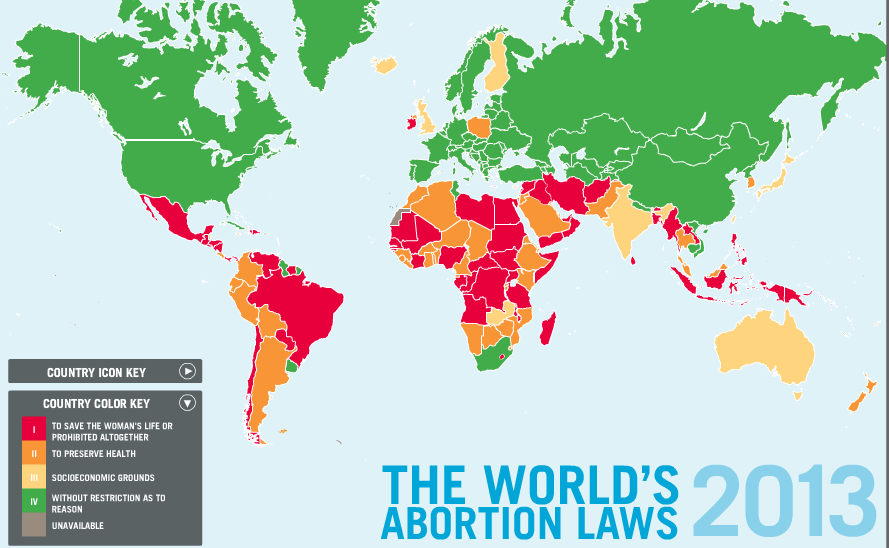
On this point, Christian ultra-conservativism agrees with the point of view of the Malik school of law among Muslims. In essence, Christian terrorists are attempting to move the United States on the below map away from a modern European norm, where abortion is elective up to a certain point in pregnancy, to an Afro-Asian and Maliki Muslim norm where it is often forbidden except to save the mother’s life (or not even then).

4541

…

The same Christian fundamentalists who fulminate most loudly against “sharia law” (medieval Muslim canon law) are perfectly happy to impose their own, Christian sharia on secular American society. Some of them are willing to deploy violence to that end, making them religious terrorists. But on this issue, there increasingly isn’t much difference between the American Republican Party and the Wahhabi clerics in their Riyadh madrasas. In both cases, religious, theological doctrines are being made the basis of public law, which is un-American and actually unconstitutional (the First Amendment refers to that as Establishment of religion, which it forbids).

Emphasis Mine

The Capitalists desire control and are willing to align themselves with those who are willing and able to exercise control on their behalf. Class warfare is brutal, and the Capitalists want brutal people to keep Capitalism going.

This is where Fascism keeps coming up. It is the iron fist ready to smash any in-roads into the profitability of big business. Although Fascism starts out as a protest against the ravages of Capitalism on the petite bourgeoise, it morphs into a rabid defender of Capitalism because it cannot conceive of an alternative economic system. It just wants to get the wrong people out of running Capitalism.

Thus, the media supports White Terrorism by treating it differently. This is because the White Terrorists are aligned to the political agenda of the Capitalists. As such they are not fighting the system, they are preventing the system from falling into the wrong hands.

Cole also lists Top Ten differences between White Terrorists and Others

5. White terrorists are part of a “fringe.” Other terrorists are apparently mainstream.

6. White terrorists are random events, like tornadoes. Other terrorists are long-running conspiracies.

7. White terrorists are never called “white.” But other terrorists are given ethnic affiliations.

8. Nobody thinks white terrorists are typical of white people. But other terrorists are considered paragons of their societies.

Emphasis Mine

And this is how the media continues to construct racism, and to convince people that the victims of terrorism are actually terrorists. This then reinforces the racism of the proto-Fascists and eventually turns abstract racism into concrete racism.


Read more!

2015/11/28

Ted Rall: Corporate News Media: Don't Vote for Trump's Racist Lies, Vote for Someone Else's Racist Lies

Ted Rall writes that Corporate News Media: Don’t Vote for Trump’s Racist Lies, Vote for Someone Else’s Racist Lies.

The third problem with the “Trump bad” narrative is that, getting rid of a toxic strain in politics requires pumping up its alternative. This, the Times and other corporate media outlets never do.

There are hundreds of American newspapers. Not a single one ever runs an opinion essay by a communist, much less hires one as a columnist. Given that 11% of Americans are communist, 11% of published opinions should be pro-communist — and would be, if we had a free press.

There are hundreds of major broadcast and online news and politics outlets. None employ a self-identified socialist. 36% of Americans are socialist.

Communists, socialists and anarchists are the only major ideologies unequivocally opposed to the racist and Latinophobic and Islamophobic garbage Trump (and most other Republican candidates, and some Democrats) are spewing. Anyone who is serious about taking on this crap must support the real left.

Emphasis Mine

Rall is mistaking a positive view of something as being an active supporter of it. Having a favourable view of Socialism does not make one a Socialist.

The reason that Communists, socialists and anarchists are…unequivocally opposed to the racist and Latinophobic and Islamophobic garbage is that we want to build an inclusive society that is richer and fairer for all of us. We do this because of where we want to end up.

Rall forgets Malcolm X's dictum:

You cannot have Capitalism without Racism.

If yoy want to get rid of racism, you have to get rid of Capitalism.

This causes real agnst for liberals as they want to keep Capitalism, but do not want the rancidness of Racism permeating their nice, clean lives.


Read more!

Noah Smith: A big sweeping theory of modern history

Noah Smith describes his version of A big sweeping theory of modern history.

Here's a Big Sweeping Theory that I've been toying with. There are lots of theories of the cycle of rise and decline of empires in the agricultural, premodern world. I'd like to create a parallel theory of low-frequency cycles (or, more accurately, long-term impulse responses to stochastic technology shocks) in the modern, industrialized world.

It's possible to see the convulsions of the World Wars and the Great Depression as a one-time event — part of the growing pains of the industrial revolution, not to be repeated. But what if some of the core features of those events are actually part of a cycle? Here's a sketch of how that cycle might work:

Smith's model consists of seven (7) main phases:

  1. Technological Change.
  2. Globalization.
  3. ?
    1. Inequality.
    2. Cultural Change.
    3. Financialization.
    4. Geopolitical Shifts.
  4. Rise of Extremism.
  5. Economic Slowdown.
  6. War.
  7. New Order.

The interesting thing is that Smith does not have an explanation for Phase 5: Economic Slowdown. Marxists do: the rate of profit declines below the necessary rate required for reproduction of Capital. In other words, Capitalists will not invest if the rate of return does not allow to get their money back within the foreseeable future. In normal times, this future is about five (5) years. In times of stress, this can drop to little as a year.

The alternative view of history is provided by Marx in which the driver of human history is class conflict. The economic organization of society creates classes which come into conflict over the distribution of the economic output. A political and ideological superstructure is created to contain this conflict. Breakdown of the system occurs when this superstructure cannot adapt fast enough to the changes in the economic organization of society.


Read more!

Mark Thoma: 'What Is Holding Back the Economy?'

Mark Thoma asks 'What Is Holding Back the Economy?'.

Not the first to say this, but the problem is that Republicans have misrepresented the causes of the distress so many households feel, in particular scapegoating those who have it even worse as somehow responsible for their problems (and the decline of America more generally). And then they sell the solutions as benefiting the middle class (trickle down anyone?) when they are really directed at reducing taxes for those at the top, and reducing the government services that people rely upon to survive in this economy to support the tax cuts.

But there is something else I'd like to note. The problem is blamed on government at all levels, and fiscal policy. We hear, when Republicans are named at all, that it is "especially" Republicans as though the balance only tilts in one direction. No, it's not especially Republicans, or even mostly Republicans that are standing in the way of doing more to help those who are struggling to make ends meet. It is Republicans. It's not congressional gridlock based upon reasonable differences over policy that cannot be resolved through compromise, it's an active attempt by one party to block anything the other party tries to do, even if it might help people economically. So long as the political benefits of this behavior — benefits based upon selling snake oil for the most part — exceed the economic costs of inaction, Republicans will stand in the way (all the while trying to convince those who are hurt the most by their actions that they will actually be helped). It's time to stop blaming "government" as though that is what is dysfunctional. The dysfunction, as evidenced by the slate of, and preferences over Republican presidential candidates, is in the Republican party. Their actions since the onset of the Great Recession have, in my view, hurt people who should have been helped, slowed the recovery, and diverted our attention from the true problems we face making it impossible to solve them (not that Republicans would have gone along with the solutions anyway). If this election tears Republicans apart and strips them of this ability to stand in the way of helping the working class, a dream I know, I will not be shedding tears. Quite the opposite.

Emphasis Mine

This is class warfare. The Capitalists are ruthlessly exploiting the Workers far more than necessary for the basic operation. This is exploitation for exploitation's sake.

With the destruction of the union movement and associated political movements, the Capitalists are rampaging unchecked taking a significant section of the working class along with them.

I do not share Thoma's tact belief that the Democratic Party is any better. They are also a Capitalist party, although less prone to rampaging.

The solution lies outside of Capitalism. This is something that nearly all workers will not consider. For them, Communism and Socialism are still evil as they think these systems prevent them from becoming rich.

The workers think they achieve a better outcome by becoming richer individuals instead of being part of a society that is richer and distributes its benefits more fairly.


Read more!

2015/11/26

Juan Cole: Why did Turkey dare shoot down a Russian Plane? The Proxy War in Syria

Juan Cole asks Why did Turkey dare shoot down a Russian Plane? The Proxy War in Syria.

We may conclude that Russia’s targeting of Turkmen, an ethnic group that speaks a language similar to that spoken in Turkey, raised nationalist hackles in Ankara. But in addition, these Syrian Turkmen are religious, just as is the leadership of the ruling AKP in Turkey. And, further, they are a linchpin for Turkish, American and Saudi intervention in Syria, since they appear to be among the arms smugglers getting munitions to the rebels against the al-Assad government. Although the CIA maintains that these weapons only go to some 45 “vetted” groups that are not extremists, they in fact get into the hands of al-Qaeda and its allies, grouped as the Army of Conquest, as well. Russia must defeat the Army of Conquest and protect the Alawites of Latakia if it is to achieve its war aims in Syria, and appears to have decided to begin by blocking Turkmen smuggling. The Turkmen had their revenge, claiming to have killed one or both of the pilots who ejected from the downed fighter jet and also taking down a Russian helicopter that attempted to rescue them. [Update: Russia later rescued both pilots, who are actually unharmed.]

Russia and Turkey are now fighting a proxy war in Syria, and have been all this fall. As of yesterday, they are not just using proxies, but are directly in conflict with one another.

Turkey and the Turkmen are carving out a sphere of influence in northern Syria and are insisting that Russia recognize it. How severe the conflict becomes depends in part on how Russia responds to this setback for its war aims. It also depends on whether Turkish goals are more ambitious, to help the al-Qaeda-led Army of Conquest take Latakia. If Jabal Turkmen is a red line for Turkey, Latakia port is a red line for Russia. Red lines have a way of turning into hot wars.

Emphasis Mine

Turkey was able to do this because it has the backing of the USA. Any retaliation by Russia means direct conflict with the USA. An indirect way would be for Russia to overtly support Kurdish rights in Turkey. And covertly support the Kurdish militias.


Read more!

SMH: Face of Reclaim Australia rally Nathan Paterson insists: I'm not racist

Face of Reclaim Australia rally Nathan Paterson insists: I'm not racist

He insisted he was not racist, referring to his friendship with the Bangladeshi owner of the kebab shop that he frequents.

In a way, Paterson is correct. He does not hate or hurt people because of their race. He is not a racist in the concrete sense.

There is a scale of concrete racism:

  1. Someone who kills a person because they are of a different race
  2. Someone who assaults a person because they are of a different race
  3. Someone who insults a person because they are of a different race
  4. Someone who is rude to a person because they are of a different race
  5. Someone who avoids a person because they are of a different race
  6. Someone who hates a person because they are of a different race
  7. Someone who dislikes a person because they are of a different race
  8. Someone who discriminates against a person because they are of a different race
  9. Someone who encourages concrete racism
  10. Someone who condones concrete racism
  11. Someone who protects concrete racism

Concrete racism occurs someone takes action to harm another based on their race. There is no evidence that Paterson has done any of these things, nor condone anyone doing such things.

Yet. he has a partial glimpse of the truth:

He has been trying to find Housing NSW accommodation for several months and has been told it could take more than 10 years to find the permanent two-bedroom home he would like to have so that the younger of his two sons can stay with him on weekends.

It's that struggle that has led him to believe governments - whether local, state or federal - aren't doing enough to help "everyday Australians".

"The government needs to start looking after its own people," he said.

"Newcastle council want to let some of those 12,000 Syrian refugees come to settle here, but there isn't even any housing for Australian people."

He points to the discrimination by Australian governments in the area of housing. He has the keen sense to recognize that there should be suitable housing for everyone.

Because of the government's war on the poor, he is unable to secure suitable housing. It is this scarity of housing that bringing up the abstract racism in him. The government is indirectly creating racism through housing scarity.

Yes, he is a racist in the abstract sense:

"They're all over in their countries blowing each other up, and they want to bring all that here. I say just leave them there."

Yet, how can he not feel this way when the media and government continually say the same thing? Why is he labelled a racist when he just repeats what people of importance say the same thing?

Paterson is being manipulated into becoming a racist of a deeper hue through the policies and actions of the government, and the blanket propaganda of the media.

The only hope for him to grasp the unpopular idea that everyone is a human being deserving of the same dignity and rights.

Even this simple act will be corroded by the simple fact of trying to survive in an economic and political system that is built on and needs racism.

You cannot get rid of racism by hounding people like Paterson, but through the revolutionary overthrow of Capitalism.


Read more!

2015/11/22

Seth Godin: A reason persuasion is surprisingly difficult

Seth Godin gives A reason persuasion is surprisingly difficult.

To many people, it feels manipulative or insincere or even morally wrong to momentarily take the other person's point of view when trying to advance an argument that we already believe in.

And that's one reason why so many people claim to not like engaging in marketing. Marketing is the empathetic act of telling a story that works, that's true for the person hearing it, that stands up to scrutiny. But marketing is not about merely sharing what you, the marketer believes. It's about what we, the listener, believe.

Emphasis Mine

This is sound advice for revolutionaries. We must thoroughly understand the world that a worker inhabits.

The best way is for us to be workers ourselves and engage other workers in political discussions based on our shared experiences.

Although we tend to inflate ourselves with our supposed superior political education, we would be wasting everyone's time if we approached every political discussion as it were an internal party debate.

As Ted Rall points out in Bernie Sanders is a Socialist and So Are You:

As far as I know, Bernie hasn’t emphasized the quality of public education in his campaign. But something is, no pun intended, radically wrong when so few Americans understand basic political and economic terms — especially when they apply to the political and economic system under which they themselves live.

By global standards, Sanders’ campaign is calling for weak socialist tea. In most European countries, all colleges are free or charge nominal fees. Socialized medicine, in which your doctor is a government employee and there’s no such thing as a big for-profit hospital corporation, is the international norm. Paid leave? Obviously. And most governments recognize the importance of public infrastructure, and not relying on the private sector to provide every job.

There can only be one reason Americans don’t know this stuff: they’re idiots. Their schools made them that way as kids. Media propaganda keeps them stupid as adults.

Emphasis Mine

So, we face a populace that is intentionally crippled in political thinking. Yes, we can decry their political idiocracy. But these people are the foundations that a Socialist revolution must be built upon.

To mis-quote Donald Rumsfeld:

As you known, you go into a revolution with the people as they are, not the people you might want or wish to have at a later time.


Read more!